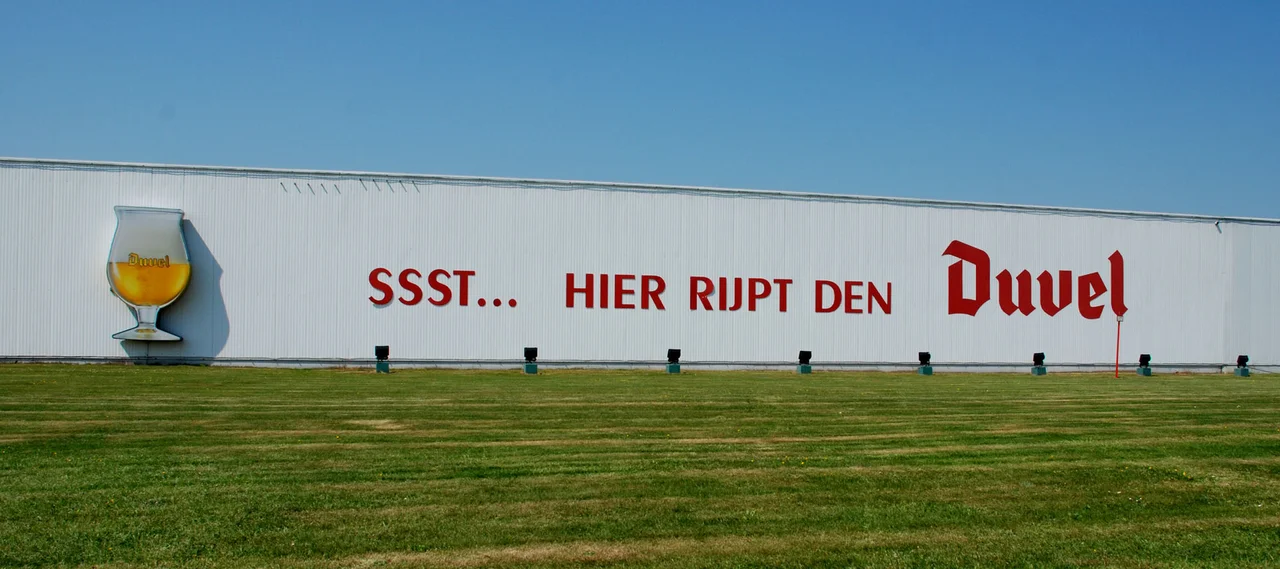

Duvel Moortgat Brewery
In the early 1920s, a man took a long drink of the new Moortgat ale and reportedly said, "nen echten duvel" - a real devil. The brewers, four years removed from the end of the First World War, had been calling their flagship beer Victory Ale. They thought about it, looked at the 8.5 percent alcohol the drinker was responding to, and changed the name. Duvel was Brabantian dialect for devil, and the bottle has carried that name ever since. The brewery itself sits in Breendonk in Antwerp Province, has been controlled by the same family since 1871, and quietly now owns breweries in five countries.
The Moortgat Family
Jan-Leonard Moortgat founded the brewery in 1871. He came from a brewing family in Steenhuffel, a village in the Flemish Brabant farmland north of Brussels, and set up in the neighboring hamlet of Breendonk. The third generation took over in the 1950s. By the early 1970s the brewery was struggling, and Moortgat made a deal that probably saved it: it became the Belgian bottler and distributor for the Danish lager Tuborg. The arrangement ended in the early 1980s, but the distribution infrastructure built during those years carried Duvel out of Belgium and across Europe. In June 1999, Duvel Moortgat went public on Euronext Brussels, and the family kept control.
Scottish Yeast and American Hops
What goes into Duvel is closer to a relic than a recipe. Albert Moortgat, Jan-Leonard's son, travelled through the United Kingdom just after the First World War and brought home a culture of Scottish yeast. That same yeast strain - propagated, guarded, but never replaced - still ferments every bottle of Duvel produced today. The beer is brewed with Pilsner malt and dextrose, hopped with Czech Saaz and Slovenian Styrian Goldings, and bottle-conditioned. It is widely treated as the definitive Belgian Strong Pale Ale. In 2007 the brewery added a third hop variety to a limited edition called Duvel Tripel Hop, pushing the strength to 9.5 percent. The first edition used American Amarillo hops; subsequent editions cycled through Citra in 2012, Sorachi Ace in 2013, Mosaic in 2014, Equinox in 2015, and HBC 291 in 2016. The 2010 edition exists only because a Facebook group called We Want Duvel Tripel Hop hit ten thousand members and the CEO honored a bet.
The Quiet Empire
Most beer drinkers know Duvel. Fewer know how much of their cellar comes from the same parent company. In 1997, Duvel Moortgat was a founding investor in Brewery Ommegang in Cooperstown, New York, a Belgian-style craft brewery run by the American importers who had been carrying Duvel into the United States since 1982. By 2003, Duvel owned the whole thing. The acquisitions continued. Brasserie d'Achouffe, makers of the gnome-illustrated La Chouffe, in 2006. Liefmans of Oudenaarde, the Flemish fruit-beer specialist, in 2008. De Koninck of Antwerp in 2010. Boulevard Brewing Company of Kansas City, Missouri, in 2014. A stake in the Amsterdam craft brewery Brouwerij 't IJ in 2015. A controlling share of Birrificio del Ducato near Parma, Italy, brought up to 70 percent in 2018. Maredsous abbey-style ale is also a Duvel product. The empire is held together by the same family that started with a single brewhouse in 1871.
Vedett and the Village Brewers
The second-best-known beer to come out of Breendonk is probably Vedett, a pilsener Albert Moortgat first brewed in 1945. It spent decades as an unfashionable working-class lager before being relaunched in 2003 as a kind of self-aware urban hipster brand - the kind that lets customers upload their own photos onto the labels. The 1989 wheat beer Steendonk was a collaboration with Palm Breweries, its name a portmanteau of the two villages where the breweries sit: Steenhuffel and Breendonk. Visit the brewery today and the village hasn't changed all that much. The buildings have grown, the tanks are larger, the bottling lines run on automation rather than hand labor. But the recipe is the same. The yeast is the same. The Moortgat name is the same. And the devil, four generations on, still lives in Breendonk.
From the Air
Located at 51.042 degrees N, 4.329 degrees E in the village of Breendonk, part of Puurs-Sint-Amands municipality in Antwerp Province. Visible from altitude as the dominant industrial complex in the flat agricultural land between Brussels and Antwerp, roughly halfway along the A12 motorway corridor. The neighboring village of Steenhuffel is 5 km southwest. Nearest major airports are Antwerp International Airport (EBAW / ANR), about 20 km north, and Brussels Airport (EBBR / BRU), about 25 km southeast. The Fort van Breendonk, the WWII concentration camp turned national memorial, sits a short distance from the brewery.
Nearby Stories
- Sonian Forest 2 km away
- Laarne Castle 4.5 km away
- Battle of Landen 8.6 km away
- Basilica of Our Lady of Scherpenheuvel 10 km away
- Baarle-Hertog 12 km away
- Hertogin Hedwigepolder 13 km away
- Borssele Nuclear Power Station 16 km away
- Ronse 20 km away