.jpg)
Laarne Castle
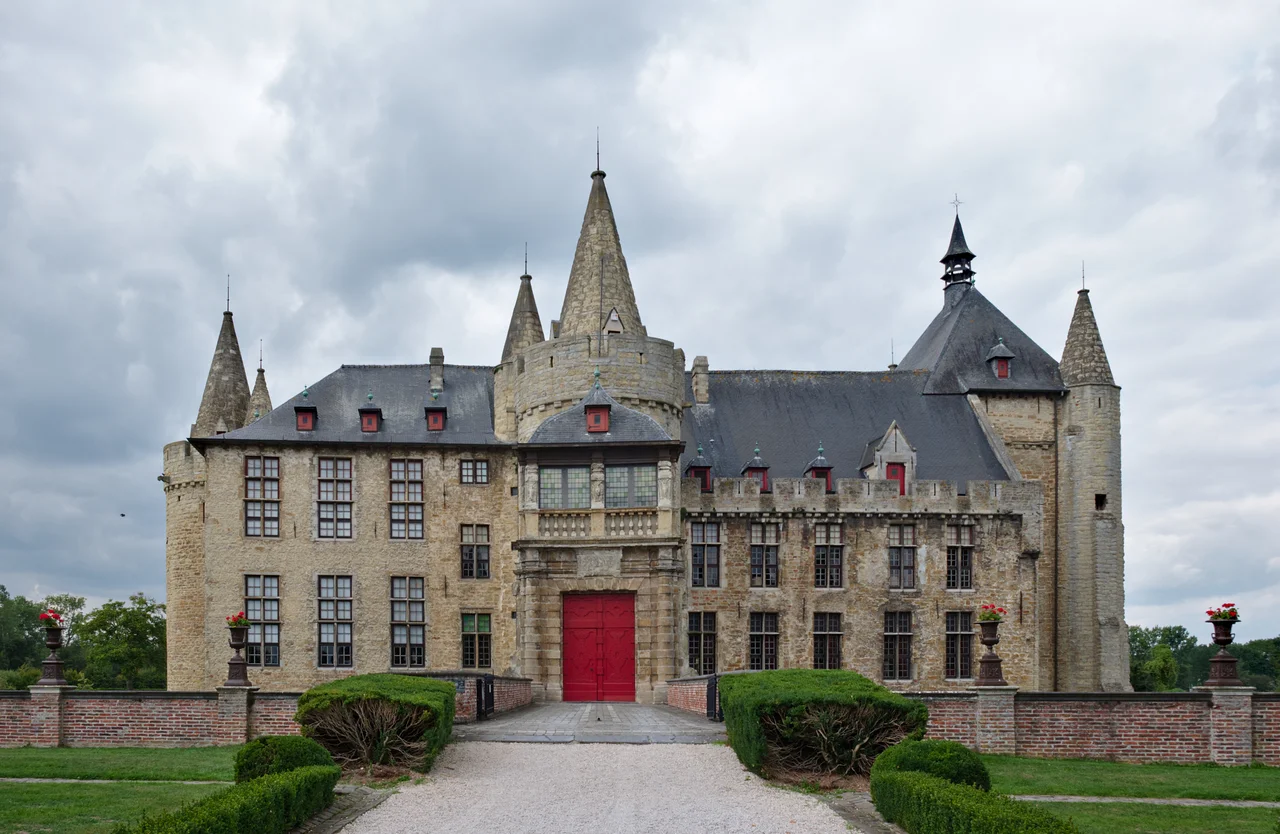
On 22 September 1382, the castle caught fire. The scorch marks are still there - blackened patches in the medieval stonework, six hundred and forty-three years old and visible if you know where to look. Laarne Castle, a moated water castle sitting on the flat clay south-east of Ghent, has been burned, besieged, occupied by wandering bandits for six years, threatened by Louis XIV's troops, plundered by Sans-culottes, slowly ruined by absent owners, and very nearly given up for lost. Its survival is partly architectural luck and partly the stubbornness of a small line of people who refused to let it disappear. Today it holds one of the most important silver collections in Europe.
A Knight Who Saw Magna Carta and the Fifth Crusade
The forerunner of the castle - a manor house called the hof van Laarne - was probably built shortly after 1228 by Giselbrecht van Zottegem, who had been granted the lordship through marriage to Mathilde van Bethune. His life is worth pausing on. In 1214 and 1215, with two of his brothers and other Flemish nobles, he served as a mercenary in the army of King John of England during the rebellion of the English barons - the very crisis that produced the Magna Carta. A few years later, in 1217 and 1218, he sailed for the Fifth Crusade and witnessed the disastrous defeat at Damietta in Egypt. He came home, built a manor, and started the dynasty that would lose and reclaim Laarne over and over.
The Donjon and the Fire
The current castle began in the early fourteenth century when the knight Gerard van Massemen built a gatehouse with a wooden bridge across the moat. Three round towers and a square keep - the donjon - followed shortly. Around 1350 a private chapel was carved into the keep itself. Fragments of its original wall paintings survive, and since 2024 they can be seen via a light projection that fills in what time and damp have worn away. Then in September 1382, Ghent revolted against its count, and the count's allies became targets. The castle was besieged and taken. The fire damage that day was bad enough that it took until 1390 before Jan van Massemen, son of Gerard, could move back in.
Rebellions and Wandering Bandits
The fifteenth century brought more trouble. In 1449 a salt tax provoked another uprising against Philip the Good, Duke of Burgundy. The rebel militia called the White Hoods took Laarne along with three other castles. The lord of Laarne, Baldwin IV de Vos, was imprisoned in Ghent. A relief force led by the Count of Saint Pol failed and lost 22 men under the walls. A second attempt by Picard cavalry on 16 December succeeded. Almost immediately, a wandering band of mercenaries known as the Green Tenters - whose name comes from their habit of sleeping in green-canvas tents on land that did not belong to them - moved in and occupied the castle for six years. During the religious troubles of the late sixteenth century, on 24 July 1579, the castle was burned and ruined again, and stood uninhabitable for a decade.
The Sun King Spared It
Two passages of seventeenth and eighteenth-century luck kept the building standing. In 1675 the troops of Louis XIV burned the village houses and the church but spared the castle, because the Sun King himself intended to spend a night there during an inspection tour. In 1796 the Sans-culottes occupied it during the French revolutionary period and pulled down the bell from the main tower, smashed parts of the chapel, and hacked away the coats of arms - but again, they left the structure standing. By the early twentieth century, after the death of his young son Maurice in 1914 and the disruption of the First World War, Count Robert-Jean Christyn de Ribaucourt's plans for restoration collapsed, and the castle slid toward ruin. The popular writer Jef Crick lived in a wing from 1923 to 1927. Then the artists. Then almost no one.
Silver and a Second Life
Saving it took an organization. In 1953 Count Ribaucourt donated the nearly ruined castle to the Royal Association of Historic Residences and Gardens of Belgium. Restoration began in the 1960s under architect Paul Eeckhout, and the castle opened to the public in 1967. Around that time, Mr. and Mrs. Claude D'Allemagne donated their European-famous silver collection - 446 pieces of fine European silverwork now displayed in a specially designed room on the first floor. The couple lived in an apartment in the castle until Claude's death in 1986. In 1996 Laarne received the Europa Nostra Prize for the quality of its restoration. From 2023 onward, the heritage organization Herita manages the domain on a 40-year lease. The murals in the keep, hidden for centuries, glow under projected light. The scorch marks remain.
From the Air
Located at 51.028 degrees north, 3.839 degrees east, about 15 km east-southeast of Ghent. Elevation 3 meters. Approach from the west with Ghent's three medieval towers as a horizon reference. Look for a square moated water castle with round corner towers and a central keep, ringed by the Eekhoekstraat and surrounded by typical Flemish polder farmland. Nearest airport is Brussels (EBBR) about 45 km southeast; alternates Antwerp (EBAW) 35 km northeast and Ghent's smaller Kortrijk-Wevelgem (EBKT). Visibility in the low Flanders plain is often reduced by morning fog over the canals; afternoon is typically clearer.
Nearby Stories
- 2017-18 Belgian Second Amateur Division 3.3 km away
- Duchy of Brabant 5.7 km away
- Wijnendale Castle 7.5 km away
- Battle of Tourcoing 7.6 km away
- Ronse 8.6 km away
- Borssele Nuclear Power Station 12 km away
- Sugar Factory Zeeland 19 km away
- HMS Wakeful (H88) 31 km away