
Verlaine Message Museum
At 9:15 in the evening on 5 June 1944, a BBC announcer in London read three lines from a 19th-century French poem into the static of shortwave radio. 'Blessent mon coeur d'une langueur monotone' - wound my heart with a monotonous languor. Forty minutes later, in a concrete bunker on a quiet street in Tourcoing, German radio operators of the 15th Army wrote the line down in their intercept log. They had been waiting for it. They knew what it meant. The invasion would begin within 48 hours. The orders went up the chain of command. Then, somewhere between Tourcoing and the divisional commanders on the Normandy coast, the warning stopped moving. The bunker still stands. So does the log entry. The museum opened in 1991 to remember what the Germans heard, what they did about it, and what they did not.
Why Paul Verlaine
Chanson d'automne was written by Paul Verlaine in 1866, a young poet of melancholy autumnal moods. The opening lines - 'Les sanglots longs des violons d'automne' - the long sobs of autumn violins - were among the most-quoted in French poetry. Almost every literate person in France could recite them. That made the verses perfect cover. The BBC's French-language service, Radio Londres, had begun in 1940 broadcasting coded 'personal messages' to the Resistance - sentences that sounded like family communications but meant pre-arranged actions. The Verlaine lines were assigned to the most important message of all: the invasion is coming. The first three lines, broadcast on 1 June 1944, meant invasion within two weeks. The next three lines, broadcast on 5 June, meant invasion within 48 hours. Familiarity made them invisible to the casual listener and unmistakable to those who knew what to wait for.
The Bunker on Rue de la Tossee
After the fall of France in 1940, the German 15th Army established its headquarters in Tourcoing - the textile town just north of Lille - and built thirteen concrete blockhouses to protect itself from air strikes and chemical weapons. Each bunker had reinforced walls thick enough to defeat anything but a direct hit. Inside, generators hummed, ventilators pulled filtered air through gas-tight doors marked with red circles, and a telephone exchange linked the 15th Army to its divisions stretched across the Pas-de-Calais and Normandy coasts. The largest of the thirteen, Type SK1 Bunker 381, housed the radio interception teams whose job was to listen to Allied broadcasts and read what they meant. They were good at their work. They had broken the Verlaine code. They had even warned their superiors that a broadcast of the second half of the poem would mean invasion within 48 hours.
The Warning Nobody Used
When Bunker 381 intercepted the second Verlaine message at 23:45 French time on 5 June, the duty officer alerted the 15th Army staff. The 15th Army staff alerted the German high command. The warning went into the pipeline. But the German command was divided that night. Hitler was asleep at the Berghof and his staff would not wake him. Field Marshal Rommel, in command of Army Group B, was in Germany celebrating his wife's birthday. Rundstedt, commanding the Western theatre, did not believe the broadcast meant what the 15th Army interpreters said it meant - he suspected deception. The panzer divisions that might have driven the Allies back into the Channel were held in reserve, waiting for clearer orders that did not come. At dawn, paratroopers were already on the ground in Normandy. By midday, the beaches were taken. The Verlaine warning had been heard, understood, transmitted, and disregarded.
The Museum That Won't Forget
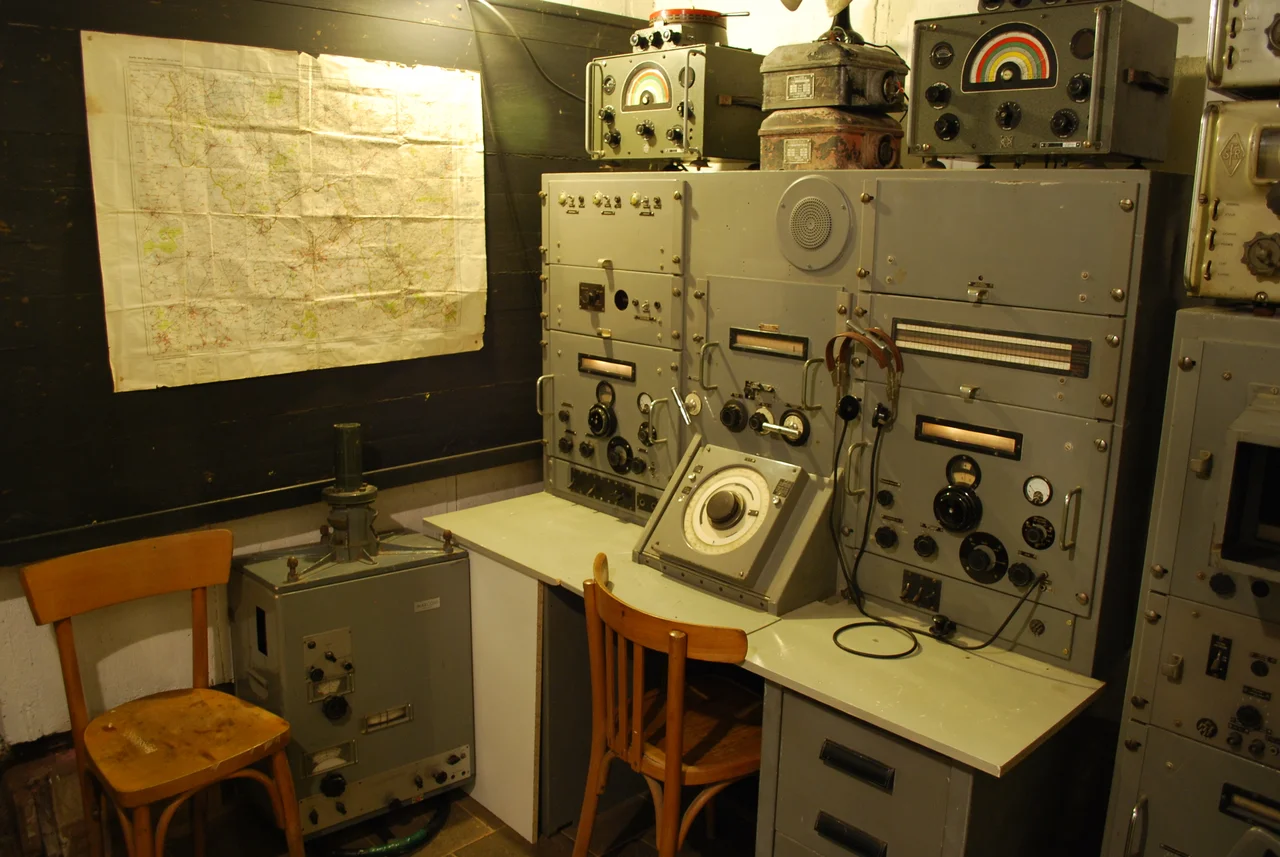
Bunker 381 was preserved after the war and converted in 1991 into the Verlaine Message Museum, also called the Musee du 5 Juin 1944. The wartime function of every room has been restored: the generator hall with its electrical circuit boards, the ventilator room with its hand-cranked air filters, the telephone switchboard, the cipher room, the general's office, the kitchen, the guard post. The radio-location equipment that the Germans used to triangulate Resistance transmitters sits where it sat in 1944. There is a reconstruction of the moment of interception - the headphones, the log, the pencil writing down the line of Verlaine. The museum's stated mission is plain: 'to fight for remembrance and against all forms of revisionism.' The bunker still smells of concrete and old electronics. The doors still seal with their red rubber gaskets. The poem still hangs in the air, set in type beside the intercept log.
What a Poem Could Carry
What strikes a visitor most is the smallness of it. A few syllables of 19th-century French verse, broadcast across the Channel at the speed of light, carrying the weight of the largest amphibious invasion in human history. The Resistance heard the lines and began sabotaging railway lines, cutting telephone cables, ambushing German reinforcements heading toward the Norman coast. The Germans heard the same lines and, divided by their own command paralysis, failed to act. Verlaine had been dead for 48 years by 1944. He had written about autumn and weariness. His poem became, for one night, the most consequential code phrase ever transmitted - heard simultaneously in farmhouses across occupied France and in a concrete room in Tourcoing where the people listening understood exactly what was coming, and could not stop it.
From the Air
Located at 50.712 N, 3.155 E in Tourcoing, 8 km north of central Lille and right against the Belgian border. The museum is at 4 bis Avenue de la Marne. Nearest airport is Lille (LFQQ/LIL), 14 km south. Brussels (EBBR) is 100 km east. Recommended viewing altitude 1,500-3,000 ft for the cross-border textile sprawl that defines the Lille-Tourcoing-Roubaix metropolitan area. From the air, the bunker is invisible - that was the point - but the Tourcoing town centre and its 19th-century mills are unmistakable.
Nearby Stories
- Museum van Deinze en de Leiestreek 0.9 km away
- Castle of Ronse 6.7 km away
- Hooglede German War Cemetery 7.4 km away
- Courrieres Mine Disaster 7.4 km away
- Dunkirk Memorial 7.8 km away
- Arques, Pas-de-Calais 11 km away
- Marcinelle Mining Disaster 66 km away
- Royaumont Abbey 145 km away