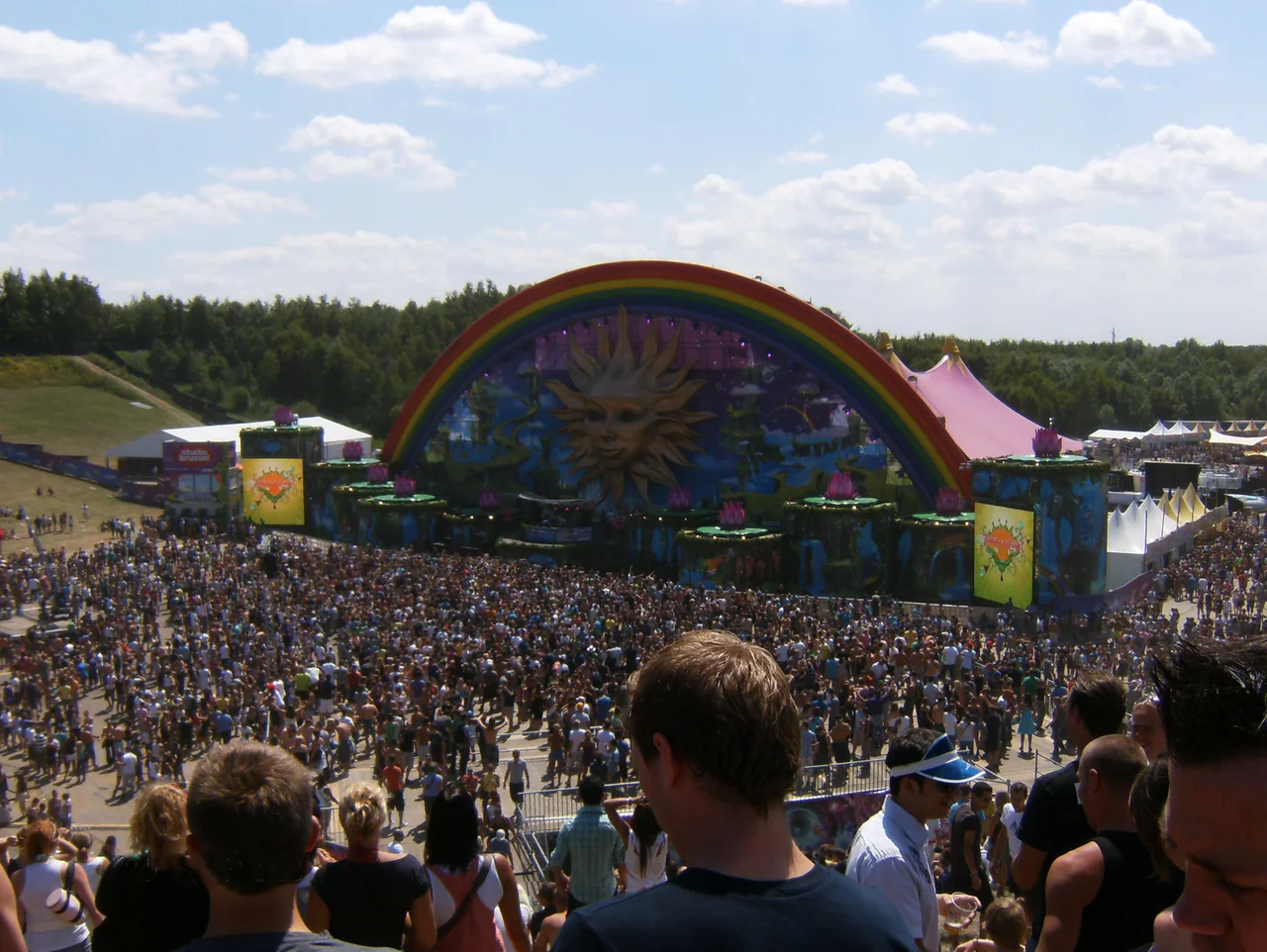

Tomorrowland
De Schorre is a provincial park built over abandoned clay pits south of Antwerp. For 51 weeks a year it is a green recreational area where families picnic and cyclists ride past a sculpture called One World by Arne Quinze, a bridge carved with messages from strangers, and a forest of wooden trolls. For the other week it is Tomorrowland, the largest electronic dance music festival in the world. The transformation is total. Fifteen stages rise out of the clay pits. A campground city called Dreamville fills the surrounding fields. Six hundred thousand people from two hundred countries arrive for one weekend, or in three-weekend years for one of three. Then the stages come down and the park goes back to being a park.
What Manu and Michiel Built
Manu Beers and Michiel Beers conceived the festival in 2004 over drinks in Antwerp. Manu was 21. The first edition, on August 15, 2005, drew about 10,000 people to De Schorre. By 2010 it was 180,000 over two days and the tickets were selling out before the lineup was announced. By 2013, all of them sold in 35 minutes; the remainder reportedly went in one second. Tomorrowland 2017 hit 400,000 attendees across two weekends and a billion social media views. The aesthetic that drove the growth was not just music. It was the mainstage, designed annually to match a fantasy theme like Book of Wisdom, Tree of Life, Reflection of Love, built as elaborate functional sculpture sixty meters tall. Each year the design is kept secret until the first morning. Each year the design is more elaborate than the last. By 2022 the mainstage was the largest stage at any festival anywhere.
Brussels Airlines and the Global Journey
In 2012, Tomorrowland partnered with Brussels Airlines to charter 25 flights from 17 cities, carrying 2,000 festival-goers directly to Brussels Airport for the weekend. The packages, called Global Journey, included flights, hotels, and weekend tickets in a single purchase. By 2013 the program had grown to 140 flights from 67 cities, carrying 8,000 people; top departure cities were Basel, Tel Aviv, Geneva, Oslo, and London. Buyers could upgrade to party flights with live DJ sets in the cabin. Brussels Airlines painted one of its Airbus A320s in full Tomorrowland livery, butterfly logo and all, and used it on European routes for years. The aviation logistics were a quiet engineering achievement. A small Belgian provincial airline had figured out how to move a small city's worth of festival-goers to a clay pit south of Antwerp for one weekend a year, then back.
The Mainstage Fire of 2025
On July 16, 2025, two days before the festival's opening, the mainstage at De Schorre caught fire. The blaze spread fast through the polystyrene-and-wood construction; about 75 percent of the structure was destroyed. No one was hurt. Antwerp authorities are still investigating it as an unintentional arson. Organizers had two days. They built a new mainstage in front of the burned scaffolding using a wide video wall and a DJ booth, with structural components flown in from Austria, where Metallica's M72 World Tour rig had been in storage. The Dreamville campsite opened on schedule on July 17. The festival opened on July 18 with the new stage. Critics noted the original structure had been built from materials a single spark could ignite. The 2026 mainstage was redesigned with the fire in mind, though the organizers will not discuss specifics.
The Brand Beyond Boom
Tomorrowland is no longer just Belgium. TomorrowWorld ran for three years in Georgia, from 2013 to 2015, until weather and logistics killed it. Tomorrowland Brasil opened in São Paulo in 2015, paused for six years over the country's economic crisis, returned in 2023, and now draws 150,000 to Parque Maeda each October. Tomorrowland Winter has run in Alpe d'Huez since 2019, controversially, after local environmentalists denounced the festival's ecological impact and ticket sales softened after the indoor 2022 and 2023 editions. Unite with Tomorrowland is a satellite system that runs simultaneous live-stream events in nine other countries during the main weekend. And in 2026, the franchise extends to Asia for the first time, at a location called Wisdom Valley in Thailand. The first edition will use three stages: Mainstage, Freedom, and Core. The other twelve stay in Boom, where the clay pits are.
From the Air
Located at 51.09N, 4.39E in Boom, Antwerp Province, Belgium, in the De Schorre provincial park. The festival site is about 15 km south of Antwerp and 25 km north of Brussels. From cruising altitude during festival weekends in late July, the site is dramatically visible: stages, tent cities at Dreamville, and crowds covering the clay-pit landscape. Outside the festival window the park looks like ordinary green space. Brussels Airport (EBBR) is 25 km south, Antwerp (EBAW) 12 km north. Recommended viewing altitude 2,000 to 4,000 ft during the festival to see the elaborate mainstage and the surrounding stage layout; higher altitudes give context to the festival's footprint in the landscape.
Nearby Stories
- Sonian Forest 2 km away
- Laarne Castle 4.5 km away
- Battle of Landen 8.6 km away
- Basilica of Our Lady of Scherpenheuvel 10 km away
- Baarle-Hertog 12 km away
- Hertogin Hedwigepolder 13 km away
- Borssele Nuclear Power Station 16 km away
- Ronse 20 km away