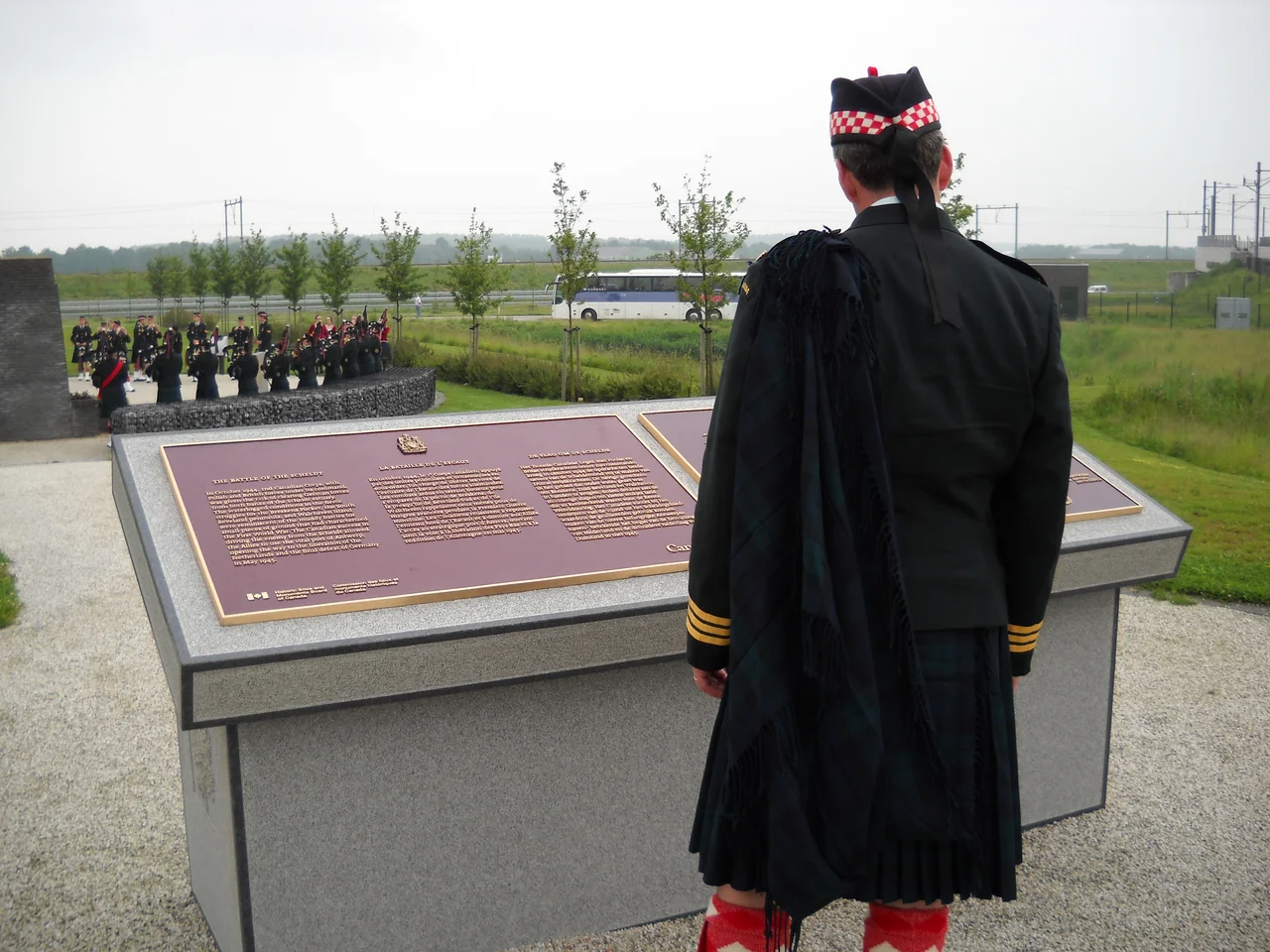

Battle of Walcheren Causeway
The Sloedam was 1,600 metres long and forty metres wide. On either side lay tidal mud too soft to wade through, too watery to walk. There was nowhere to take cover. The Germans had blown a deep crater in the middle as an anti-tank obstacle and zeroed every gun they had on the causeway's narrow span. On 31 October 1944, 'C' Company of the Black Watch (Royal Highland Regiment) of Canada stepped onto the western end of that road. By dawn on 1 November, after a night of inching forward under flame weapons and grenade attacks, men from the Calgary Highlanders had reached the Walcheren shore. They paid in friends to do it.
Why a Tiny Road Mattered
By September 1944 the Allied armies had broken out of Normandy and were racing across France and Belgium, but the war was running on the fumes of an over-extended supply line. Field Marshal Bernard Montgomery's 21st Army Group had captured Antwerp on 4 September with its enormous port facilities intact - a logistical prize that could have shortened the war by months. Except no ship could reach Antwerp's docks. The Scheldt estuary, fifty miles of waterway between the city and the North Sea, was still held by the German 15th Army, with coastal batteries on Walcheren Island commanding every approach. Until those batteries were silenced, the port was useless. The Battle of the Scheldt was the bitter, weeks-long campaign to take them. The Walcheren Causeway was one of the doors in.
An Island Made Smaller by Bombs
In early October 1944, RAF Bomber Command breached the dykes of Walcheren in four places - first at Westkapelle on 3 October, then west and east of Vlissingen on the 7th, then at Veere on the 11th. The bombings drowned most of the island's centre and forced the German defenders onto the high rims around the coast and into the towns. The strategic logic was clear: flooding immobilised the German garrison. The human cost was also clear. The Westkapelle raid in particular killed many Dutch civilians whose village happened to sit on the dyke. The Canadians who would advance toward Walcheren a few weeks later did so toward a landscape that had been partly turned back into ocean. By 31 October the 2nd Canadian Infantry Division had cleared all of South Beveland and stood at the eastern end of the causeway, looking west toward an island where the only dry ground was the rim.
Three Days on the Sloedam
The Calgary Highlanders had trained in Britain for an opposed water crossing - storm boats, paddles, the whole drill, because invasion planners had once thought they would force the Seine. The Seine had fallen without that fight. Now, in the last days of October 1944, the Sloe Channel turned out to be too shallow and too muddy for assault craft. The Highlanders were ordered to walk across the causeway instead, into the teeth of German fire, as conventional infantry. 'C' Company of the Black Watch went first, on the afternoon of 31 October, in an attempt to 'bounce' the position. They were torn up by machine-gun and mortar fire. 'B' Company of the Calgary Highlanders went forward just before midnight and was stopped halfway down. A new fireplan was drawn, and Major Bruce McKenzie's 'D' Company inched forward through the night, reaching and holding the west end of the causeway at dawn on 1 November. German counter-attacks were heavy and prolonged. Flamethrowers were used on the Canadians. In one Highlander company, every officer was killed or wounded; the brigade major, George Hees, took over a company himself. Company Sergeant Major 'Blackie' Laloge of the Calgary Highlanders earned the Distinguished Conduct Medal for, among other things, throwing live German grenades back over the parapet before they could detonate among his men.
The Cost, and What Came After
Two platoons of Le Régiment de Maisonneuve took over the bridgehead on 2 November but were forced back onto the causeway. A battalion of the Glasgow Highlanders came through next and could not expand the foothold either. In the end it was the British Commandos of the 4th Special Service Brigade, landing from the sea at Vlissingen and Westkapelle in Operation Infatuate, who broke the German defences on Walcheren. The causeway battle, the official record would later judge, had been a costly and ultimately unnecessary diversion. The Calgary Highlanders lost sixty-four men in three days. Le Régiment de Maisonneuve lost one killed and ten wounded. The Black Watch suffered eighty-five casualties between 14 October and 1 November, the bulk of them on the causeway. Each of those numbers stands for a young man - many in their early twenties, most volunteers, most a long way from home - who walked onto an exposed forty-metre ribbon of road because someone had decided the war could not wait for the boats to come.
What Remains
The causeway itself is gone. In the decades after the war, the Sloe Channel on either side was reclaimed for farmland, and the railway embankment now runs through what looks like ordinary Zeeland polder. Remnants of German concrete fortifications still sit in fields on both Walcheren and South Beveland, slowly being absorbed into the landscape. A monument to the 5th Canadian Infantry Brigade stands near the old crossing, alongside memorials to the 52nd (Lowland) Division and to the French troops who fought there in May 1940. Each year, the Calgary Highlanders hold a parade and church service on the weekend closest to the anniversary, and members of Calgary's Dutch community are invited. The 2020 Dutch film 'The Forgotten Battle' depicted the assault. The phrase is apt: outside Canada and the Netherlands, almost no one remembers the causeway. The men who crossed it deserved better than to be forgotten.
From the Air
Coordinates 51.5031 N, 3.7050 E - the former Sloedam crossing between Walcheren and South Beveland, in Zeeland province, southwest Netherlands. Recommended viewing altitude FL040-FL070. Visual landmarks: the inverted-arrowhead shape of Walcheren island to the west, the Eastern Scheldt storm barrier to the north, the long ribbon of South Beveland to the east, and the rail line crossing the former causeway. The whole landscape lies barely above sea level - patchwork of polders, dykes, and tidal channels. Nearest airports: Rotterdam (EHRD) 70 km north, Antwerp (EBAW) 60 km southeast, with the small Midden-Zeeland airfield (EHMZ) on Walcheren itself 10 km southwest.
Nearby Stories
- Haamstede Castle 4 km away
- 2017-18 Belgian Second Amateur Division 7.1 km away
- Sugar Factory Zeeland 9.4 km away
- Battle of Wijnendale 9.6 km away
- Prinsenhof, Ghent 11 km away
- Volkerakdam 13 km away
- Second Ostend Raid 26 km away
- Southern Bight 48 km away