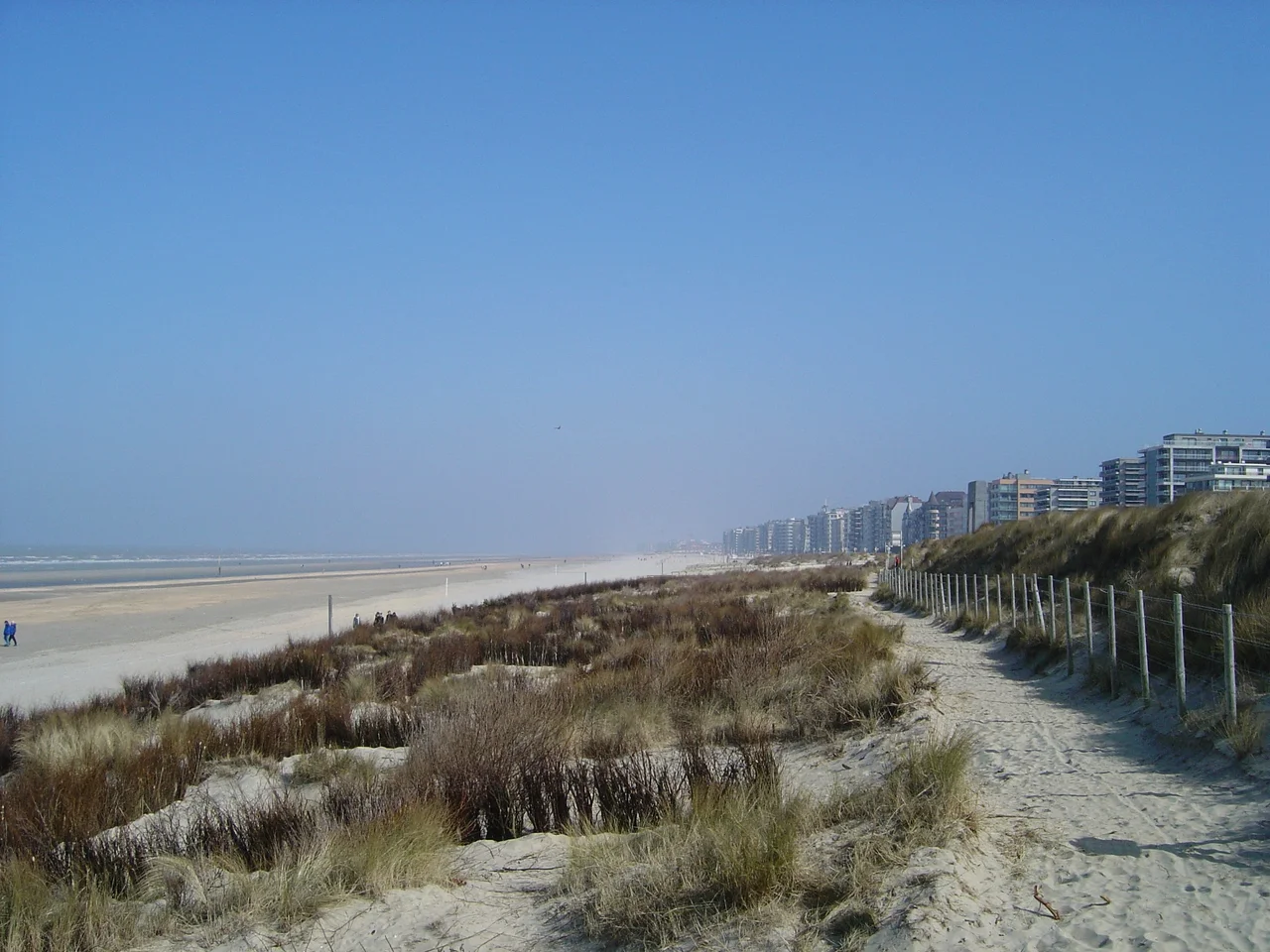

De Panne
For four years between 1914 and 1918, the entire kingdom of Belgium was the size of a Flemish coastal resort. The Germans held everything else, ninety-five per cent of the country, and Belgium's king refused to leave. King Albert I and his queen, Elisabeth of Bavaria, moved into a villa in De Panne and stayed. He commanded what remained of the Belgian army from there. She trained as a nurse and worked in the field hospitals along the Yser front. The royal family of an occupied nation lived in a seaside town at the western end of their kingdom, fifteen kilometres from the trenches. Lucien Frank painted the residence in 1915. The painting is gentle. The view through the window was not.
The Last Corner of Belgium
De Panne sits at the western edge of Belgium where the dunes meet the French border. It is the westernmost municipality in the country. In peacetime that was a tourism fact, a curiosity to mention to children on the beach. In autumn 1914 it became strategic. As the German army pushed across Belgium and the Belgian field army fell back along the coast, the country shrank to a sliver of West Flanders behind the Yser inundation. De Panne was on the Allied side of that flood. So was Adinkerke, which forms the same conurbation. So was Veurne, where Albert kept his military headquarters in the city hall. Together they made up the King's Belgium, and the royal family chose to spend the war on Belgian sand rather than in Parisian or London exile.
The Royal Villa
The house Albert and Elisabeth used in De Panne was not a palace. It was a substantial brick villa of the kind wealthy Belgians built on the coast in the late nineteenth century, and Lucien Frank's 1915 painting shows it weathered, modest, the kind of place a doctor's family might own. The royal couple lived there four years. Albert visited the front almost daily. Elisabeth, who had trained as an oculist before her marriage, ran a hospital. She is the figure in Frank's 1920 portrait of the royal family at De Panne, watching her children play on a beach in a country that was almost gone. After the war the villa was demolished, the dune system rebuilt, and the resort returned to what it had been before, with one statue and a few markers to indicate what had happened.
The Belgium That Began Here
It was not the first time De Panne mattered to the Belgian crown. On 17 July 1831 the country's first king, Leopold I, sailed from England, came ashore at this beach, and started his reign on the sand. The Leopold I Esplanade and its statue commemorate that arrival. For a country invented in 1830 by international conference, the moment when the king physically arrived was the moment when the new state became real, and De Panne is where it happened. Eighty-three years later, in October 1914, the same town held the entire territory of Belgian sovereignty against the Imperial German Army. There is no town hall plaque large enough to capture what that doubled meaning would feel like to a Belgian schoolchild.
Land Yachts and Bicycles
Not everything at De Panne is wartime. The Dumont brothers built the first sport land yachts here in 1898, sail-rigged carts that ran on the hard sand at low tide and reached speeds that scared their builders. The town hosts the Three Days of De Panne every year, a cycling race that has run since 1977 and is used by professional riders to prepare their legs for the Tour of Flanders. Plopsaland, the children's theme park, sits at the inland edge of the municipality on what used to be Meli Park, a bee-themed attraction. None of these are accidents. De Panne has always been a coastal town that worked at being interesting, a resort that earned its visitors rather than waiting for them.
Dunkirk Across the Border
In May 1940, when the British Expeditionary Force was pushed onto the beaches at Dunkirk, the operational headquarters of the British commander Lord Gort sat at De Panne. The choice was not random. Before the war Siemens had laid an undersea telephone cable from De Panne to England, and that cable gave Gort a direct line to the War Office during the evacuation. Some of the men evacuated in Operation Dynamo walked east along the beach from Dunkirk into Belgium and were lifted off the sand at De Panne itself. The town that had been the last corner of free Belgium in one war became, twenty-six years later, a working part of saving an army in the next.
The Beach Today
Modern De Panne has the wide flat beach of the southern North Sea, apartment buildings stepping back from the dunes, and a population of about eleven thousand that swells in summer. The Belgian Military Cemetery on Kerkstraat holds 3,744 soldiers from both wars, including British dead from 1940. Adinkerke Military Cemetery, the Commonwealth ground, sits a short walk inland. The resort and the graves coexist easily. Belgians have had a century to learn that you can build sandcastles in front of a memorial without disrespecting either.
From the Air
De Panne lies at 51.1019 N, 2.5917 E on the Belgian North Sea coast, the westernmost municipality of Belgium, bordering France at Bray-Dunes. From altitude the coastline is dominated by a wide beach, a dune belt, and the Belgian coast tram running east. Adinkerke and Plopsaland sit just inland. Closest airports are Ostend-Bruges (EBOS) about 27 km northeast, Lille-Lesquin (LFQQ) about 65 km south, and Calais-Dunkerque (LFAC) about 30 km southwest. Recommended viewing altitude 2,500 to 4,000 feet. North Sea fog can roll in fast in spring and autumn.
Nearby Stories
- Port of Zeebrugge 3 km away
- 1921 SNETA Farman Goliath ditching 4.5 km away
- 1382 Dover Straits Earthquake 7.7 km away
- HMS Wakeful (H88) 8.2 km away
- Battle of Mouscron 8.4 km away
- Battle of Cassel (1677) 10 km away
- 1933 Imperial Airways Ruysselede Crash 12 km away
- Boulonnais 26 km away