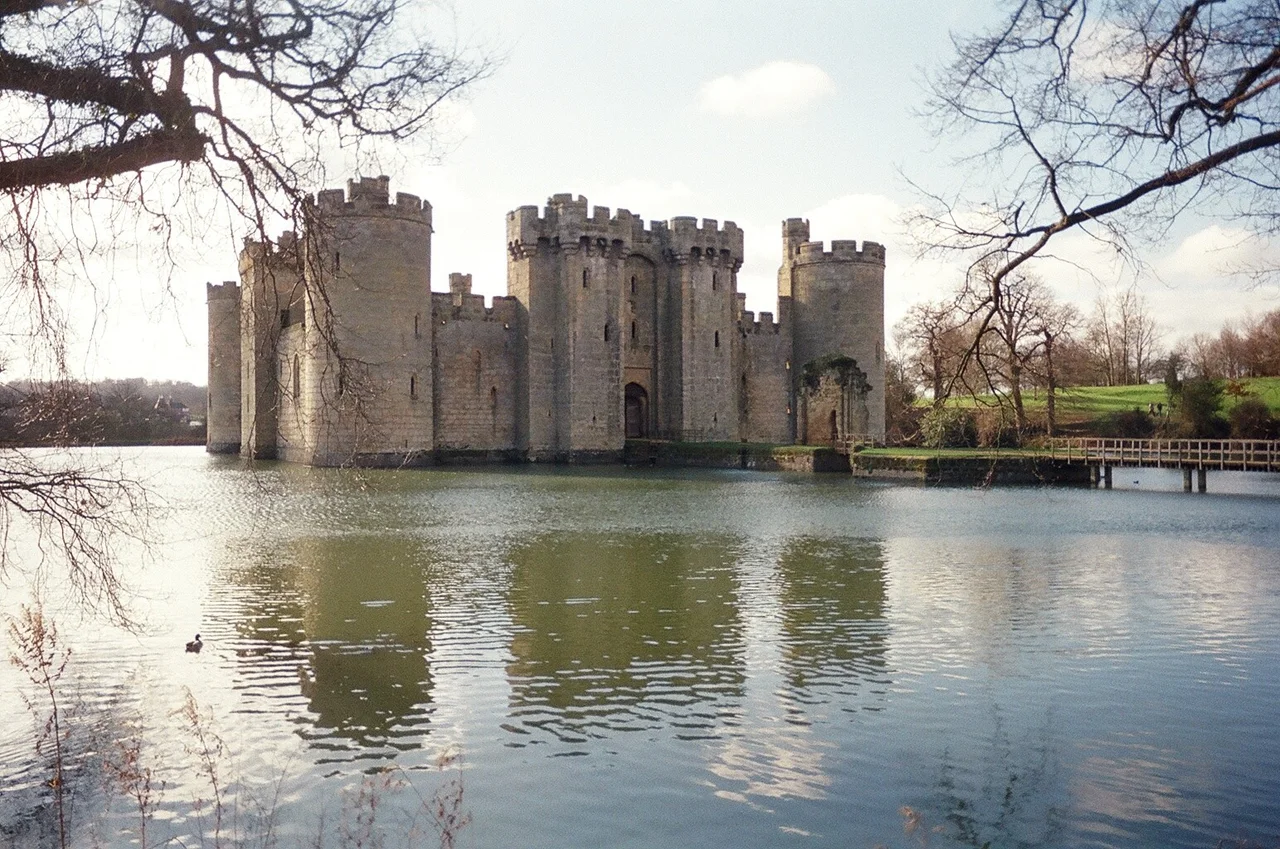

Bodiam Castle
Bodiam Castle has twenty-eight toilets, and they all drained directly into the moat. The archaeologist Matthew Johnson called it an open sewer. The moat is what tourists notice first, the reflective rectangle around the perfectly proportioned stone fortress that everyone, including Monty Python's location scouts, takes for the popular ideal of a medieval castle. Edward Dalyngrigge built it in the 1380s with a licence from Richard II to refortify his manor house. He built a new castle instead, on a fresh site, in a single phase of construction. The French raids on the south coast gave him the excuse. The wealth he had won fighting in France gave him the means. Whether Bodiam was ever serious about defending England, or whether it was always meant to look serious while functioning as a country house, has been argued by castle historians for over a century.
Dalyngrigge's Hurry
Edward Dalyngrigge served as Captain of the port of Brest in 1386-87, far from his Kentish lands. The castle went up quickly during those years - archaeologist David Thackray has deduced from the architectural uniformity that construction was completed in a single phase, probably before 1392. Dalyngrigge died by 1395. He hardly had time to live in the finished building. His coat of arms above the gatehouse sits between those of the Wardeux family - for his wife Elizabeth - and the Radynden family for his mother Alice. Above them all sits a helm bearing a unicorn head crest, the family device. The postern gate carries the arms of Sir Robert Knolles, the famous mercenary captain Dalyngrigge had fought for during the Hundred Years' War. The castle was built by a man whose entire identity ran through war.
The Octagon and the Bridges
Getting into Bodiam was meant to be theatre. The original approach involved two bridges from the western bank, one of them a drawbridge. The route crossed an artificial island in the moat called the Octagon, which had its own garderobe and was probably defended by a small guard. From the Octagon, another bridge - probably also a drawbridge - led to a two-storey barbican, of which only fragments remain. Beyond the barbican stood the twin-towered gatehouse with its portcullis, and only then did the visitor reach the central courtyard. Every stage was designed to be experienced as a sequence of judgments, intimidation, and impression. The military historian Cathcart King compared the approach to Edward I's castles in Wales, like Caerphilly. The military historian Charles Coulson disagreed, calling Bodiam a piece of display architecture rather than a serious fortification.
Wars of the Roses and a Siege That May Never Have Happened
Bodiam passed to the Lewknor family in 1470. Sir Thomas Lewknor was a Lancastrian, and when Richard III took the throne in 1483 he was accused of treason. The Earl of Surrey received permission to levy men and besiege Bodiam Castle. Whether the siege actually went ahead is unrecorded. Thackray suggests Lewknor surrendered without much resistance. The castle and its lands were confiscated and given to a Yorkist supporter. Then Henry VII won at Bosworth in 1485, the Yorkist regime fell, and Bodiam came back to the Lewknors. The English Civil War nearly took the castle again: Sir John Tufton, 2nd Earl of Thanet, who had bought the property in 1639, fought for the Royalists and was fined heavily. He sold Bodiam to the Parliamentarian Nathaniel Powell for £6,000 in 1644 to help pay his fine. The castle's military potential was, by then, finished.
Mad Jack and Lord Curzon
By 1815 Bodiam was a ruin overgrown with ivy and trees, a picturesque Gothic Revival fantasy that had become a kind of early tourist attraction. John Mad Jack Fuller bought it in 1829 for £3,000 - Fuller was a Sussex squire and parliamentary character famous for his eccentric monuments and his refusal to apologise for anything. He saved the castle from demolition. George Cubitt continued repairs, commissioning the first detailed survey in 1864. The decisive intervention came from Lord Curzon, former Viceroy of India, who decided in 1916 that so rare a treasure should neither be lost to our country nor desecrated by irreverent hands. Curzon and the architect William Weir drained the moat - it was only five feet deep on average, with three feet of accumulated silt. They found the original bridge footings. They cleared the vegetation that was destroying the masonry. Curzon gave Bodiam to the National Trust in 1925.
Swamp Castle
In 1975, Bodiam appeared briefly in Monty Python and the Holy Grail as the establishing shot for Swamp Castle in the Tale of Sir Lancelot - the castle that kept sinking into the swamp until the king built a fourth one that stayed up. The Goodies had used it in 1973. Doctor Who came in 1983 with The King's Demons and again in 2014 with Robot of Sherwood. The castle is photogenic in a way few medieval ruins manage - the moat reflects it, the symmetry holds, the popular imagination supplies the rest. The debate in castle studies over what Bodiam was really for - serious fortress or aristocratic country house dressed in fortress clothing - has not been resolved. The moat could have been drained in a day, scholars point out. The exterior windows are large enough to be defensive weak points. None of which seems to matter to the 175,000 people who visit each year. Charles Coulson was probably right. Bodiam represents the popular ideal of a medieval castle, and that, in the end, is what it is.
From the Air
Located at 51.00 degrees N, 0.54 degrees E, in the valley of the River Rother near the Kent-East Sussex border. The castle appears as a near-perfect rectangle of stone surrounded by a reflective rectangular moat in flat farmland. The Rother Valley railway runs nearby. Nearest airports: Lydd (EGMD) eighteen miles southeast, London Gatwick (EGKK) thirty-two miles west-northwest. Best viewed at 2,000-3,500 feet, ideally in low sun for maximum reflection in the moat.
Nearby Stories
- Saltwood Castle 2.8 km away
- Jezreel's Tower 5.4 km away
- Bethlem Royal Hospital 6.2 km away
- Herne Bay Pier 6.7 km away
- Royal Sovereign Lighthouse 11 km away
- Plymouth Brethren 15 km away
- Battle of Boulogne 40 km away
- Fratton Park 75 km away