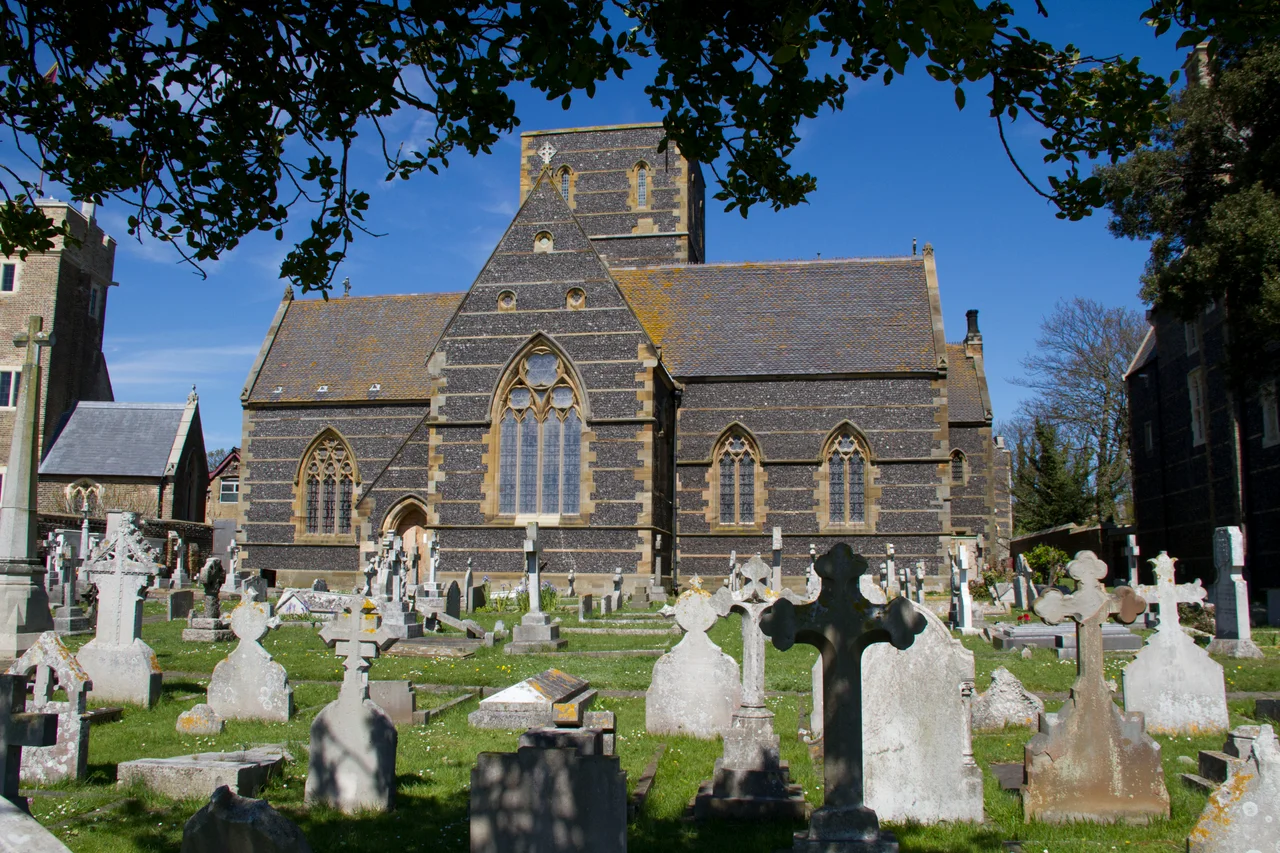

St Augustine's Church, Ramsgate
On the morning of 14 September 1852, Augustus Welby Northmore Pugin walked from his front door across the patch of grass that separated his house from his church, stepped inside St Augustine's at Ramsgate, and remarked to a companion how beautiful it was. He went home. A few hours later he was dead, aged forty. He is buried in the chantry chapel he designed, in a vault beneath an effigy carved by his eldest son. The church above him is the only one he ever built with his own money - the only one, he wrote, where "not one of the true principles will be broken." It stands today on the West Cliff of Ramsgate, knapped flint and Caen stone, the National Pugin Centre, with a spire he never finished still missing from the central tower.
Why this cliff
Pugin was rich, famous, and in a hurry. By 1843 he had already designed the interiors of the Palace of Westminster for Charles Barry. He had been received into the Catholic Church and become its most articulate architectural advocate, championing Gothic Revival as the only true Christian style. He needed a place to live and a place to work out his ideas in pure form. He chose Ramsgate for three reasons, all of which he wrote down. His Aunt Selina lived nearby at Rose Hill Cottage. He loved the sea and was an enthusiastic sailor. And he was devoted to Augustine of Canterbury, the missionary monk who had landed at Ebbsfleet on the Isle of Thanet in AD 597 - just a mile up the coast from the plot Pugin bought. "Where blessed Austin landed," Pugin wrote in a letter. He moved in to The Grange with his family in late October 1844. He was thirty-two.
Building it himself
Pugin laid the first stone of St Augustine's in 1845. Construction continued until his death in 1852, with his sons completing the cloisters afterwards. The arrangement was unusual: Pugin paid for every part of it from his own income. Most architects work within budgets set by clients. Pugin worked within a budget set by Pugin, which is why the building reads as pure ideology in stone. Every detail - the encaustic floor tiles, the stained glass, the carved stonework, the iron hinges on the doors, the woodwork of the screens - was made under his direct supervision. He even ran a free school for poor local children in the first completed building, the schoolroom of 1846 - until he caught them stealing his coal and shut it down. The building was the largest privately funded Catholic church construction in 19th-century England, and it remains a Grade I listed building.
The shrine that came back
In 1538 King Henry VIII and Thomas Cromwell ordered the destruction of St Augustine's shrine at the abbey in Canterbury where his bones had rested for nine centuries. Most of his remains were destroyed. Some relics, given as gifts to Continental churches in earlier centuries, survived. For 474 years, England - the country Augustine evangelised - had no shrine to the saint. On 1 March 2012, the 200th anniversary of Pugin's birth, Archbishop Peter Smith of Southwark designated St Augustine's at Ramsgate as the official shrine of St Augustine of England. The priests of the Oxford Oratory donated a small piece of bone - one of the surviving relics. It is kept now in a shrine on the north side of the church, west of the chancel. The story is almost too neat: the missionary who landed here, the shrine destroyed by the king who broke with Rome, the relic returned at last to the Catholic cliffside church the obsessive medievalist built next to his own house.
Inside
Step into the nave - the word comes from the Latin navis, ship, because the church metaphorically carries souls toward Christ - and you find the baptismal font, the stained glass, the heavy stonework, the Lady Chapel with its glass that Pugin exhibited at the Great Exhibition of 1851. The Pugin Chantry Chapel of St Stephen and St Lawrence holds his vault and his effigy. The Augustine Window above it, installed in 1861 as a memorial, shows the saint's mission from his papal commissioning in Rome to his landing on Thanet to his founding of the Canterbury monastery. At the bottom of the window Pugin himself appears with his three wives and their patron saints, presenting the church. The chapel also holds the altar from Pugin's private chapel at The Grange, moved here in the 1930s. Two reliquaries contain a fragment of Laurence of Canterbury, the second Archbishop, and a fragment of Pope Gregory the Great - the pope who sent Augustine to the English in the first place.
Whole society in flint
Pugin did not think of the church as a single building. He thought of it as the centre of a complete community - the kind, he believed, that medieval England had built and Reformation England had destroyed. So he built a church, and a school, and a presbytery for the priest, and across the road his sons Edward and Peter Paul completed an abbey, the first Benedictine monastery in England since the Reformation. The Pugin family compound at the top of the West Cliff worked as a small model of the social order he wished he lived in: education, healthcare, spiritual care, employment, all radiating from a Gothic Revival church, all funded by donors operating in the long shadow of the medieval guild. The monks left in 2011 for a quieter site in Surrey. The journalist Clive Aslet has called for the whole site to be designated a World Heritage Site. The church is now a working parish and the National Pugin Centre, with an Education, Research, and Visitor Centre opened in 2017 in the old schoolroom. Pugin Week is held every September around the anniversary of his death. He is still under the floor.
From the Air
Church at 51.33N, 1.41E, on the West Cliff of Ramsgate, east Kent. The flint exterior is hard to spot from altitude, but the cliffside ridge formed by The Grange, the church, and St Augustine's Abbey across St Augustine's Road is identifiable in a line above the Royal Harbour. Nearest airfield is Manston (EGMH) about four miles north-northwest. The Channel is two miles east; the French coast about 30 miles further. Ebbsfleet, where the historical Augustine landed in AD 597, is about a mile inland to the northwest.
Nearby Stories
- Westenhanger Castle 6.6 km away
- MV Tricolor 8.4 km away
- Battle of Dover Strait (1916) 11 km away
- Battle of Bossenden Wood 14 km away
- Battle of Gravelines (1558) 18 km away
- White House Farm murders 19 km away
- Maunsell Forts 25 km away
- Southern Bight 67 km away