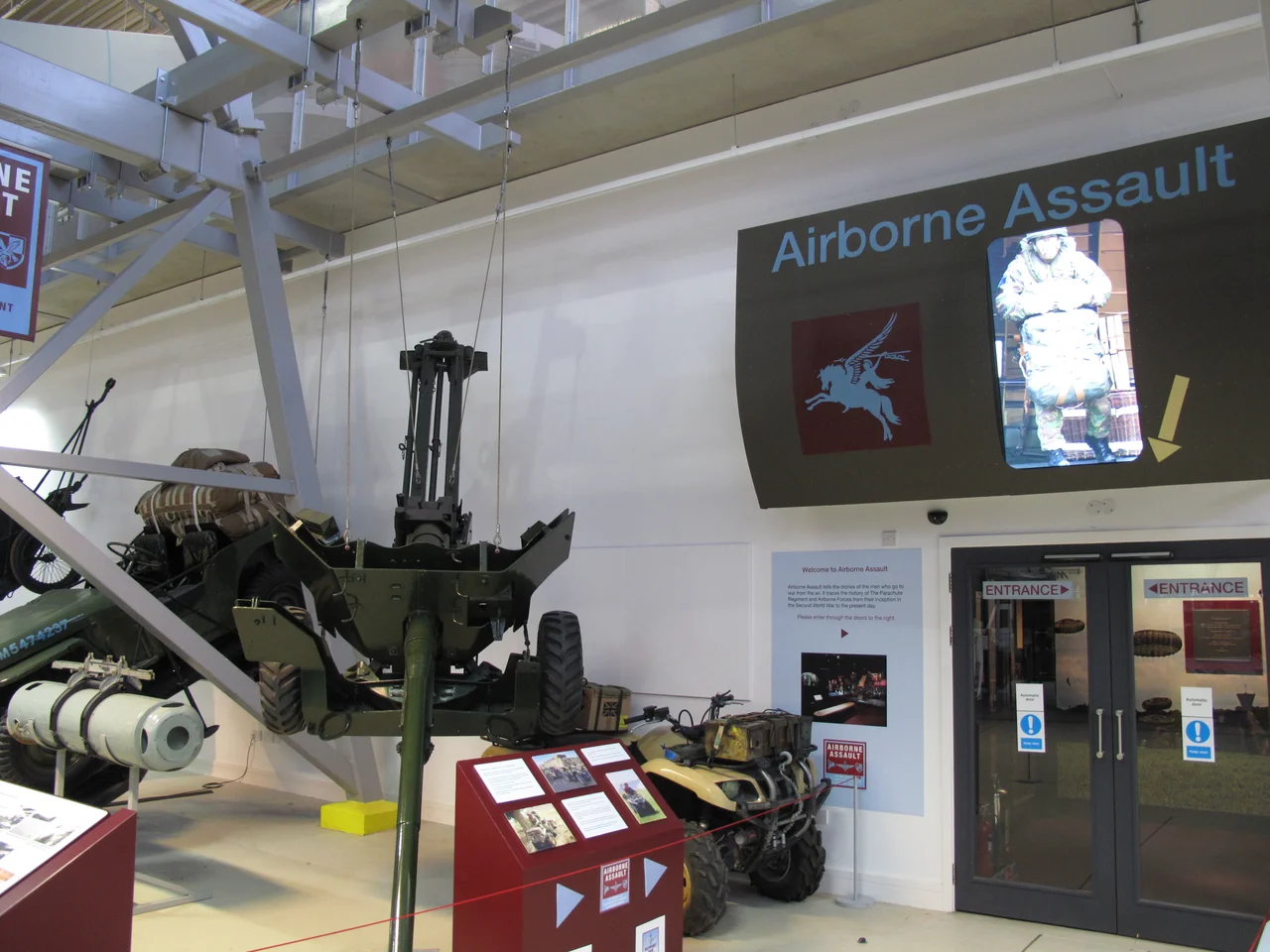

Parachute Regiment and Airborne Forces Museum
In 1940, Winston Churchill sent a memo demanding Britain create a force of 5,000 parachute troops. The country had no such capability. Building one from scratch — the aircraft, the equipment, the tactics, the training — took time. The men who went through that process became one of the most distinctive fighting forces in British military history. The museum that tells their story, Airborne Assault, opened at Duxford in 2008. The exhibits include weapons and heavy drop equipment suspended from the ceiling, arranged as if in the process of descending. Among them is Bing, an Alsatian and Collie cross who dropped by parachute with British airborne forces in 1944.
From Aldershot to Duxford
The museum's origins trace to a meeting of the Parachute Regiment Association in October 1946, the year after the war ended. Veterans wanted to preserve the record. For decades the museum operated in various barracks. A permanent home opened at Browning Barracks, Aldershot Garrison, on 23 March 1969, when Field Marshal Lord Montgomery performed the opening. In 2008 the museum relocated to Duxford, moving into a dedicated exhibition space within the Imperial War Museum site. The new exhibition was formally opened on 8 December 2008 by Charles, then Prince of Wales and Colonel-in-Chief of the Parachute Regiment — now King Charles III. The combination of purpose-built multimedia displays and the aviation context of Duxford gave the collection a setting appropriate to its subject.
Arnhem, Market Garden, and the Rhine
The museum's Second World War exhibits centre on the operations that defined British airborne forces as a fighting concept. The original briefing models used to plan the operations are on display — physical scale models created before the missions, showing terrain, objectives, and drop zones. A dedicated exhibit explains Operation Market Garden, the attempt in September 1944 to seize bridges across the Rhine and Maas rivers and end the war before winter, and the Battle of Arnhem, where the 1st Airborne Division held their positions against heavy German armour for nine days with only light infantry weapons, awaiting a ground force that never arrived in time. The Bruneval Raid of 1942 — a Combined Operations attack on a German radar installation in northern France — and the Rhine Crossing of March 1945 are also covered. An original nosecone from a Horsa glider, the wooden aircraft that carried airlanding troops into Normandy and across the Rhine, is on display.
A Medal Gallery and Posthumous Courage
The Medal Gallery displays awards earned by British airborne troops across the regiment's history. Among them are the posthumous Victoria Crosses awarded to Lieutenant John Hollington Grayburn of the 2nd Battalion at Arnhem, and to Captain Lionel Ernest Queripel of the 10th Battalion during the same battle — both men killed while holding their positions against forces that vastly outnumbered them. A Victoria Cross awarded in 2007 to Corporal Bryan Budd of the 3rd Battalion, who died leading his section against insurgents in Helmand Province, Afghanistan, represents the regiment's more recent service. Post-war campaigns covered include Borneo, Suez, the Falklands War, Northern Ireland, and Afghanistan.
Living History and Bing the Paradog
The museum operates a resource called ParaData — a comprehensive database recording all who have served with the Parachute Regiment and Airborne Forces, linked to accounts of campaigns and engagements, with photographs, letters, and audio and film interviews. The database aims to be both a definitive history and a continually updated record of service. Among the more unusual exhibits is Bing, an Alsatian and Collie cross who was assigned to the 13th Battalion Parachute Regiment and trained to carry message bags. He made his first operational jump on 6 June 1944 — D-Day itself — and was awarded the Dickin Medal, sometimes described as the animal equivalent of the Victoria Cross. His taxidermied remains, including his Dickin Medal, are displayed in the museum.
From the Air
Airborne Assault museum is located within the IWM Duxford site at approximately 52.100°N, 0.140°E, south of Cambridge near the village of Duxford. The airfield (ICAO: EGSU) is active; maintain appropriate clearance. The M11 motorway runs along the eastern boundary of the site. Cambridge City Airport (EGSC) is approximately 6 nautical miles to the north. The museum building is best identified by its position within the line of Duxford hangars; it lies to the west of the main aircraft exhibition buildings. Best viewed from 1,500–2,000 feet in clear conditions.
Nearby Stories
- Kentwell Hall 2.5 km away
- Thetford Hoard 2.8 km away
- King's Ely 6 km away
- Bedford 7.8 km away
- White House Farm murders 13 km away
- Oundle 14 km away
- Hemel Hempstead 14 km away
- North Weald Airfield 15 km away