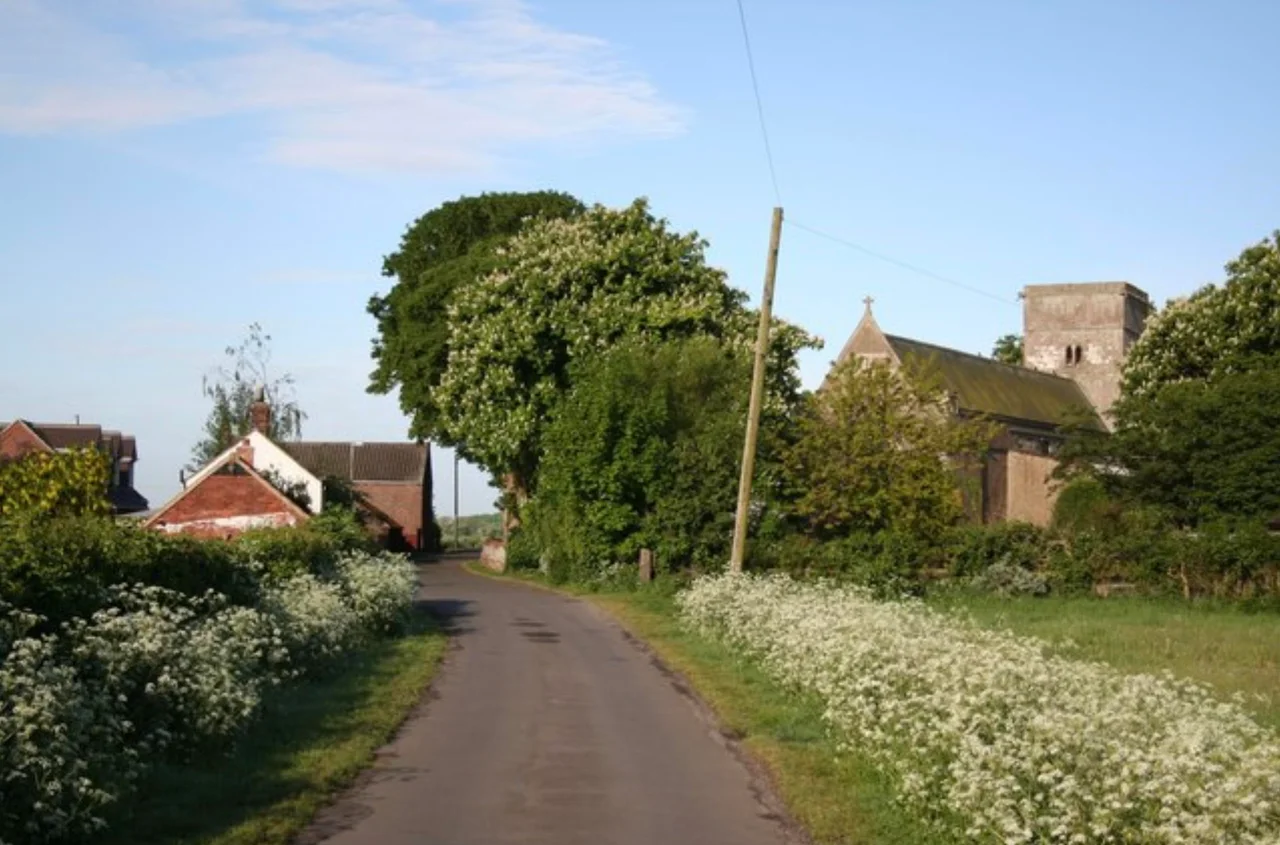

North Somercotes
The name tells you what this place was for. North Somercotes is Anglo-Saxon for 'the northern summer cottages' - the dwellings used only in summer, when the marsh dried out enough for sheep and cattle to graze. In winter the water came back and the cattle went somewhere else. A thousand years of drainage works later, the village is a year-round home of seventeen hundred and thirty-two people, but the old seasonal logic still shows in the landscape. Cross the road from the village pub and walk a mile east, and you reach Donna Nook beach, where every November and December a grey seal colony hauls out to give birth - the marsh now belongs to the seals as much as to anyone.
Marshland Church
St Mary's at Church End is the kind of building that earns the Grade I listing without quite shouting about it. It is what the local term calls a 'Marshland' church - twelfth-century in its bones, Early English in its style, heavily restored in the nineteenth century but still essentially the building that medieval villagers raised when this was still Domesday country. The church has done what marshland churches do: stood through a thousand years of floods, lay through the Reformation, kept its tower upright through the storms that have battered this coast since the North Sea began eating Holderness. The parish today shares its priest with South Somercotes' St Peter's and the cluster of nearby villages that make up the Deanery of Louthesk.
Donna Nook, the Seals, and the Bombs
RAF Donna Nook is technically based at North Somercotes, though most people who come to this stretch of coast are not here for the bombing range. The RAF uses the beach for live ordnance practice on weekdays during designated windows. But every autumn the bombs stop, the airspace clears, and the beach belongs to the seals. The grey seal colony - one of the largest in England - hauls out in November and December to give birth. Pups weigh about fifteen kilos at birth and triple their weight in three weeks. Visitors crowd a warden-controlled path along the dunes to watch the mothers and white-coated pups within arm's reach. By Christmas the beach is full of seals. By February most have returned to sea, and the RAF returns to its range.
The Schools and the Memorial
The village primary school traces its origin to 1691 - one of the oldest in the East Midlands - though it was rebuilt as a new school in 1992. The older institution, Birkbeck School, became the centre of a tragedy in November 2003 when a fourteen-year-old pupil, Luke Walmsley, was stabbed and killed by another pupil in a corridor between classes. His parents responded by founding the Luke Walmsley Sports Foundation in his memory. The foundation raised more than a hundred and fifty thousand pounds. The money built a new pavilion on the playing fields, upgraded the changing rooms, and laid two full-size sports pitches and a mini-soccer pitch. Work began in February 2009 and finished that September. A small village turned its grief into something children could use for generations.
Life in the Village
Two pubs - the Axe and Cleaver and the Bay Horse - anchor the village centre. There are three convenience stores, an Italian restaurant, takeaways for Chinese and kebab, a hairdresser, a shop selling log burners. The post office, which has existed since the 1840s, has moved into the greengrocer's and still issues vehicle licences and foreign currency. The Marsh Medical Practice keeps four GPs who rotate between the village surgery and one in nearby Manby. The fire station is staffed by on-call retained firefighters - one of thirty-eight in the Lincolnshire service - and attends about eighty calls a year. The village carnival, with its decorated floats and Rose Princess crowned in mid-July, ran every year through 2000. The 2001 foot-and-mouth outbreak shut it down, and it never quite started again. The annual pancake race on Shrove Tuesday - children running with sizzling pans across a school field - is still going.
What the Land Records
Look at the 1920s Ordnance Survey maps and you can still see something interesting: a small agricultural tramway network that ran from The Holmes on Holmes Lane out to the fields around Pyes Farm and Marsh Grange. Tramways of this kind often used surplus narrow-gauge equipment from the First World War trench railways - the same kind of light track that allowed soldiers to move shells through Flanders mud now carried Lincolnshire potatoes off the fenland fields year-round. The tramway is gone. The fields remain, drained, cropped, and worked. Beyond them, towards the coast, Locksley Hall stands - a sixteenth-century red brick and ashlar house, Grade II listed, on Warren Lane south of the village. North Somercotes lies between extremes: between the bombing range and the seal colony, between the medieval church and the modern pavilion, between the summer pasture its Anglo-Saxon name describes and the year-round home it has become.
From the Air
North Somercotes sits at 53.45°N, 0.13°E in the East Lindsey Marshes, just inland from the North Sea coast. Recommended viewing altitude is 2,000-3,000 feet AGL to take in the village, RAF Donna Nook to the east, and the strip of dune and beach that hosts the grey seal colony in winter. The church tower of St Mary's is the most prominent landmark. Nearest airports are Humberside (EGNJ) to the north-west and RAF Coningsby (EGXC) to the south-west. CRITICAL: avoid the RAF Donna Nook bombing range to the east - check NOTAMs for active ordnance times. The seal colony season is November through mid-January. Best light is mid-morning easterly.
Nearby Stories
- Westermost Rough Wind Farm 2.5 km away
- Silver Pit 5.4 km away
- Beverley Minster 7.4 km away
- Lincoln Cathedral 13 km away
- 2004 Ingoldmells Bus Crash 14 km away
- Humber Bridge 21 km away
- Holkham National Nature Reserve 33 km away
- SMS Blucher 333 km away