.jpg)
Major Oak
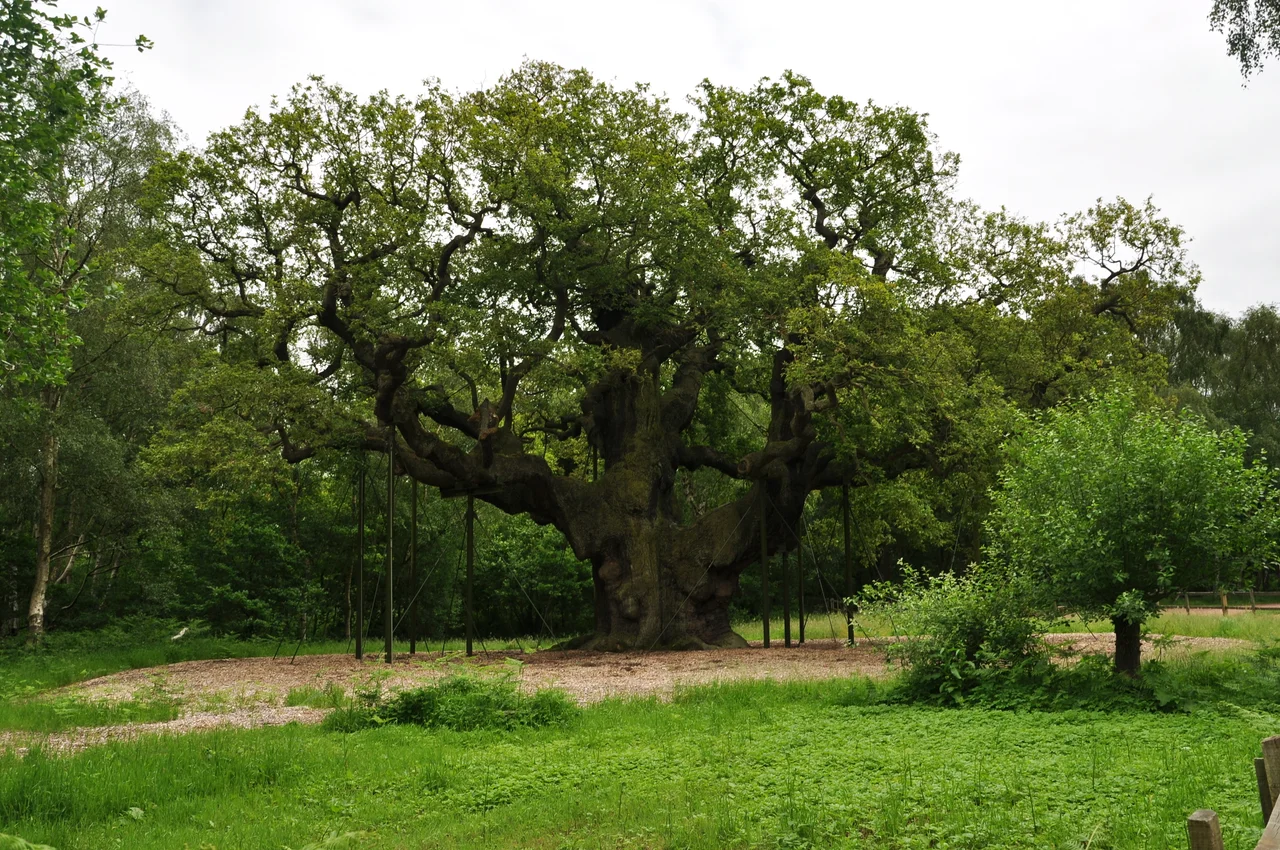
Major Hayman Rooke saw the tree in 1790 and was already calling it a majestic ruin. The Major Oak weighs an estimated 23 tonnes, has a girth of 33 feet, a canopy stretching 92 feet across, and is somewhere between 800 and 1,000 years old. It stands in a clearing near Edwinstowe in the heart of what remains of Sherwood Forest, leaning on a forest of iron crutches and steel scaffolding, fenced off so visitors cannot compact the soil over its roots. The tree predates Magna Carta. It may or may not predate Robin Hood, depending on how literally you take the legend. What it does, indisputably, is stand.
Hayman Rooke's Tree
The oak was known as the Cockpen Tree before it was the Major Oak, because the people of nearby Edwinstowe used to hold cockfights under its canopy. The name change came courtesy of Major Hayman Rooke, a retired army officer turned antiquarian who lived nearby at Mansfield Woodhouse and made a study of the great trees of Welbeck Park. In 1790 Rooke published Descriptions and Sketches of some Remarkable Oaks, in the Park at Welbeck, in which he wrote of the tree: I think no one can behold this majestic ruin without pronouncing it to be of very great antiquity, and might venture to say, that it cannot be much less than a thousand years old. After his death the tree took his rank as its name. The Major was already, in 1790, supported by props; ageing oaks of this scale have always needed help. It is unclear whether the Major Oak is genuinely a single tree or several saplings that fused together centuries ago through the natural process called inosculation. That uncertainty may explain the tree's lopsided, sprawling shape.
The Robin Hood Question
Local folklore says Robin Hood and his Merry Men slept inside the hollow of the Major Oak, which is sometimes presented in postcards as historical fact. It is not. Robin Hood, if he existed at all, was a thirteenth-century outlaw whose legend grew rapidly in the fourteenth and fifteenth centuries, and the specific association between Robin and the Major Oak is a piece of later cultural overlay rather than recorded medieval history. The tree was probably a sapling during the period the legend supposedly describes, not yet large enough to shelter anyone. But the story is its own kind of truth. Sherwood Forest was a real royal hunting reserve, the outlaws who lived in its margins were real, and the Major Oak, the largest tree in the forest, was eventually elected as the standard-bearer for a folk hero whose actual hideouts no one ever recorded. The 46th Infantry Division of the British Army carried a stylised image of the Major Oak as its formation badge during the Second World War, including battalions of the Sherwood Foresters regiment. A medieval tree had become a piece of national iconography.
Iron Chains and Scaffolding
Support chains were first fitted to the Major Oak in 1908 to keep its enormous limbs from tearing free under their own weight. The scaffolding visible today, an elaborate system of pillars and props supporting the heaviest branches, has been in place since the 1970s. In 1974, after decades of visitors trampling and compacting the soil over the root plate, fences were installed around the tree to give the roots room to breathe. A 2018 ground-penetrating radar survey mapped the root system in detail for the first time. The tree is reckoned the UK's second-largest oak, surpassed only by the Majesty Oak at Fredville Park in Kent. In 2002 a public survey voted the Major Oak Britain's favourite tree; in 2014 the Woodland Trust's online poll named it England's Tree of the Year with 18 percent of the vote. In 2003 a Dorset plantation of 260 saplings was started from acorns gathered beneath the Major, an unobtrusive way of insuring against the parent tree's eventual loss.
Heatwaves and a Patient Watch
Since 2022 the Major Oak has produced noticeably fewer leaves each summer, a response to the repeated heatwaves and drought conditions that have stressed older oaks across England. Reports that the tree was dying spread quickly. The RSPB, which manages this part of Sherwood Forest, has dispelled them: a thousand-year-old tree producing fewer leaves in a difficult summer is doing what such a tree does, conserving resources, waiting for cooler conditions. Oaks of this age go through what arborists call retrenchment, gradually pulling their crown inward and shedding heavy branches to reduce the load on the remaining living tissue. The Major Oak has been retrenching for a long time. The Visit Sherwood centre at Edwinstowe is the gateway to the forest paths that lead to the tree, and even on busy summer Saturdays the clearing has a particular quiet around it. People approach the fence, look up, and stop talking. The tree does not require any folklore to be impressive. It just has the folklore anyway.
From the Air
The Major Oak stands at 53.20°N, 1.07°W in Sherwood Forest National Nature Reserve, about a mile north-east of the village of Edwinstowe. Recommended altitude 1,500-2,500 feet. The forest reserve appears as a darker, irregular patch of woodland in the otherwise open mining and farming country north of Mansfield. Look for the cluster of paths converging on the visitor centre at Edwinstowe. The tree itself is too small to identify from the air, but its clearing is visible as a small open patch within the woods. Nearest airports: Nottingham East Midlands (EGNX) about 22 nm south-west; RAF Syerston (closed to fixed-wing flying) about 15 nm south-east. The A6075 runs through Edwinstowe.
Nearby Stories
- HMS Sherwood (shore establishment) 1.7 km away
- Sudbury Hall 2.7 km away
- Grantham Rail Accident 3.8 km away
- Conisbrough Castle 5.2 km away
- Doddington Hall, Lincolnshire 6 km away
- Litton Mill 8.9 km away
- Flixborough Disaster 20 km away
- Astley Deep Pit Disaster 22 km away