
South Yorkshire Aircraft Museum
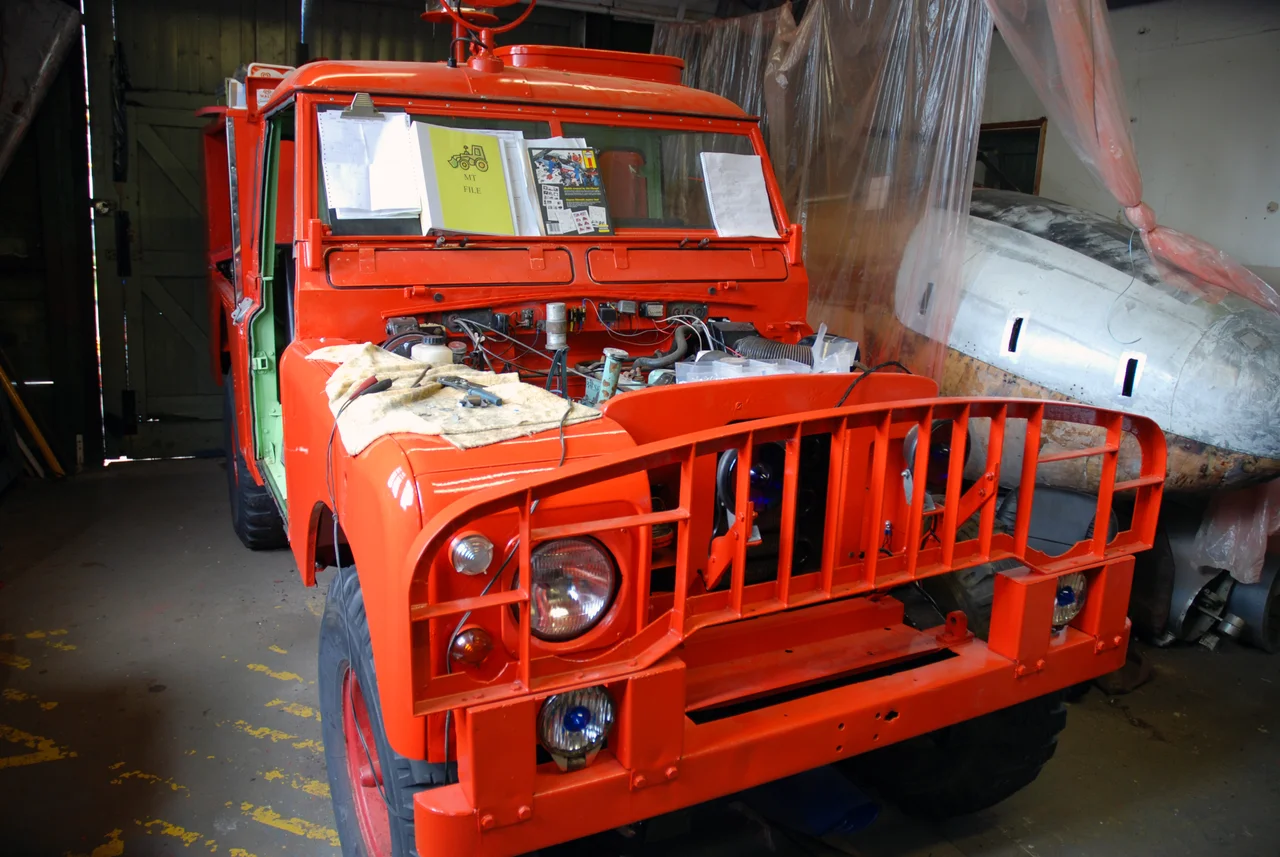
The volunteers rebuild aircraft in a Bellman hangar that was already old when they started. The South Yorkshire Aircraft Museum occupies the last surviving original buildings of the wartime RAF Doncaster - a Bellman hangar, two wooden Air Ministry billet huts numbered 19 and 21, and a few smaller structures. To house the World War Two collection they added an ex Air Training Corps cadet hut beside Building 21. The contrast between the airframes inside - some painstakingly restored, some still in the slow process of becoming whole again - and the modest sheds around them is the point of the place.
From the Bleriot to the Vulcan
The collection ranges from a Bleriot XI replica - built in 2009 to commemorate the centenary of the 1909 Doncaster Aviation Meeting, the first held in England, in which the French aviator Leon Delagrange flew - to the cockpit section of an Avro Vulcan B.2, the V-bomber that defined Britain's Cold War nuclear deterrent. There is a Gloster Meteor T.7, the trainer version of Britain's first operational jet fighter. There is a Bristol Sycamore helicopter restored by the Yorkshire Helicopter Preservation Group, which moved here from the Yorkshire Air Museum at Elvington in July 2002. There are gliders and Cessnas. Many of the aircraft have local links: BAE Hawks, Handley Page Jetstreams, Dominie trainers and a Vickers Varsity cockpit all flew from RAF Finningley, a few miles south, before its closure in 1996.
The Falklands Collection
SYAM holds the largest permanent display in the UK honouring those who fought in the Falklands War of 1982, with aircraft that flew during the conflict or represent the types that did. The Westland Wessex HU.5 XS481 was transported south as an attrition replacement for the helicopters lost when the container ship Atlantic Conveyor was sunk by an Exocet missile - it arrived after the Argentine surrender and saw no combat but worked through the immediate aftermath. The Westland Gazelle XX411 of 3 Commando Brigade Air Squadron was shot down on the first day of the British landings at Port San Carlos. Its pilot, Sergeant Evans, was killed. The airframe was recovered in October 1982 and assessed as a structural loss. It is displayed here as a record of one of the war's earliest casualties.
Captured Argentine Aircraft
The collection includes three aircraft captured from Argentine forces. The Aermacchi MB-339 (4-A-116) is one of three taken by British forces and the only one returned to the UK; after stints at the Fleet Air Arm Museum and at Rolls-Royce in a white scheme, it has been repainted in its original Argentine markings. The Bell UH-1H Iroquois Huey (AE-406) flew with the Aviacion de Ejercito Argentino and was captured during the war. The FMA IA-58 Pucara (A-533) arrived at Goose Green on 15 May 1982 as a replacement for the Pucaras lost in the SAS Raid on Pebble Island; it was captured at Stanley Racecourse at the war's end, returned to the UK for evaluation under the British serial ZD486, and eventually scrapped except for the cockpit, which arrived at SYAM in September 2024.
What a Volunteer Museum Holds
The Westland Sea King HAS.6 XV677 was transported to the Falklands aboard the Queen Elizabeth 2 - the second helicopter to land on her after modifications were completed - and arrived at Port San Carlos on 2 June 1982. It flew with 825 Naval Air Squadron, was upgraded after the war, and became the first Sea King to enter UK preservation when it arrived at SYAM in July 2006. The Westland Scout XV139 was at Port Harriet House on 9 June 1982 when Argentine troops fired a Blowpipe shoulder-launched missile at it; the missile missed by less than 25 yards. These are not the aircraft of museums where the airframes are immaculate and untouched. They are the aircraft of a small museum where volunteers strip paint, rebuild instrument panels, and keep telling the stories of men who flew, fought, and in some cases did not come home - on both sides of an eleven-week war in the South Atlantic.
From the Air
Located at 53.51N, 1.11W at Lakeside on the former site of RAF Doncaster, in the east of Doncaster, South Yorkshire. Doncaster Sheffield Airport (formerly EGCN, closed 2022) lies about 3 nm south-east; Robin Hood/Doncaster Sheffield's runway is the obvious visual reference. Leeds Bradford (EGNM) is about 24 nm north-west. The museum site is part of the Lakeside development, recognisable from 2,000 to 3,000 ft by the surviving wartime hangar and huts alongside the lake. The former RAF Finningley, mentioned often in the collection, is a short distance south.
Nearby Stories
- Litton Mill 0.9 km away
- Bradford Murders 1.2 km away
- Battle of Sherburn in Elmet 2.2 km away
- Bolsover Castle 5.6 km away
- Doddington Hall, Lincolnshire 5.8 km away
- Flixborough Disaster 11 km away
- Huddersfield Town Hall 13 km away
- Beverley Bar 19 km away