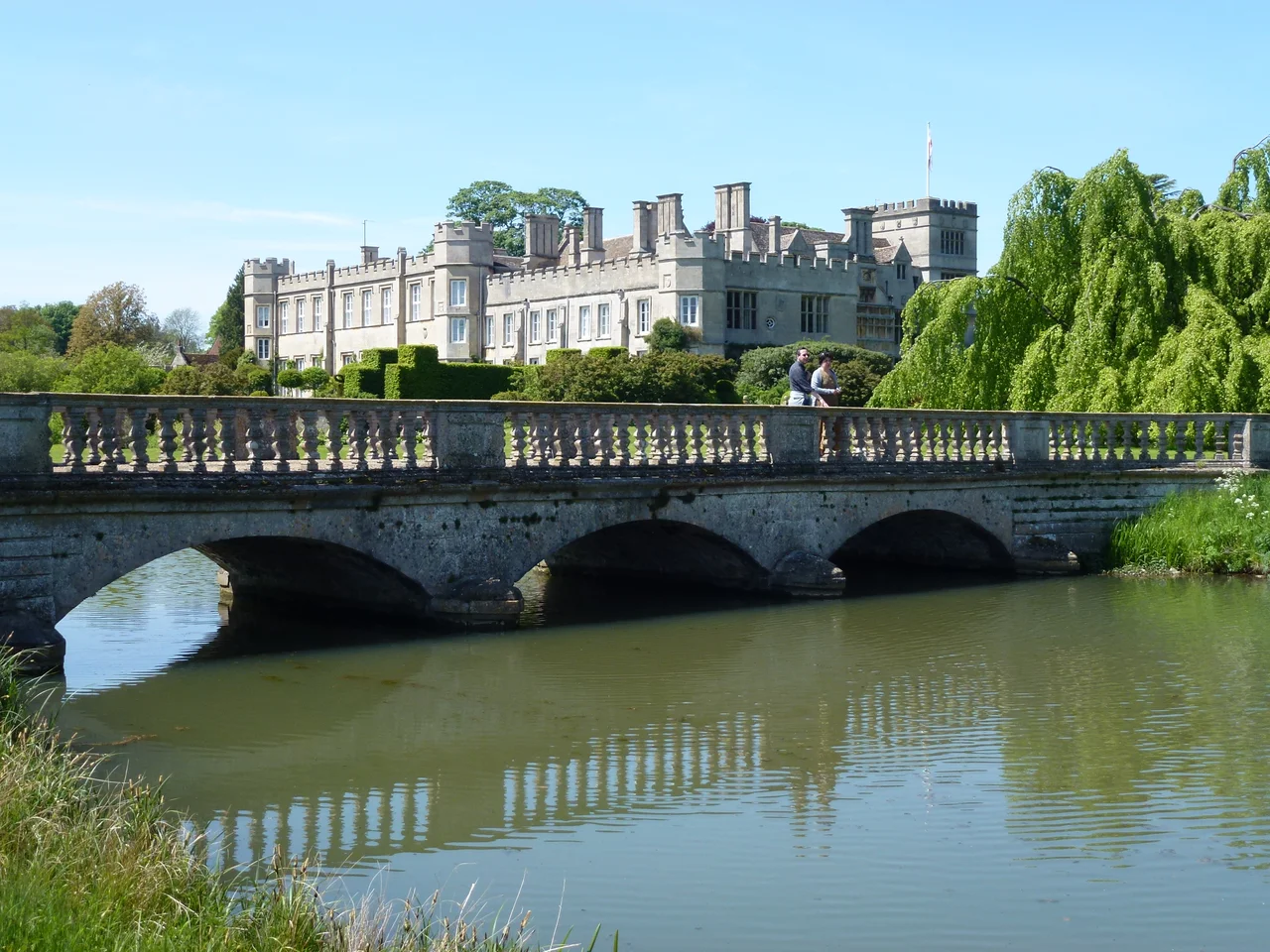

Deene Park
Ronald the horse came home. His rider survived too, but the men of the Light Brigade mostly did not, and that uneasy arithmetic still sits at the heart of Deene Park. Behind the honey-coloured walls of this Grade I listed manor, five miles north-east of Corby, are preserved Lord Cardigan's uniforms, the cavalry trumpet, and the head and tail of the chestnut charger who carried him into the Russian guns at Balaclava on 25 October 1854 and out again. The house has been the seat of the Brudenell family since 1514. The cavalry charge that made it famous lasted twenty minutes.
Westminster's Rented Manor
Until 1970, the Brudenells paid eighteen pounds a year in rent to Westminster Abbey for the right to live at Deene. The manor had belonged to the abbey since the Middle Ages, and the family who would produce seven Earls of Cardigan held it as tenants rather than freeholders. The arrangement is a quiet reminder of how property worked in pre-modern England, and how stubbornly old contracts could endure. The hall itself reaches back to the fourteenth century, expanded outward from its courtyard core through Tudor, Stuart and Georgian remodellings. In 1571 the great hall received its carved screen panelling and a fireplace large enough to warm a wedding feast, both still in place. A library was assembled in the sixteenth century by Sir Thomas Tresham and his son-in-law, the 1st Earl of Cardigan; for centuries it held a manuscript of Chaucer's Canterbury Tales and the last copy of Magna Carta in private hands. Both have since left the shelves, but the bow-windowed room that housed them remains.
Theirs Not to Reason Why
James Brudenell, 7th Earl of Cardigan, was vain, quarrelsome and not very bright. None of that was decisive on the day at Balaclava when his Light Brigade rode the wrong direction into a valley flanked by Russian artillery on three sides. Lord Raglan's order, scrawled by an aide and delivered by Captain Nolan, had been ambiguous about which guns to attack. Cardigan questioned it, was told to proceed, and led from the front. Of the roughly six hundred and seventy men who rode in, only around one hundred and ninety-five answered the next muster. The earl reached the Russian battery, turned, and rode back, untouched. Tennyson published the poem six weeks later, and the line that endured was the right one: theirs not to reason why. The men who died had been given a confused order by overlapping aristocratic egos and obeyed it because that was what soldiers did. Cardigan came home a hero, which was uncomfortable for almost everyone, and he and Ronald lived out their years at Deene. The horse's head and tail are still here. So is the blue cherrypicker uniform he wore that day.
Hicks Gardens and Quiet Inheritance
The 7th Earl died childless in 1868, and the title eventually merged into the Marquessate of Ailesbury, but Deene itself passed through a second cousin to a different branch of the family. After his widow died in 1915 the estate descended to Brudenell-Bruces who later reverted to the original Brudenell surname by Royal Licence. The house that visitors see today is largely the work of Edmund and Marian Brudenell, who inherited a half-tended pile in the mid-twentieth century and spent their lives bringing it back. Marian was the granddaughter of Tsar Nicholas I's chamberlain; Edmund had a long memory for what the gardens needed. They commissioned David Hicks, one of the great post-war designers, to lay out the parterre that now overlooks the lake, and the newly planted avenue that stretches into the parkland. Their son Robert inherited in 2014. Paintings by Reynolds and Gainsborough hang in the rooms. St Peter's Church in the grounds holds the funeral monuments of the Brudenells, including the 7th Earl, who is buried where he was born.
Greenbelt in the Park
Throughout the 1990s, the long lawns of Deene hosted something rather unexpected for a Brudenell estate: the Greenbelt Festival, an annual gathering of Christian musicians, theologians and several thousand campers, held over the August bank holiday weekend. It became a fixture of the British alternative festival circuit, and for a decade Deene was as likely to be associated with worship bands and discussion tents as with cavalry charges. The festival has since moved elsewhere, and the parkland has returned to its older quiet. The Welland Viaduct, eighty-two brick arches striding across the valley a few miles east, remains the longest masonry viaduct across a river valley in Britain. From the air, the geometry of the parterre and the lake reads clearly against the surrounding ironstone villages. The house opens to the public on selected days each summer.
From the Air
Deene Park sits at 52.5239 degrees north, 0.6009 degrees west, in the rolling ironstone country between Corby and Stamford. Best viewed from 2,500 to 4,000 feet AGL on clear days; the parterre, lake and avenue are unmistakable against pastureland, with the Welland Viaduct visible a few miles north-east. Nearest airports: Sywell Aerodrome (EGBK) about 25 nm south-west, with East Midlands (EGNX) and RAF Wittering (EGXT) within easy range. Class G airspace; watch for low-level military traffic out of Wittering and Cottesmore.
Nearby Stories
- Selwyn College, Cambridge 7.2 km away
- John Bunyan Museum 9 km away
- Canons Ashby House 9.4 km away
- Woolsthorpe-by-Colsterworth 11 km away
- Loughborough 11 km away
- Wigston 13 km away
- RAF Witchford 19 km away
- King's Lynn Minster 27 km away