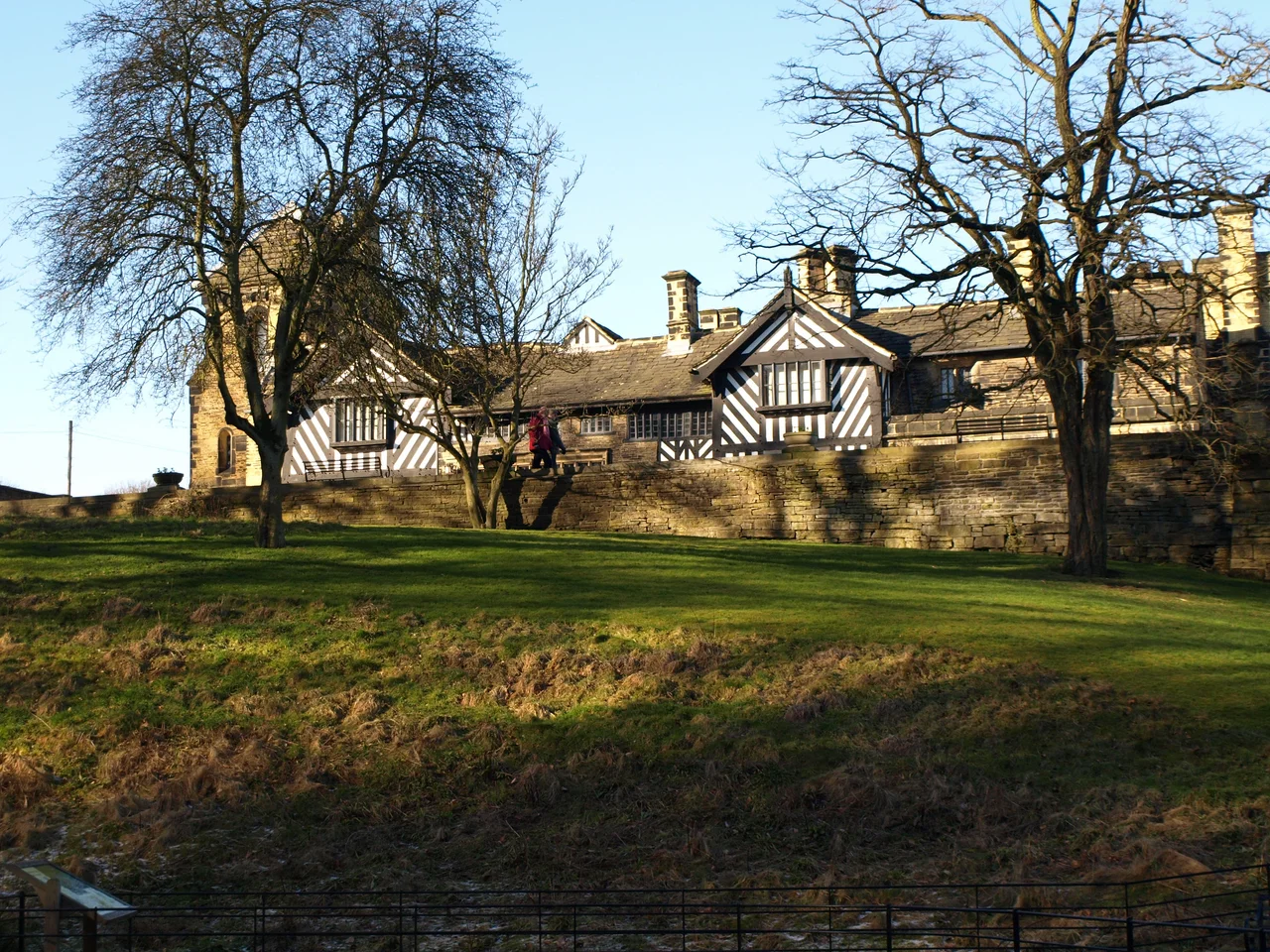

Shibden Hall
Anne Lister inherited Shibden Hall in 1826 and immediately set about making it hers. She added a gothic library tower so she could read alone. She commissioned terraced gardens, a boating lake, cascades. She studied geology and bought a colliery. She managed her own estates, walked Pyrenean peaks no Englishwoman had climbed, and filled four million coded words of diary with the candid account of a life she had no template for. When she died in 1840 at the age of 49, on horseback in the Caucasus, the estate passed to her partner Ann Walker. Two centuries later, the half-timbered Tudor front of Shibden Hall is the place where her story is told.
Six Hundred Years on the Hill
The hall dates from around 1420, when records show one William Otes living there. For nearly two centuries it passed between the Savile, Waterhouse and Otes families, whose three armorial symbols are still preserved in a stone-mullioned twenty-light window. The estate came to the Lister family in 1619, through an inheritance arranged by an uncle who married his two sons to the heiress sisters when they reached sixteen. Over the next 300 years the Listers, wealthy mill owners and cloth merchants, would shape the hall through every architectural fashion that passed. The Tudor half-timbered front survives because each generation thought it worth keeping. The interior layers tell the rest of the story: Jacobean panelling, Georgian doorways, Anne Lister's gothic library.
Anne Lister of Shibden
Anne Lister was born in 1791. By 1826 she was sole owner of Shibden Hall, having inherited from her uncle and aunt. She was clear-eyed, formidable, and entirely herself. Her diaries, kept from her teens until her death, run to about five million words; roughly a sixth of them are written in a personal cipher of Greek letters and mathematical symbols that hid the record of her life with women from public view. In 1834 she and Ann Walker, who lived at nearby Crow Nest, took communion together at Holy Trinity Church in Goodramgate, York, in what they considered a marriage. Walker moved into Shibden with her. The blue plaque on Holy Trinity now commemorates the date. Lister has been described as the first modern lesbian, though the description is necessarily an outsider's word for a life she lived on her own terms, in her own language, with her own definitions.
The Park She Built
In 1830 Lister commissioned the York architect John Harper and landscape gardener Samuel Gray to transform the grounds. They added a gothic tower for her library, terraced gardens, a rock garden, a boating lake, and cascades down the slope below the hall. In the 1850s Joshua Major designed a Paisley shawl garden on the upper terrace, the pattern of an Indian textile rendered in box hedge. After Lister's death in 1840, the estate passed to Ann Walker, who lived there until her own death in 1854. Walker's life after Lister was marked by family disputes over her inheritance and a period of confinement on grounds of mental incapacity, the precise truth of which historians still debate. The hall and park then returned to the Lister family until 1926, when Arthur McCrea took over the mortgages and donated the property to Halifax Corporation.
A Television Resurrection
By the late twentieth century, Shibden was a much-loved local museum. Then in 2019 the BBC and HBO released Sally Wainwright's Gentleman Jack, with Suranne Jones as Lister, filmed largely at the hall itself. Almost six million people watched each week. Visitor numbers tripled, and Calderdale Council extended the opening hours to keep up. The West Yorkshire Folk Museum, housed in the adjoining barn and farm buildings, kept telling its older stories: the brewery, the basket-weaving shop, the tannery, the stable full of horse-drawn carriages, the dry stone walling exhibition, the miniature steam railway in the park. The Heritage Lottery Fund and Calderdale Council put more than five million pounds into restoring the grounds between 2007 and 2008. The gardens were Grade II listed in 2000. The hall itself is Grade II starred.
The Square Piano
Among the hall's quieter treasures is a square piano in the music room, made by Johannes Pohlman and dated 1769. It is one of the earliest Pohlmans in existence. The instrument is unrestored, though its stand is later. To stand in front of it now is to imagine Anne Lister sitting at it on a winter evening, the gothic library above her stocked with the books she had ordered for her own self-education, the diaries locked in their cipher in her writing desk, Ann Walker upstairs, the gardens she had designed running away down the slope to the boating lake. Six hundred years of other people lived here too. Their fragments remain in the carvings, the panels, the armorial glass. But it is Lister whose life shapes what visitors come to see, and whose dignity the hall now exists to keep.
From the Air
Located at 53.728 N, 1.840 W in the Shibden valley northeast of Halifax. Best viewed from 2,000-3,500 ft AGL; the half-timbered front and the surrounding park are clearly identifiable from low altitude. Nearest airports are Leeds Bradford (EGNM) 11 nm northeast and Manchester (EGCC) 24 nm southwest. The valley is steep and the surrounding moors can hold low cloud, especially morning and evening. Castle Hill in Huddersfield lies about 8 nm south as a navigational landmark.
Nearby Stories
- Ribston Hall 1.5 km away
- Bolton Priory 3.5 km away
- Clifton Park and Museum 4 km away
- Blackburn 5 km away
- Nostell Priory 5.5 km away
- Mellor Mill 9.4 km away
- Warrington bombings 10 km away
- Ashton Memorial 23 km away