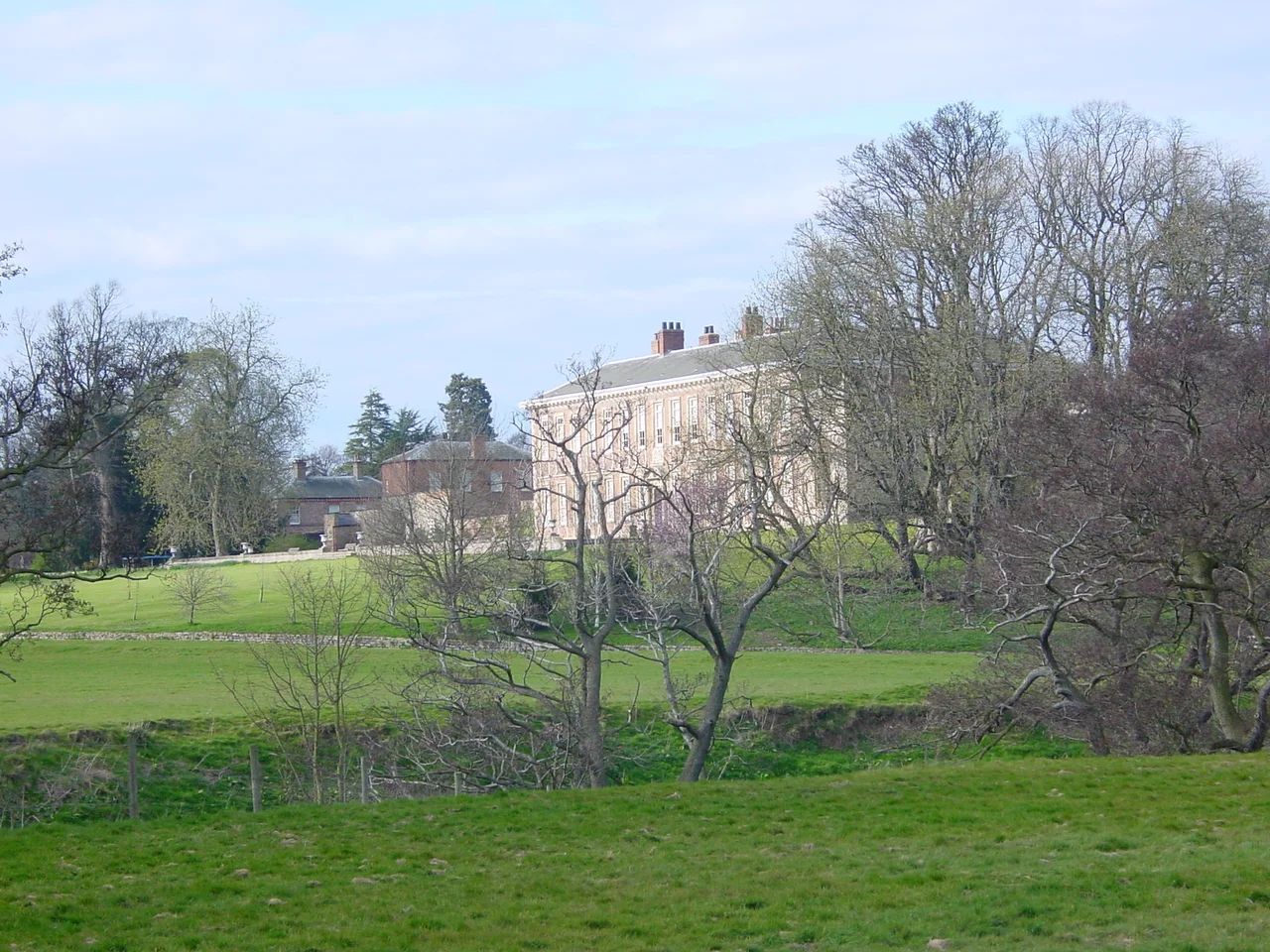

Ribston Hall
In 1217, Robert de Ros granted the estate at Ribston to the Knights Templar. The transfer was not unusual for the time. The Templars were a military religious order, accumulating land across Christendom to fund their operations in the Holy Land. They built a preceptory on the bend of the River Nidd, ran sheep, banked money, and trained their European recruits for the long ride east. By the early fourteenth century the Templars were dissolved across Europe under pressure from the King of France, their leaders burned, their property confiscated. Ribston passed to the Knights Hospitaller, the Templars' rival order, who held it until Henry VIII dissolved them too. The estate has rotated through warrior monks, dukes, royalist baronets, and modern private owners for eight hundred unbroken years.
From Templars to Tudors
After the Hospitallers were dissolved in 1540, the Crown took back the estate. Henry VIII granted it to Charles Brandon, 1st Duke of Suffolk, his close friend and the husband of his sister Mary. Suffolk did not keep it long. He sold Ribston to Henry Goodricke in 1542. The Goodrickes were rising Yorkshire gentry, and Ribston became their family seat for the next two centuries. Henry's son Richard served as High Sheriff of Yorkshire for 1579-80 and died in 1581. Richard's son, also Richard, was High Sheriff for 1591-92 and died in 1601. Then came Sir Henry Goodricke, whose son John was made the first Baronet Goodricke in 1641 just as the country slid into civil war. The pattern of sons inheriting the sheriffdom and the title, generation by generation, ended only when the male line ran out.
A Royalist Escapes the Tower
Sir John Goodricke, 1st Baronet, chose the wrong side in the English Civil War. He fought for King Charles. After the Royalist defeat he was fined, then imprisoned in the Tower of London. From the Tower, he escaped to France, an unusual feat for a baronet in his middle years. He stayed in exile through the Commonwealth and Protectorate, waiting out Oliver Cromwell and his son. When Charles II returned in 1660 and the Restoration brought the old Royalists back into favour, Sir John came home with them. He was elected Member of Parliament for Yorkshire in 1661 and sat until 1670. His son Sir Henry Goodricke, 2nd Baronet, sat for Boroughbridge from 1673 to his death in 1705. He was the one who tore down most of the old building on the site and put up the existing seventeenth-century house, a two-storey mansion presenting a fifteen-bay front to the north-east.
St Andrew's Chapel
Attached to the south-east of the hall is St Andrew's Chapel, separately grade II* listed, built in 1444 and altered in 1700 and again around 1850. The construction is limestone and sandstone with sandstone quoins and a flat roof. A continuous nave and chancel run the length of the building, with a lean-to two-storey porch at the east end of the south wall and a doorway with a chamfered surround under a hood mould. An embattled parapet runs along the south end. In the corner between the chapel and the main hall, a stair tower climbs. The west end has a parapet pierced with quatrefoils and topped with finials, while three recesses in the west wall include one containing a coat of arms. The interior holds eighteenth-century woodwork, a baptismal font from around 1700, and a contemporary memorial.
Stables and Sphinxes
The mid-eighteenth-century stable block, also grade II* listed, encloses a courtyard in red brick with stone dressings and a hipped Westmorland slate roof. There are two storeys, nine bays across the main range, with the middle three projecting under a triangular pediment that holds a coat of arms in a square plaque. The ground floor opens through a round-arched entrance flanked by round-headed windows in relieving arches. A cupola crowns the roof, square-based, carrying a clock, a lead dome, a weathervane, and a bell. Flanking the entrance drive are Walshford Lodges, single-storey stone buildings in their own grade II* listing. Curving walls link the lodges to two pairs of gate piers. The outer piers, banded with rustication, stand about three metres high and are topped with sphinxes. The inner piers stand four metres high, with entablatures carrying rosette motifs and triangular pediments crowned by lions, each with a paw on a globe.
Still Private
Ribston Hall remains in private hands today. Unlike so many other grand Yorkshire estates that passed to the National Trust or English Heritage during the twentieth century, Ribston has stayed inside its private ownership. The fifteen-bay entrance front looks out across the Nidd much as it did in Sir Henry Goodricke's day. The estate is not generally open to the public, which is itself a kind of historical preservation: a privately maintained country seat whose appearance from the road would have been recognizable to a seventeenth-century traveller. The grade II* listings cover the hall, the chapel, the stables, and the lodges with their gates and railings. The Templars' bend of the river is still a bend of the river. The Nidd flows on.
From the Air
Ribston Hall stands at 53.98°N, 1.40°W on the south bank of the River Nidd at Great Ribston, near Knaresborough in North Yorkshire. Recommended viewing altitude 2,000-3,000 feet for the fifteen-bay entrance front and the surrounding parkland. Nearest airports: Leeds Bradford (EGNM) 11nm south-east and Teesside International (EGNV) 35nm north. The Nidd loops in tight meanders past the estate, with the A1(M) motorway visible 2nm to the east. The estate's tree-lined drives and walled gardens stand out against the open farmland of the Vale of York.
Nearby Stories
- Hole of Horcum 1.7 km away
- Sledmere House 8.3 km away
- Shibden Hall 8.7 km away
- Mount Grace Priory 8.8 km away
- Battle of Ferrybridge 9 km away
- 1975 Dibbles Bridge Coach Crash 11 km away
- Bolton Castle 13 km away
- Flixborough Disaster 19 km away