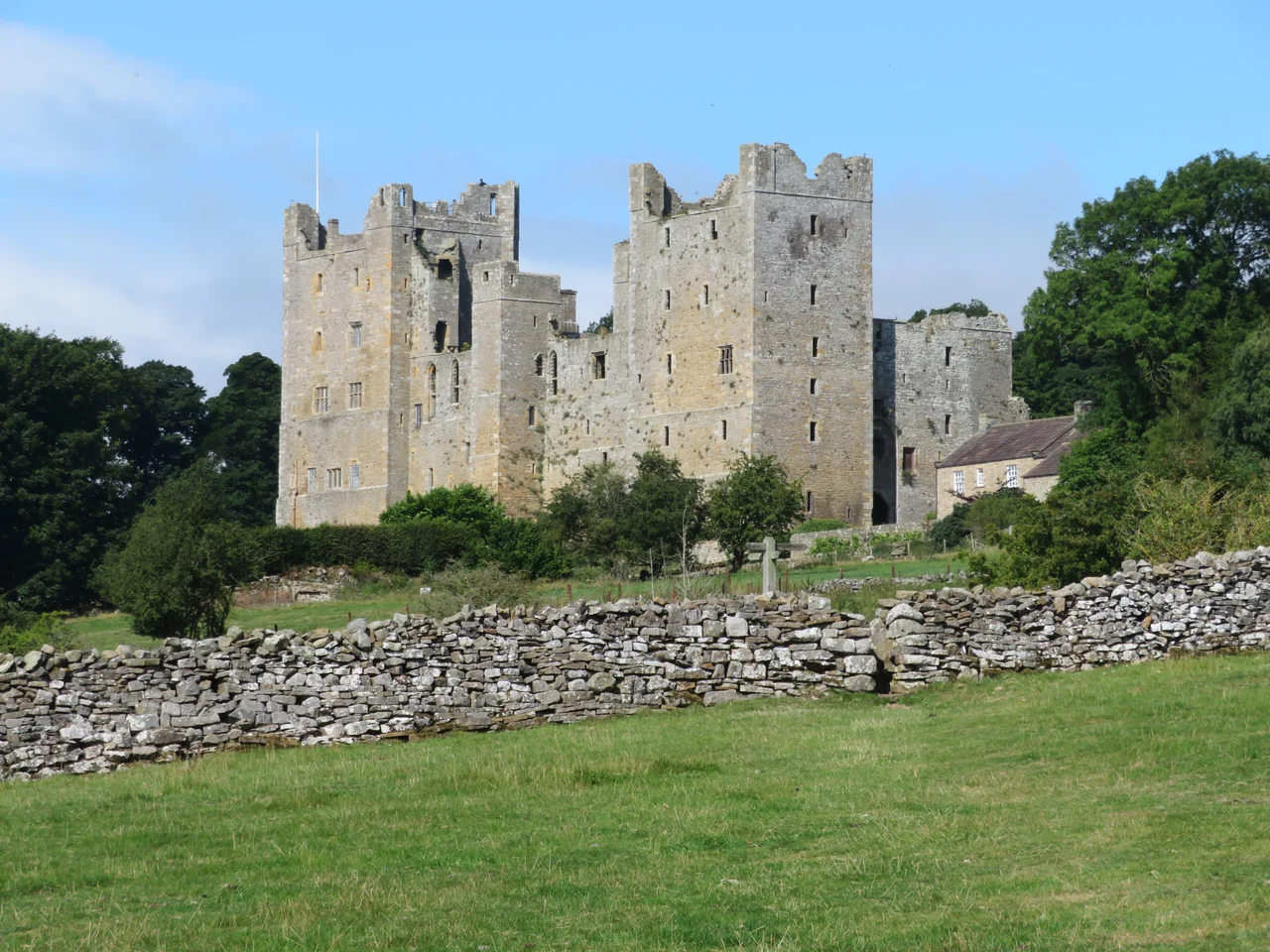

Bolton Castle
On a clear July evening in 1568 a deposed Scottish queen rode through the gate of a castle she had never seen, accompanied by thirty of her household and watched by guards who were trying to figure out where to put her. Mary Stuart had crossed the Solway Firth two months earlier after losing the Battle of Langside. She was 25, widowed twice, mother of a one-year-old future King James I of England, and an enormous diplomatic problem. Elizabeth I had moved her south from Carlisle to a castle deep in Wensleydale, partly for security and partly because nobody quite knew what else to do. The castle was Bolton, and it had been waiting for someone like her since 1399.
Eighteen Thousand Marks
Bolton Castle was built between 1378 and 1399 by Richard Scrope, the 1st Baron Scrope of Bolton, on the north side of Wensleydale. The contract with the master mason John Lewyn survives from September 1378. The royal licence to crenellate followed in July 1379. The reported cost was 18,000 marks, an enormous sum equivalent to roughly £12,000 in fourteenth-century money. The result was a quadrangular castle - a square arrangement of buildings around a central courtyard with four corner towers - rather than the older motte-and-keep design. Sir Francis Knollys later described it as having the highest walls of any house he had ever seen. The sixteenth-century antiquary John Leland recorded an astronomical clock in the courtyard and a clever flue system that carried smoke from the great hall hearth through tunnels in the walls. The Scrope family lived there for two centuries before Mary arrived.
Pilgrimage and Punishment
In 1536 John Scrope, the 8th Baron, threw the castle's weight behind the Pilgrimage of Grace - the great northern Catholic rebellion against Henry VIII's dissolution of the monasteries. When the rising collapsed, Scrope gave sanctuary inside Bolton to Adam Sedbar, the Abbot of nearby Jervaulx Abbey. The king's men came for them both. Scrope escaped west to Skipton. Sedbar was caught, dragged to Tyburn, and hanged. Henry's revenge on the castle was fire: he ordered Bolton torched, and the damage was extensive. Yet within a few years much of it had been repaired and the chastened Sir John resumed his seat in Parliament. The Scropes had decided the long view was worth the price of accommodation, and they kept their castle when other rebellious families lost everything.
A Queen in the South-West Tower
Mary spent six months at Bolton, from July 1568 to January 1569. She was given Henry Scrope's own apartments in the south-west tower. Of her retinue of 51 people, only 30 men and 6 ladies-in-waiting could be lodged inside. The rest took rooms in the village. She brought a hairdresser, embroiderer, apothecary, physician, surgeon, and a goldsmith whom Knollys worried might counterfeit seals for forged correspondence. The castle was not equipped to house royalty, so tapestries, rugs, and furniture were borrowed from nearby houses and from Barnard Castle in County Durham. Elizabeth herself sent pewter vessels and a copper kettle. Mary obtained an old cloth of estate from Scotland and hung it above her chair in the great chamber, making it a makeshift throne room. She was allowed to walk the grounds and to hunt. She had her hair dressed daily by Mary Seton. She met local Catholics, for which her keepers were severely reprimanded. Knollys, whom she nicknamed Schoolmaster, taught her English - she had previously spoken only French, Latin, and Scots - and she wrote him a letter in the new language, apologising that she had never used it before.
The Shawl and the Long Survival
Local legend says Mary tried to escape and fled toward Leyburn, dropping her shawl on the cliff edge that runs west out of the town. The escarpment is still called The Shawl and remains a favourite walking route with sweeping views down Wensleydale. The story is almost certainly later embellishment, but the name stuck. Mary was moved south to Tutbury in January 1569 and eventually executed at Fotheringhay in 1587 after nineteen years of confinement. Bolton itself survived the English Civil War of the 1640s, was slighted afterwards to render it militarily useless, and was inherited in 1630 by the Powlett family through Mary Scrope, illegitimate daughter of the last Earl of Sunderland. The Powletts became Lords Bolton. The current owner, Thomas Peter Algar Orde-Powlett, the 9th Baron Bolton, inherited from his father in June 2023. The castle has never been sold. It is still a family seat, still partly a ruin and partly restored, and still has the same impossibly tall walls Knollys described in 1568.
From the Air
Located at 54.322 N, 1.950 W in Wensleydale, North Yorkshire. The castle sits above the small village of Castle Bolton on the north side of the dale, roughly halfway between Leyburn and Aysgarth. Best viewed at 1,500-3,000 feet AGL. Recognizable as a near-square stone block with four corner towers, set against the steep escarpment of The Shawl. Leeds Bradford (EGNM) lies about 35 nm south, Teesside (EGNV) about 25 nm north-east. The castle is inside the Yorkshire Dales National Park. River Ure visible to the south. Frequently used as a film location for medieval-period productions.
Nearby Stories
- Howgill Fells 2.6 km away
- Cross Fell 4.2 km away
- Battle of Boroughbridge 4.9 km away
- Weardale 5.4 km away
- Mount Grace Priory 6.8 km away
- 1975 Dibbles Bridge Coach Crash 8.6 km away
- Hartlepool 13 km away
- Forest of Bowland 23 km away