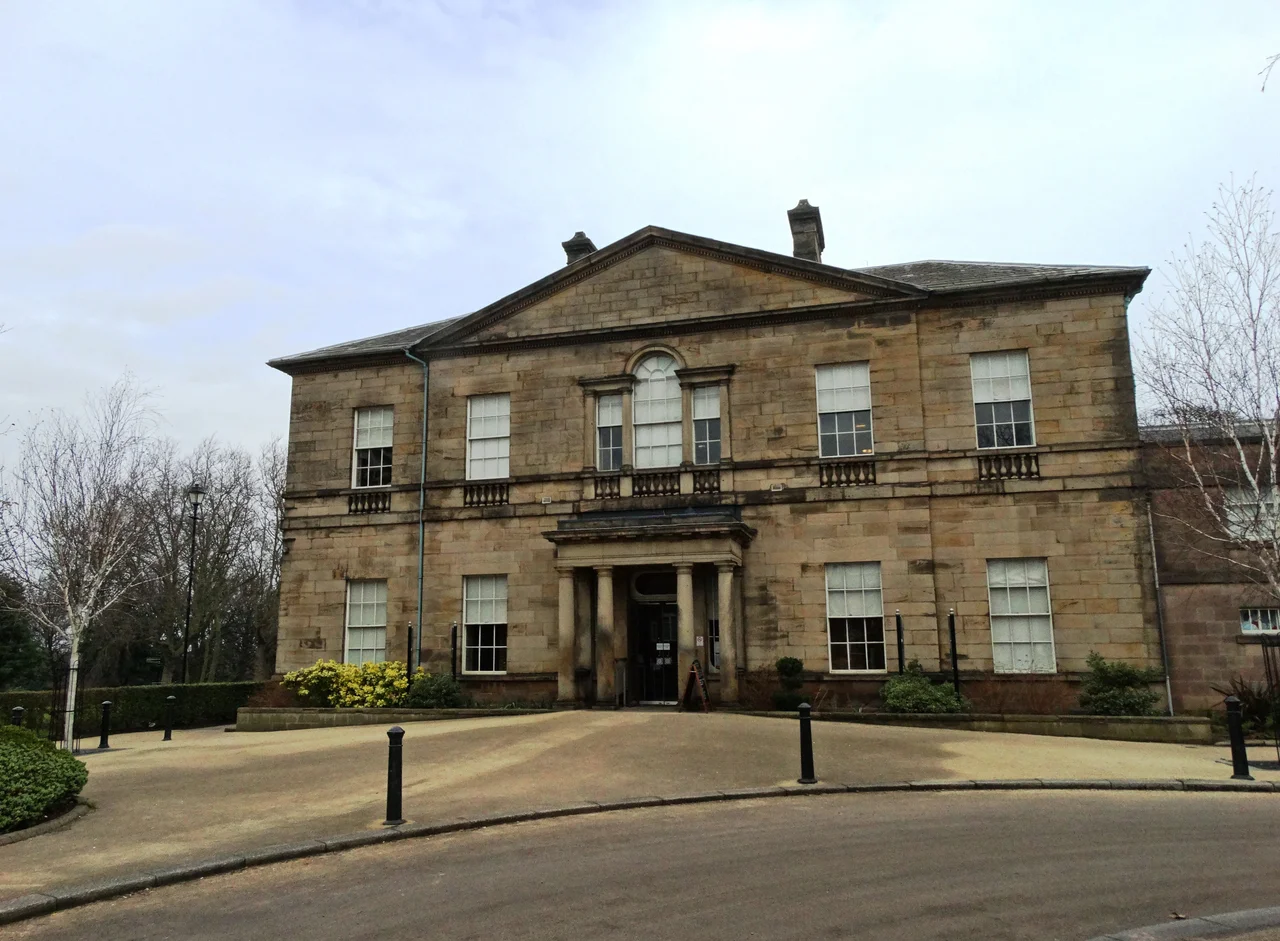

Clifton Park and Museum
Two porcelain rhinoceroses sit somewhere in a glass case in Rotherham. They are not exactly rhinoceroses. They are the porcelain Rhinoceros Vase, one of two ever made, produced in the 1820s by the Rockingham Pottery as a showpiece for the firm's most extravagant work. The other is held elsewhere. Both have survived for two hundred years partly through luck and partly because municipal museums in industrial towns sometimes turn out to contain treasures that no one in the larger art world is paying attention to.
John Carr's House
Clifton House was designed by John Carr of York, the prolific Yorkshire architect responsible for Harewood, Buxton Crescent and dozens of country houses across the north of England, and completed in 1784 for Joshua Walker. Walker was an iron and steel industrialist, part of the Walker family of Masbrough, whose foundries turned out cannon for the Royal Navy during the Napoleonic Wars. The house is restrained Georgian, in the symmetrical, proportioned style Carr favoured, set in grounds on the eastern edge of what was then Rotherham proper. In 1891 the Municipal Borough of Rotherham bought house and grounds together, and within months had reopened the house as a public museum, with most of the initial exhibits loaned from local people who simply walked their treasures up to the door.
Rockingham, Templeborough and a Cape Lion
The collections that grew there reflect Rotherham itself: local industrial history, archaeology, natural sciences, coins, medals, fine and decorative arts. Roman remains from Templeborough, the auxiliary fort that stood at the confluence of the Don and the Rother, occupy a section of their own. So does Nelson, a Cape Lion preserved by taxidermy, the species now extinct in the wild and represented worldwide by only a handful of museum specimens. But the heart of the collection is the Rockingham porcelain. The Rockingham works at Swinton, a few miles away, produced some of the most ornate English porcelain of the early nineteenth century before going bankrupt in 1842. Clifton Park holds one of the two surviving porcelain Rhinoceros Vases, an object built to demonstrate just how far the pottery could push its craftsmanship before it ran out of patience or money.
Closed for the Refurbishment
In 2003 the museum closed its doors for a major refurbishment funded in part by the Heritage Lottery Fund. The £3 million programme covered the roof, the heating systems, the stonework, the windows and the electrical systems, alongside new displays, a study room, a cafeteria and a gift shop. A lift went in to make the building fully accessible. The interior was redecorated using the exact colour scheme of the original Georgian house, returning the walls and trim to what Joshua Walker would have seen. The museum reopened on 29 January 2005. Twice during the closure, in 2003 and again in 2004, it was shortlisted for the Gulbenkian Prize for Museum of the Year, recognition won not for the collections (which were behind locked doors) but for the outreach programmes the staff ran while the building was empty.
The Park Around It
Clifton Park itself was opened on 25 June 1891 by the Prince of Wales, the future Edward VII. The Park is Grade II listed by Historic England, the gate piers grade-listed in their own right, and the layout has accumulated features over more than a century: a commemorative beech planted for Queen Victoria's coronation in the 1830s, the main entrance added in 1900, a Cenotaph in 1922, Memorial Gardens added after the Second World War in 1948. A £7.6 million Heritage Lottery Fund award funded another round of improvements between 2009 and 2011, including the water play area that is now a fixture of summer visits. Around the museum sit a skate park, a bandstand, tennis courts, a bowling green, a landtrain, a sand pit, mini golf and crazy golf, picnic areas, the memorial gardens and the rockery. A parkrun takes the loop every Saturday morning. The house is the original draw, but the park is what most of Rotherham actually uses.
From the Air
Clifton Park and Museum is at 53.430 N, 1.347 W, just east of Rotherham town centre in South Yorkshire. The site is at about 50 m elevation in the lower Don valley. The Georgian house and surrounding parkland are clearly distinguishable from the air. Best viewed from 2,000-3,000 ft AGL. Nearest airports: Doncaster Sheffield (EGCN) 10 nm east, Sheffield City Heliport. The M1 runs 2 nm to the west, and the steel-and-Don landscape of Sheffield and Rotherham fills the surrounding view.
Nearby Stories
- Flixborough Disaster 0.8 km away
- Peveril Castle 1.7 km away
- Newstead Abbey 2.6 km away
- Huddersfield Town Hall 3.8 km away
- Ackworth School 7.9 km away
- RAF Scampton 11 km away
- RAF Cranwell 16 km away
- Croxden Abbey 18 km away