
Mellor Mill
If you walk down through Bottoms Wood today, past the still water that local people call the Roman Lakes, the ground under your boots holds the bones of one of the most ambitious cotton mills of the early industrial age. Samuel Oldknow built it in the 1790s on a stretch of the River Goyt where Cheshire then met Derbyshire. The mill was six storeys high and four hundred feet long, with three waterwheels and ten thousand spindles, employing five hundred and fifty people at its peak. Then on a night in 1892 it burned to nothing. The fire took the building so completely that for over a century almost no one knew exactly where it had stood, until archaeologists started digging in the 2010s and found the wheel pits intact beneath the leaf mould.
Oldknow's Big Idea
Samuel Oldknow already owned mills in Stockport, Heaton Mersey and Anderton when he started buying land at Mellor in 1787. He bought three adjoining estates over several years, then began building the largest cotton mill anyone had yet attempted in this corner of England. The financing was nervous from the start. Oldknow secured the project on his reputation and on loans from Richard Arkwright the younger, with whom he was also negotiating a marriage alliance through Arkwright's daughter. The financial crisis of 1792 to 1793 wrecked his plans. The engagement was broken off. Oldknow sold his other mills, poured everything into Mellor, and finished the building in 1795 with the help of yet more Arkwright money. By 1797 he was on the verge of bankruptcy.
The Rescue and the Long Quiet
Richard Arkwright junior was not a sentimental man, but he understood the value of the asset. In 1797 he formed a partnership that absorbed Oldknow's debts and let him stay on as manager. When that partnership dissolved in 1805, Oldknow's estate was nominally worth one hundred and sixty thousand pounds while his debts stood at one hundred and fifty-six thousand. He spent the rest of his life running the place for the Arkwrights without ever quite owning it. He died in 1828, and the mill and estate passed entirely to Arkwright. From 1824 the manufacturing had actually been run by Oldknow's half-brother John Clayton, and after 1828 Clayton's firm took over as tenants. The mill ran on through the nineteenth century, quietly profitable, never quite as famous as its size deserved.
Engineering the River
To power a mill this large, Oldknow had to remake the river. The Goyt, which then formed the boundary between Cheshire and Derbyshire, was diverted and dammed with a weir. The leat fed a millpond, which fed another millpond, supplemented by a reservoir up at Linnet Clough. The original Wellington wheel ran inside the building. Around 1815 a second wheel, the Waterloo, was added on the outside; twenty-two feet across, breastshot, narrower than the first but carrying the spillover from the Wellington's pit. Because the tail race sat lower than the Goyt itself, a six-hundred-metre tunnel carried the spent water back to the river at a point where the gradient had finally dropped enough. A third wheel powered a stone corn mill at the southwestern gable. Together the three raised 120 horsepower, more than most factories of the period could muster. Two 20-horsepower steam engines from Goodfellow of Hyde joined the system in 1860 to fill in for low water.
The Night of the Fire
Cotton mills burn. They have always burnt: the dust of raw fibre, the oil on the spindles, the bone-dry wooden floors saturated with decades of lubricant, the line shafts spinning at hundreds of revolutions per minute. Mellor Mill went up in 1892 and was beyond saving by morning. The outbuildings, set apart, survived. The main block did not. In 1921, during the excavation of one of those outbuildings, a coach-house, workers found a cache of Oldknow's business papers tucked away and forgotten. The economic historian George Unwin used them to write Samuel Oldknow and the Arkwrights in 1924, a book that remains the standard source on early cotton industry finance. Without the fire, the papers would never have been hidden in the coach-house. Without the survival of the coach-house, the papers would have burnt with everything else.
What You Can See Now
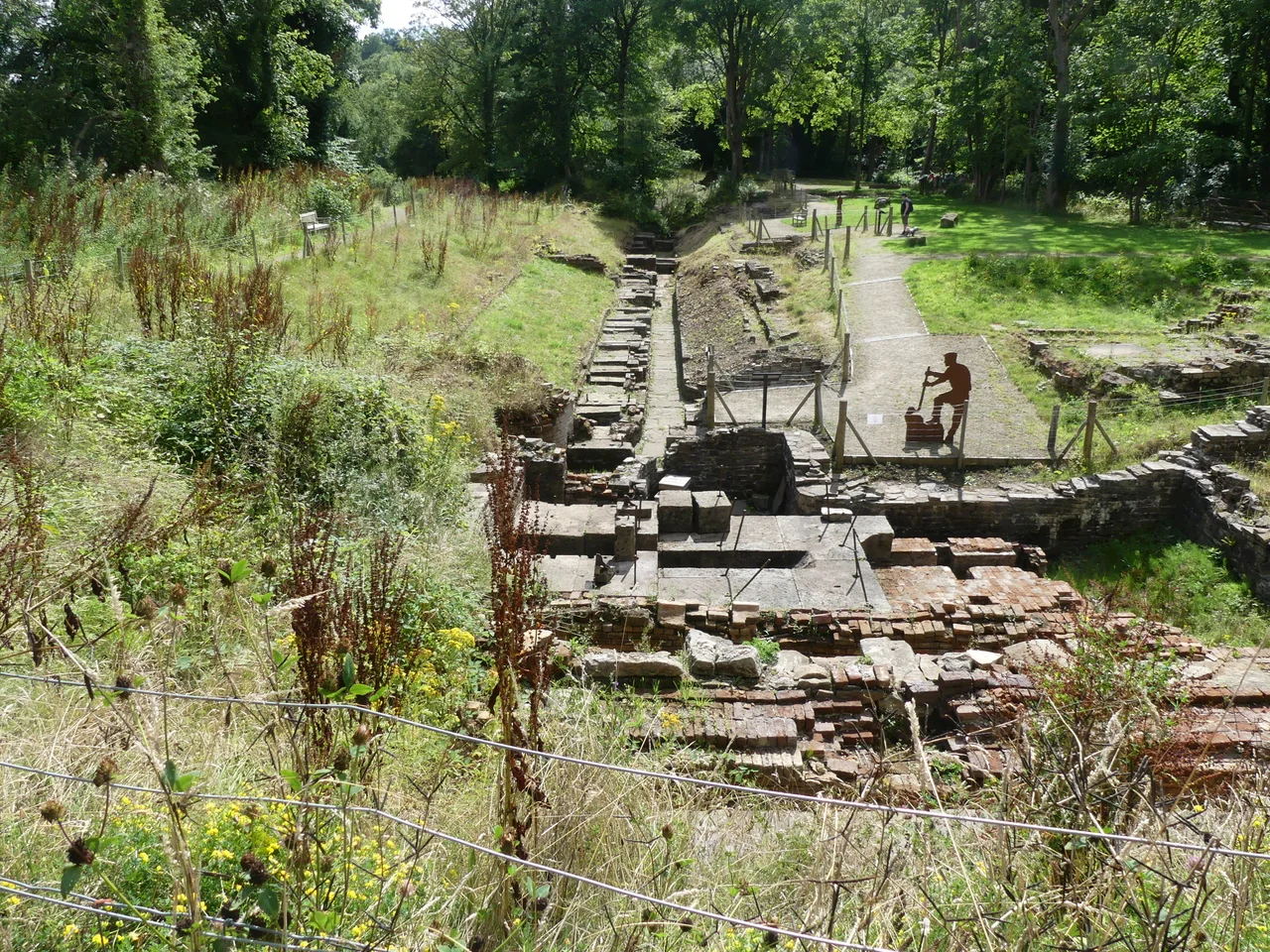
From the surface, nothing of the mill remains. But the Roman Lakes are still there, named in the nineteenth century when picnickers thought their straight lines looked like something an emperor might have ordered, and the woodland path follows the line of the leat. The Mellor Archaeological Trust has uncovered the Wellington wheel pit, the Waterloo wheel pit, and large sections of the mill's stone foundations. On open days you can stand in the chamber that once held a twenty-two-foot wheel, look up at the ferns growing where the mill walls rose six storeys above you, and feel exactly how completely a great building can vanish. The river itself runs as it did before Oldknow remade it, except for the curve of his weir, which the water still has to climb.
From the Air
Mellor Mill's foundations lie at 53.387°N, 2.047°W in the steep wooded valley of the River Goyt between Marple and Mellor, on the edge of the Peak District National Park. From the air, look for the chain of dark green millponds (the Roman Lakes) below Marple Bridge; the mill site is in the woods immediately west of the largest pond. Recommended viewing altitude is 2,500 to 3,500 feet AGL to clear the surrounding ridges, which rise above 800 feet AMSL. Manchester (EGCC) lies about 10 nautical miles west, with busy approach traffic; Manchester Barton (EGCB) is about 12 nautical miles northwest. The Peak District weather is changeable, with low cloud common in the Goyt valley on still mornings.
Nearby Stories
- Orgreave rail accident 3.7 km away
- Winter Hill Air Disaster 3.9 km away
- Nostell Priory 4.5 km away
- Nantwich 4.6 km away
- Lion Salt Works 8.6 km away
- Eastwood, Nottinghamshire 10 km away
- Huddersfield Town Hall 11 km away
- Croxden Abbey 15 km away