
Warrington bombings
Johnathan Ball was three years old. He had walked into town with his babysitter to buy a Mother's Day card. Tim Parry was twelve, from Great Sankey, and had gone to buy a pair of football shorts with money he had been given for his birthday. It was a Saturday morning, 20 March 1993, the day before Mother's Day, and Bridge Street in Warrington was full of families doing the same kinds of errands. Two small bombs had been hidden in cast-iron litter bins about a hundred yards apart. They went off at 12:25 in the afternoon. Johnathan died at the scene. Tim was taken to hospital and held on for five days before his parents agreed to let the doctors stop. Fifty-six other people were hurt, four of them very badly.
The Warning That Did Not Help
About half an hour before the explosions, a man called the Samaritans office in Liverpool and said that a bomb had been planted outside a Boots shop. He did not specify which Boots. He did not name Warrington. Merseyside Police sent officers to check Boots branches in Liverpool and passed a warning to the Cheshire Constabulary. By the time anyone was looking at the right Boots, in the wrong town, the bombs detonated. The Provisional IRA issued a statement the following day, claiming the warnings had been precise and adequate and that responsibility lay with the British authorities for failing to act on them. Almost no one accepted that argument. The killing of two children, on a busy shopping street, on the eve of Mother's Day, broke something in the public mood toward the IRA campaign in England. In Dublin, tens of thousands signed a book of condolence. In Cheshire, the killings remain on the police list of unsolved murders. No one has ever been convicted.
What Happened Before
The Bridge Street attack was the second IRA bombing in Warrington that year. On the night of 25 February, three IRA members had planted Semtex bombs at the gas holders on Winwick Road. A police officer stopped their van on Sankey Street and asked them what they were doing. They shot him three times and drove off. An hour later they hijacked a car in Lymm, locked the driver in the boot, and headed toward Manchester. About a hundred people had to be evacuated from their homes when the gas holder bomb went off; the damage was extensive but no one was hurt. Two of the bombers were eventually caught after a high-speed chase. The shot officer survived. Bridge Street, three weeks later, was a different kind of attack: small charges in public bins, no precise warning, in a town centre crowded with families.
Colin and Wendy Parry
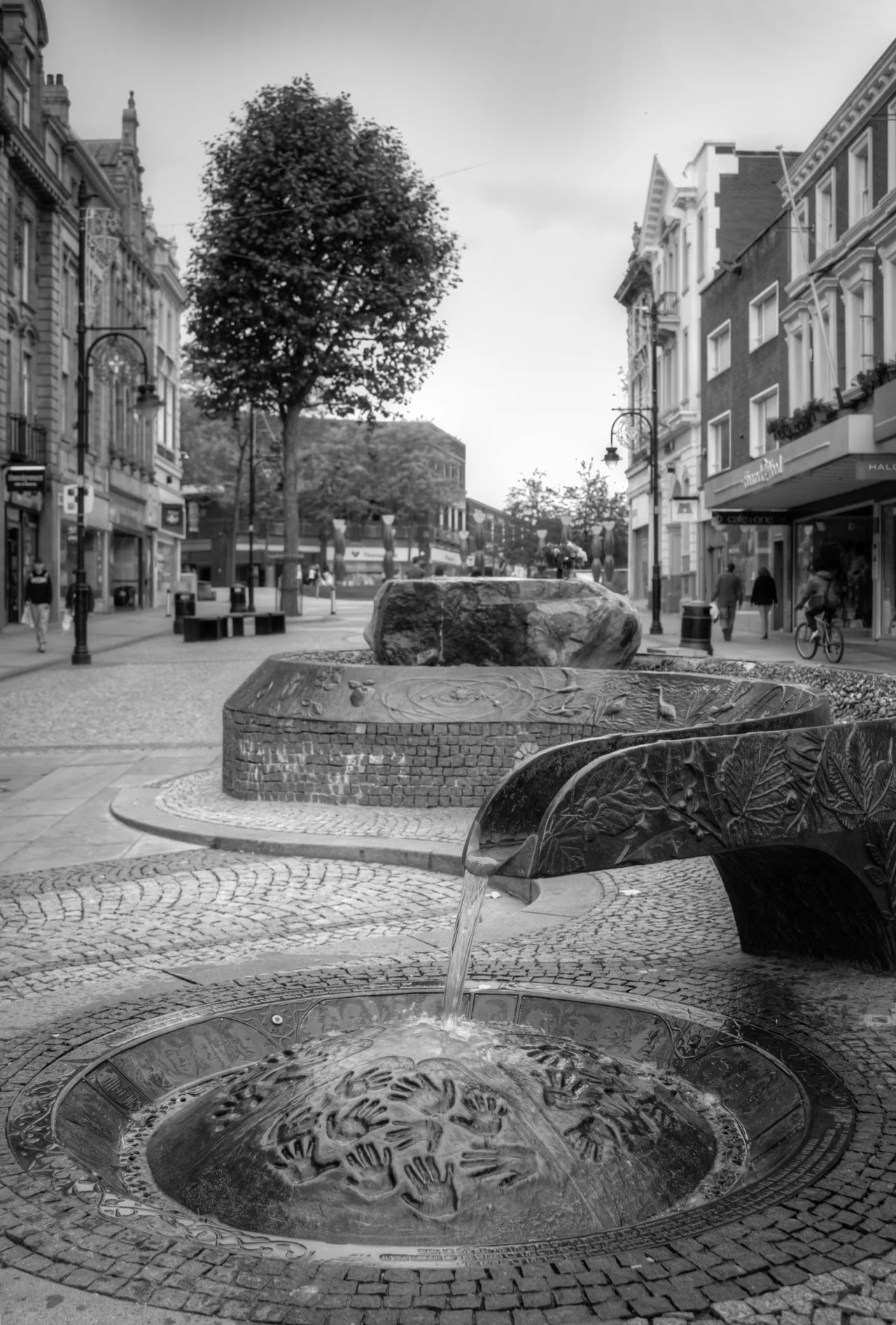
Tim Parry's parents, Colin and Wendy, did something that almost no one would expect of bereaved parents. They decided that grief should not curdle into hatred, and that the most useful thing they could build with their son's memory was the opposite of a bomb. The Tim Parry Johnathan Ball Trust was founded in 1995. With government and private support it raised enough money to build the Peace Centre on Great Sankey, which opened on 20 March 2000, the seventh anniversary of the bombing. The centre runs conflict-resolution programmes for young people from divided communities, supports survivors of terrorism, and provides a meeting space for difficult conversations between Britain and Ireland. The Cranberries song Zombie, written by Dolores O'Riordan in protest at the Warrington killings, became the band's biggest hit. The Duchess of Kent unveiled a memorial called The River of Life on Bridge Street in November 1996. The Parrys still live in Warrington.
Why Remember
The Good Friday Agreement was signed in April 1998, five years after the bombs on Bridge Street. The Warrington killings were not the only reason the political climate shifted, but they were part of why the IRA's claim to legitimacy collapsed in mainland Britain. Two children buying a Mother's Day card and a pair of football shorts had no part in any of it. The Peace Centre that bears their names has spent twenty-five years trying to make sure that being a child in the wrong place at the wrong time stops meaning what it meant for them. In Warrington town centre the River of Life memorial flows year-round, the names of Johnathan Ball and Tim Parry carved into stone, and the people who knew them still walk past it on their way to do the shopping.
From the Air
The bombings occurred in central Warrington, 53.39N, 2.59W. Bridge Street runs north from Warrington Bridge over the Mersey into the heart of the town; the River of Life memorial fountain marks the site today. From the air, Warrington reads as a Mersey-side industrial town set in the gap between the M6 and M62 motorways, with the Manchester Ship Canal cutting along the south. Recommended viewing altitude 3,000-4,000 ft to take in the town centre, the river, and the canal together. The Peace Centre is at Great Sankey, about 2 nm west of the town centre, near Warrington West railway station. Nearest airports: Manchester (EGCC) 16 nm east, Liverpool John Lennon (EGGP) 16 nm west, Hawarden (EGNR) 18 nm southwest. Approach this place with the gravity it deserves.
Nearby Stories
- Anson Engine Museum 1.3 km away
- West Kirby 2.9 km away
- Battle of Nantwich 6.2 km away
- Winter Hill Air Disaster 8.3 km away
- Horseshoe Pass 8.8 km away
- Caverswall Castle 12 km away
- Murder of Lindsay Rimer 15 km away
- Piel Castle 50 km away