
Ashton Memorial
From the M6 motorway you see the dome long before you see Lancaster. It rises above Williamson Park on a hill east of the city, copper-green where the sun catches it, pale Portland stone below. On a clear day it is visible from Black Combe in the Lake District, fifty miles north, and from ships out in the Irish Sea. England's grandest folly was built by a linoleum manufacturer for a woman almost no one remembers - Jessy Williamson, second wife of James Williamson, 1st Baron Ashton, who died in 1904. Her widower spent £87,000 - more than ten million pounds in today's money - making sure she would not be forgotten.
A Folly with Conviction
John Belcher designed it. Construction ran from 1907 to 1909. The plan is essentially a domed pavilion in the Edwardian Baroque manner: heavy stone steps in Cornish granite leading up to a great central space topped by a copper-clad dome 150 feet above the ground. The structural trick is modern and invisible - Portland stone hung as a weatherproof skin on a steel frame, the same engineering principle that built skyscrapers. That steelwork has caused most of the conservation headaches of the past century, as Edwardian rivets and bolts have rusted within the stone they were meant to support. The building is what the British call a folly, but folly is the wrong word for something this serious. It was built to last.
Allegories and Asymmetry
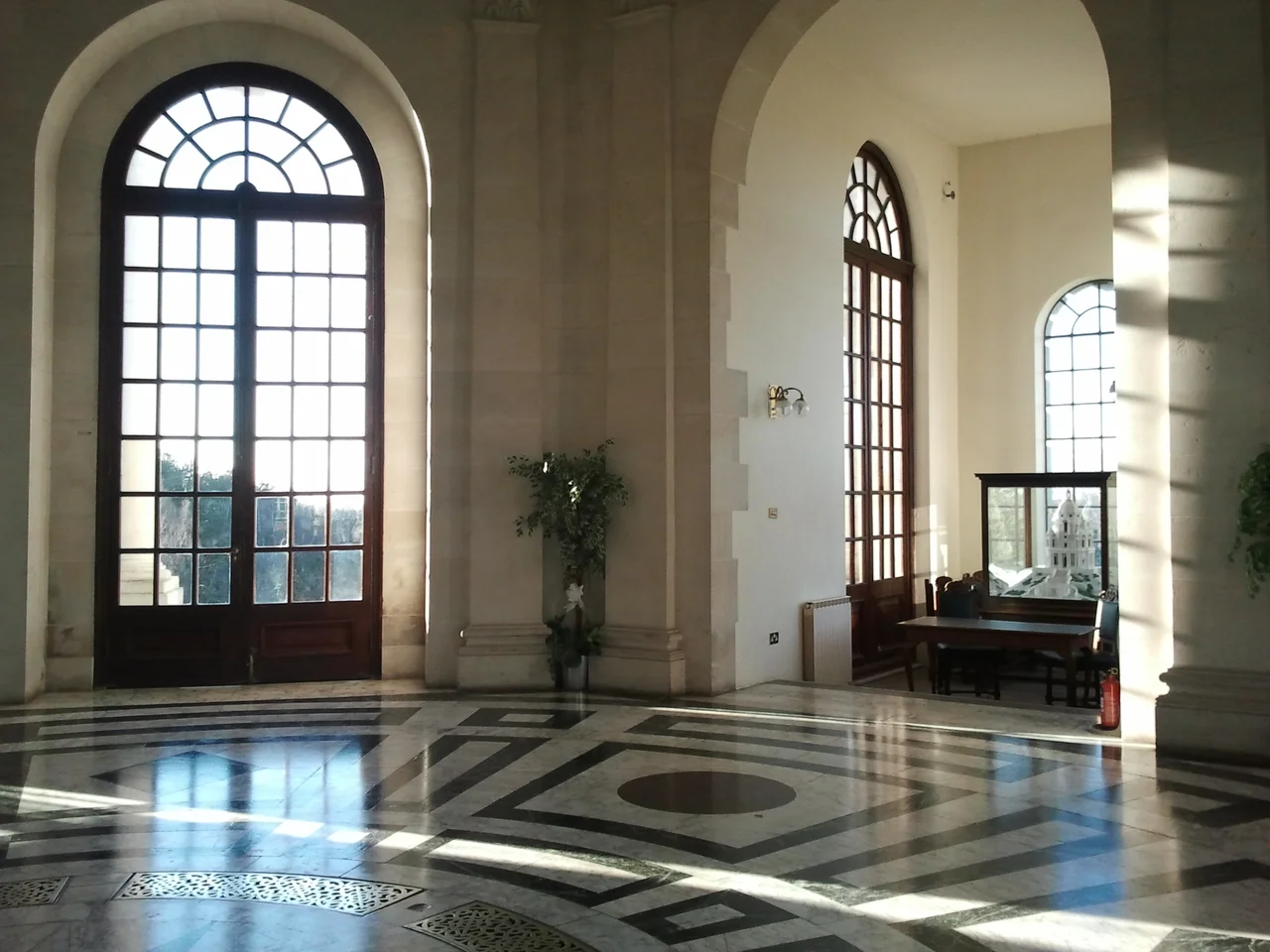
Around the exterior of the dome, sculptor Herbert Hampton carved four allegorical figures: Commerce, Science, Industry, and Art. Hampton had completed the Queen Victoria Memorial in Lancaster's Dalton Square the previous year, also commissioned by Lord Ashton, so the family style is consistent. Inside the dome are painted allegories of Commerce, Art, and History by George Murray, and decorative work whose plaster mouldings were inspired by Islamic architecture - an unexpected element in an English Edwardian monument. The floor is laid in white, black, and red marble. The whole interior is now used for exhibitions, concerts, and weddings, but the original purpose was simpler: to give Lancaster a building grand enough to hold a single absence.
The Industrialist Behind It
James Williamson, 1st Baron Ashton, was Lancaster's linoleum king. His Storeys Lune Mills factory dominated the town's economy for decades, producing oilcloth and floor coverings that sold across the British Empire. He was one of the wealthiest commoners in Edwardian England before his peerage in 1895, and he gave Lancaster much: Williamson Park itself, the Queen Victoria Memorial, hospital wings, and after Jessy's death, this enormous dome. He was, by contemporary accounts, a difficult man - litigious, controlling, capable of sudden generosity. The Ashton Memorial is the architectural form of grief filtered through someone who would not accept that grief should be modest. The Taj Mahal comparison is not hyperbole; it was the comparison the architects themselves used.
The View
Williamson Park sits on Lancaster Moor, the high ground east of the city. Climb the granite steps to the colonnade and the view runs west over Lancaster's rooftops to the spires of Lancaster Cathedral and Lancaster Priory, then on to the broad estuary of Morecambe Bay and, beyond it, the hills of the Lake District fading north. On a clear evening the dome turns gold in the sunset. By coincidence, the memorial stands very close to the mathematical centre point of the United Kingdom of Great Britain and Northern Ireland - a fact noted on plaques and discussed in Ordnance Survey circles. It seems fitting that a building this large should also be, almost accidentally, exactly in the middle.
From the Air
The Ashton Memorial sits at 54.045°N, 2.782°W, on high ground in Williamson Park about a mile east of Lancaster city centre. The structure stands roughly 150 ft (50 m) tall, dome topping out around 700 ft AMSL. Best viewed VFR at 2,000-3,000 ft AGL with the M6 motorway as a line reference - it runs immediately west of the park. Nearest airports: Blackpool (EGNH) about 18 nm southwest, Manchester (EGCC) about 50 nm south. The copper dome catches light strongly and is unmistakeable against the green of the park; on clear days it is visible from Morecambe Bay to the west and as far as Black Combe in the Lake District to the north.
Nearby Stories
- Piel Castle 1.3 km away
- Samlesbury Hall 4.7 km away
- Kendal Castle 6.5 km away
- Murder of Lindsay Rimer 7.8 km away
- Hardknott Pass 9.8 km away
- Bolton Castle 10 km away
- Embsay and Bolton Abbey Steam Railway 12 km away
- Hoylake Lifeboat Station 43 km away