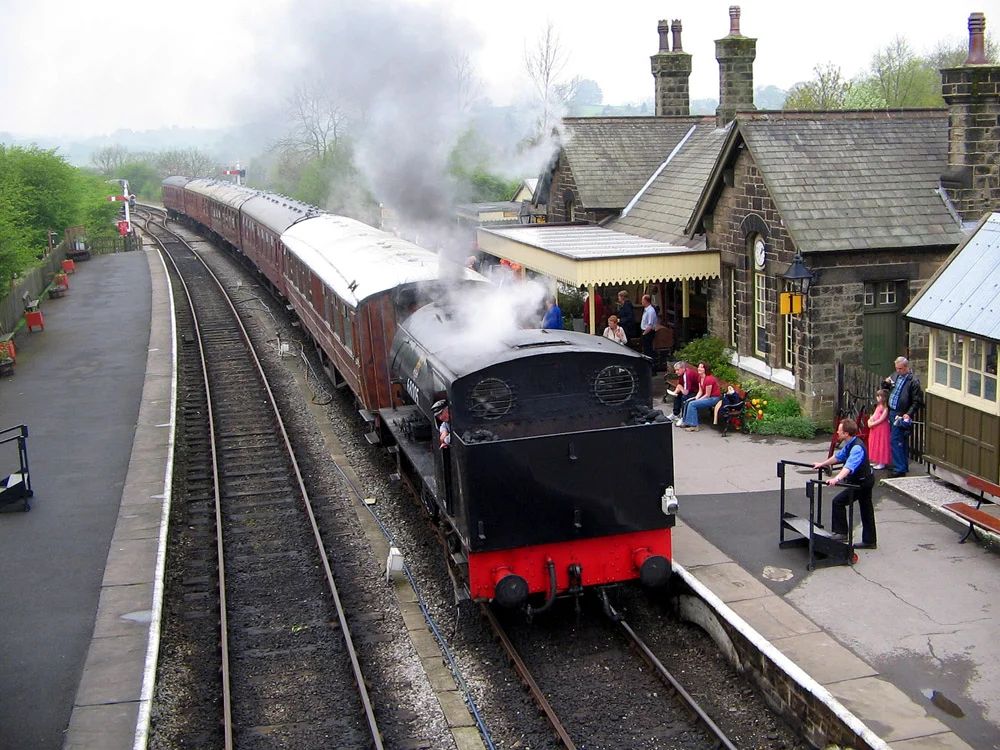

Embsay and Bolton Abbey Steam Railway
British Rail closed the line in 1965. The Midland Railway had built it in the late nineteenth century, running from Skipton through Embsay to Ilkley, carrying the wool and limestone of upper Wharfedale to market and the mill workers of Bradford up to the Dales for their day out. Then the trains stopped. The track began to disappear. Fourteen years later, in 1979, a group of volunteers refused to let the rest go. They reopened Embsay station in 1981, extended a little further every few years, and reached Bolton Abbey in 1998. Today the Embsay and Bolton Abbey Steam Railway runs four miles of track, twenty industrial locomotives older than the volunteers who maintain them, and around a hundred thousand passengers a year.
Saving What Was Left
Embsay station was built in 1888 in the simple Midland style: stone walls, gabled roof, a single platform face. The station closed with the rest of the line in 1965 and went derelict. In the late 1970s, a small group of preservationists started clearing the site. They rebuilt the booking office, the waiting room, and the run-round loop locomotives need to switch ends. Embsay opened again in 1981 with limited services. By 1987 the line had been pushed east to a newly built halt at Holywell, named for its view of the Craven Fault, the geological boundary where Yorkshire suddenly becomes limestone. Bolton Abbey station, three miles further east, was reopened in 1998 after another decade of weekend labour. The four miles between them is what the railway runs today.
The Locomotives
Heritage railways often borrow famous main-line engines. Embsay's specialty is industrial steam: small, sturdy locomotives that once shunted coal yards, gasworks and quarries. Twenty of them live on the line, the oldest built in 1908. There are also three diesel multiple units and ten other diesels for backup. The collection reflects what the West Riding actually used: brutal little 0-6-0 saddle tanks designed to move tonnage on short curves, not glamorous express engines. Every September the railway holds the Branchline Weekend gala. Visiting locomotives turn up, the line runs intensive timetables, and photographers line the trackside in conditions that range from bright Dales sunshine to horizontal rain.
The Long Plan
Embsay's volunteers have always thought beyond the current four miles. The original Midland route ran on through Bolton Bridge and Addingham to Ilkley, a total of about ten miles end to end. Reopening that whole stretch is a decades-long project rather than a real plan. The embankment supporting Addingham station was replaced with houses in the 1980s. Cuttings between Addingham and Ilkley have been filled in. Ilkley viaduct was demolished in 1973. At the western end the railway hopes to reconnect to Skipton station, where the disused platforms 5 and 6 wait beneath weeds. A Network Rail survey put the cost of reinstating the connection and the platforms at between 1.1 and 2.6 million pounds. Funds would have to be raised for a decade before the work could start. Meanwhile the existing line keeps running.
A Day Out by Steam
Embsay is the working terminus, with the souvenir shop and the engine sheds. Trains drop downhill through Holywell and the passing loop at Stoneacre, then on to Bolton Abbey where the station tearoom faces the platform. From there it is a mile and a half walk south to Bolton Priory itself, which is the point: the steam railway is the slow, smoky way to approach one of the most beautiful ruined abbeys in England. Volunteers staff the booking office and drive the engines. The carriages smell of warm wood and coal smoke. On a clear Yorkshire afternoon, with the Craven Fault rising green beyond the line, the experience is so close to the original Midland branch that the only obvious difference is the price of the ticket.
From the Air
The railway runs east from Embsay (53.98 N, 1.99 W) through Holywell and Stoneacre to Bolton Abbey station (53.97 N, 1.95 W), a four-mile line in the southern Yorkshire Dales. The nearest airport is Leeds Bradford (EGNM), fifteen miles south-southeast. Manchester (EGCC) is forty miles south. From altitude, look for the curve of the line cutting east from the village of Embsay through farmland into the woods above the Wharfe Valley, with the town of Skipton three miles southwest and the priory ruins of Bolton Abbey at the eastern end. Best viewed from 3,500 to 5,500 feet on a clear day; the steam plume from an active locomotive can sometimes be spotted from the air.
Nearby Stories
- Bolton Castle 1.2 km away
- Murder of June Anne Devaney 2.7 km away
- Sedbergh School 4.7 km away
- Battle of Boroughbridge 5 km away
- Allerton Bywater Colliery Explosion 5.8 km away
- Hebden Bridge 7.2 km away
- Mount Grace Priory 9.4 km away
- Forest of Bowland 14 km away