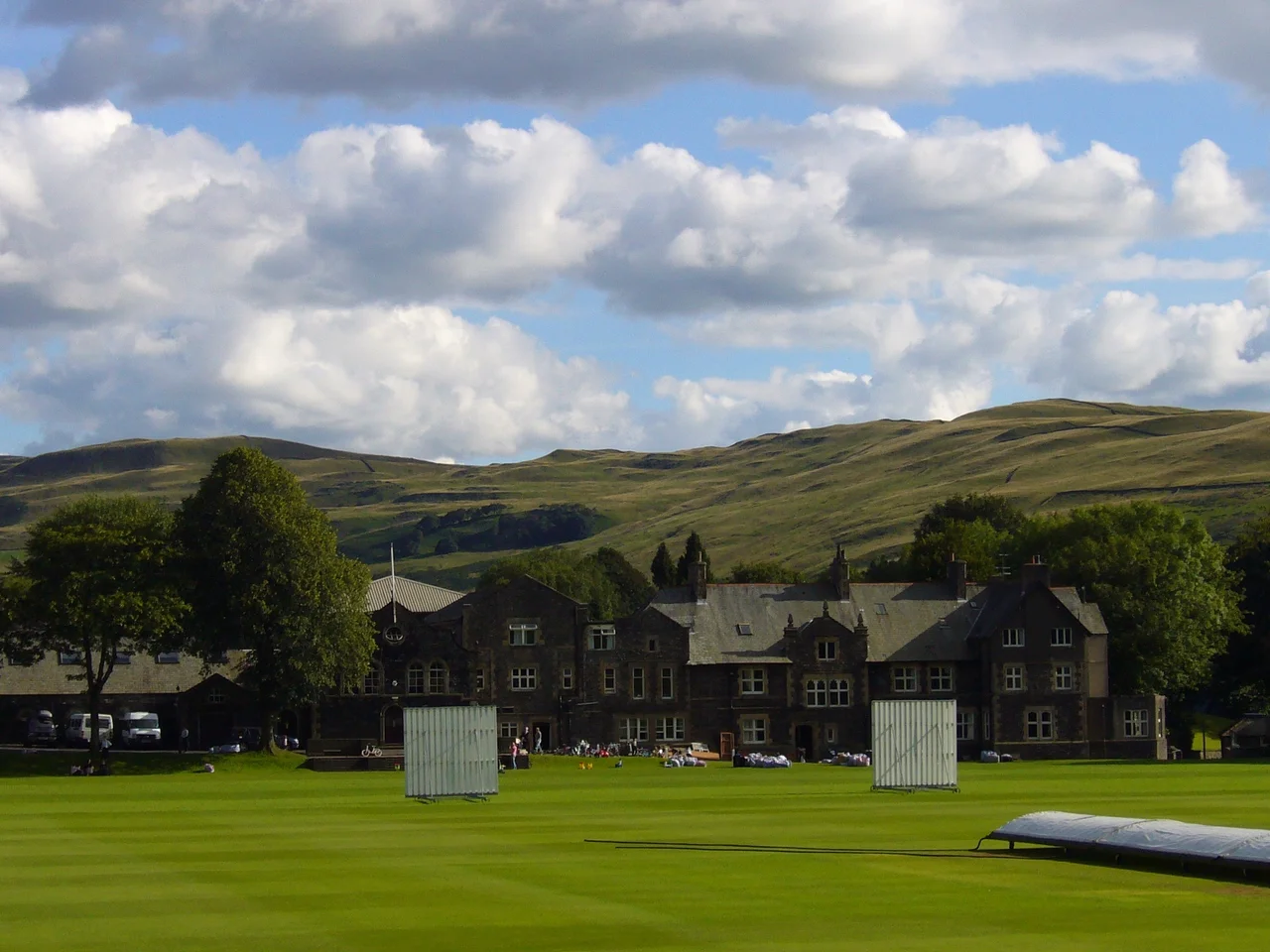

Sedbergh School
Stern Nurse of Men, the school motto declares - Dura Virum Nutrix in Latin, formalised under headmaster Henry George Hart in the late nineteenth century. The choice of words is deliberate. Sedbergh School sits in a Cumbrian market town at the western edge of the Yorkshire Dales, ringed by the Howgill Fells, and the school's defining tradition is a ten-mile run across those fells called the Wilson Run - one of the longest, hardest school races anywhere in Britain. Pupils have to qualify to enter it. The course has been cancelled exactly three times in over a century, twice for epidemic and once for snow. That is the kind of place this is. It was founded in 1525 by a Yorkshire-born Provost of Eton as a small chantry school, survived the Reformation through a single clever bequest, and grew slowly into one of the more distinctive of the English boarding schools.
Roger Lupton's Bequest
Roger Lupton was born at Cautley, in the parish of Sedbergh, in 1456. He climbed up through the Tudor church and ended his career as Provost of Eton, which gave him both wealth and the connections to direct it. In 1525 he provided for a chantry school in his home parish. By 1528 the land had been bought, a school built - probably on the site of the present library - and the foundation deed signed. The endowment was clever: Lupton attached to it numerous scholarships and fellowships to St John's College, Cambridge, with the condition that if any of the last four were left vacant for a year, the lands would revert to his next of kin. The condition tied Sedbergh's fate to St John's, and it almost certainly saved the school during the Chantries Act of 1546-48, when Henry VIII's commissioners dissolved most chantry foundations and seized their assets. Sedbergh re-emerged as a re-endowed grammar school in 1551 and has functioned in some form ever since.
The Long Recovery
The school's fortunes through the seventeenth and eighteenth centuries depended almost entirely on the character of the headmaster - a pattern common to small endowed schools across Britain. Numbers fluctuated wildly. Early in the nineteenth century total enrolment briefly fell to eight day boys. The recovery began under John Harrison Evans, headmaster from 1838 to 1861, who rebuilt both the school's reputation and parts of the town itself, funding the construction of the Market Hall and Reading Room. By 1857, the special link to St John's that had bound Sedbergh's scholars to one Cambridge college since Lupton's time was finally broken; the scholarships were reorganised. Sedbergh acquired a more independent governing body in 1874 - resisting a proposed amalgamation with Giggleswick School. The first meeting of the new governors took place at the Bull Inn in Sedbergh in December of that year.
Rugby, the Wilson Run, and the Modern School
Frederick Heppenstall's headship in the 1870s saw a tremendous burst of building: a Headmaster's House, classrooms, a chapel, four boarding houses. Henry George Hart took over in 1880 and presided over the construction of a new chapel in 1897, the inaugural Wilson Run, and the establishment of the prefectorial system and the school motto. The Wilson Run is the singular tradition. Named after Bernard Wilson, first housemaster of Sedgwick House, the race covers just over ten miles - of which around seven crosses open fell - and pupils must qualify over an eleven-mile training route to enter. In rugby Sedbergh has produced a remarkable string of England players: Wavell Wakefield, John Spencer, Will Carling, and the 2003 World Cup winner Will Greenwood. In November 2010 the school's unbeaten team was named School Team of the Year at the Aviva Daily Telegraph awards. Lancashire CCC has played County Championship matches on the school's main cricket ground. The atmosphere is rooted in the fells: the school song is named Winder after the hill that dominates the northern skyline, and tradition dictates that every pupil must climb it at least once.
The 1930 Inquest and What Came After
Sedbergh's history includes a moment of public reckoning that is worth marking. In 1930 an inquest into the death of a fourteen-year-old Sedbergh pupil concluded that the boy had taken his life because of his dislike of the school's fagging system - the institutionalised arrangement under which younger boys served as personal attendants to senior pupils. The jury returned a verdict of suicide and recommended that the practice be discontinued at public schools generally. The boy was named in the proceedings, but the wider point is that he was fourteen and had been pushed to the edge by a system the school had inherited unchallenged for centuries. Fagging persisted in many British public schools for decades more before it was finally abolished, and the 1930 inquest is one of the documented moments when the cost of that tradition became visible. Sedbergh, like the rest of its peers, has changed considerably since. The school became coeducational in 2001, merged with Casterton School in 2013, and now operates two campuses serving day and boarding pupils from age four through eighteen. Four old Sedberghians have been awarded the Victoria Cross. Their names are commemorated in the war cloisters, alongside masters and pupils killed in both world wars.
From the Air
Sedbergh School is located at approximately 54.32 degrees north, 2.53 degrees west, in the town of Sedbergh in eastern Cumbria. From altitude, look for the school buildings on the south side of the town, with the Howgill Fells rising immediately to the north - Winder, the school's symbolic hill, is the most prominent peak in the foreground. Best viewed from 2,500-3,500 feet AGL. Carlisle (EGNC) lies approximately 40 nautical miles north; Leeds Bradford (EGNM) is about 45 nautical miles southeast. The Howgills dominate the airspace north; the Yorkshire Dales open east; the M6 corridor runs roughly 8 nautical miles west.
Nearby Stories
- Hardknott Pass 2.1 km away
- Furness Abbey 2.3 km away
- Ireby 8 km away
- Cross Fell 10 km away
- Weardale Railway 11 km away
- Morecambe Bay Cockling Disaster 13 km away
- Bolton Castle 14 km away
- 1975 Dibbles Bridge Coach Crash 15 km away