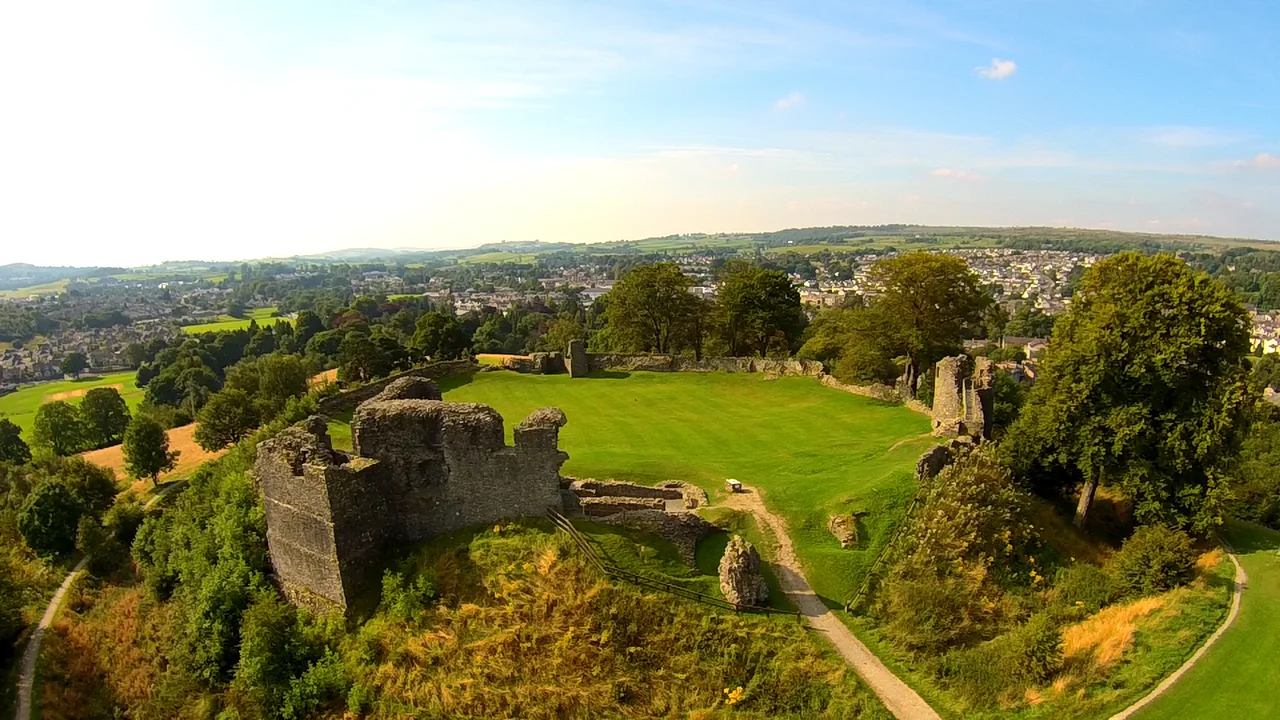

Kendal Castle
It sits on top of a drumlin - one of the smooth, elongated mounds that the last ice sheet pressed into the Lake District landscape - and from the walls of the surviving tower you can see why anyone with thirteenth-century power would have wanted to build here. The Kent valley spreads below you in three directions, Kendal pooled in the bottom, the western fells lifting toward Scout Scar and the Lakes. The Parr family lived here for generations. Their most famous descendant, Catherine Parr, became Henry VIII's sixth and final wife, the one who outlived him. For a long time it was believed that she had been born in the castle itself. Modern research has gently corrected that romance: by Catherine's birth in 1512, the castle was already crumbling, and her father preferred London. She was almost certainly born in Blackfriars. But Kendal Castle is still where the Parr fortune was rooted, and the ruin still stands above the town that bears their queen's name.
Two Castles, One Town
Kendal had two medieval castles. The earlier one, Castle Howe, was a Norman motte-and-bailey raised on the west side of the town shortly after the Conquest, when the settlement still went under the name Kirkbie Strickland. By the late twelfth century - probably in the 1180s or 1190s - the Lancaster family, Barons of Kendal, decided that the earthworks were no longer adequate. They built a new castle on the drumlin to the east of town, the high stone fortress whose ruins remain. The earliest documentary reference to a castle at Kendal occurs in 1216 and might refer to either site. What you see today is the stone castle: roughly circular within an 85-foot-wide ditch, three mural towers spaced unevenly around the curtain wall, a gatehouse on the north side, and a hall to the east of the entrance built in the fourteenth century. Castle Howe survives only as earthworks on the other side of the river.
The Parr Inheritance
Sir William Parr married Elizabeth Ros, heiress of the Barony of Kendal, during the reign of Edward III in the mid-fourteenth century. The marriage brought the castle into a family that would, over the next century and a half, push steadily upward into the orbit of the Tudor court. Sir William Parr who died in 1483 - Catherine's grandfather - seems to have been the last of the Parrs actually to live at Kendal Castle. By then, the family's interests were almost entirely in London. Catherine's father Sir Thomas Parr served as a courtier to Henry VIII early in his reign and lived in Blackfriars. Catherine became maid of honour to Princess Mary, married twice as a young widow, and in 1543 became queen at thirty-one. She survived Henry by outliving him in 1547 - the only one of his six wives to do so. The Parr properties, including Kendal Castle, were confiscated by the Crown in 1566 after the family fell out of royal favour.
Keats on the Walls
Poet John Keats visited the ruins in the summer of 1818, in the middle of his walking tour of the Lakes with his friend Charles Brown. The two had stayed the previous night at Endmoor, walked up to Kendal, climbed the drumlin to see the castle, and then continued on to Windermere. Keats was twenty-two. He had less than three years to live - he would die in Rome in February 1821 - but he was walking hard and writing furiously through that summer, working out the rhythms that would produce the great odes the following year. The Wordsworth circle had made the Lake District a literary destination by then. Keats's visit to Kendal Castle, brief as it was, marks a moment when the Romantic generation was actively gathering the landscape into English poetry.
Excavation and Survival
Serious investigation of the castle began surprisingly recently. A small excavation led by J. E. Spence and involving pupils from nearby Heversham Grammar School was carried out on the site of the gatehouse in 1951. Barbara Harbottle - one of the leading medieval archaeologists of her generation - led more substantial excavations in 1967-69 and again in 1971. A geophysical survey in 2001 identified a possible further ditch. The site is open to the public and is now maintained by Westmorland and Furness Council, the new unitary authority that was created on 1 April 2023 from the merger of South Lakeland, Eden and Barrow with Cumbria County Council. The ruins are free to visit, the climb is short, and the view across Kendal to the Lakeland fells is one of the best in the town - much as it must have looked to a Parr standing here in 1450, watching the smoke rise from the cloth-workers' yards below.
From the Air
Kendal Castle sits at 54.32 degrees north, 2.74 degrees west, on a drumlin immediately east of Kendal town centre in Cumbria. The ruins crown a distinctive whaleback hill rising about 40 metres above the surrounding valley - prominent from the air. Best viewed from 2,000-2,500 feet AGL. Carlisle (EGNC) lies approximately 50 nautical miles north; Blackpool (EGNH) is about 40 nautical miles south. The Lake District National Park rises to the west and northwest; the Howgill Fells lift to the east; Morecambe Bay opens to the southwest.
Nearby Stories
- Hardknott Pass 2.1 km away
- Furness Abbey 2.3 km away
- Ireby 8 km away
- Cross Fell 10 km away
- Weardale Railway 11 km away
- Morecambe Bay Cockling Disaster 13 km away
- Bolton Castle 14 km away
- 1975 Dibbles Bridge Coach Crash 15 km away