
Hoylake Lifeboat Station
On 16 September 1803, the Liverpool Dock Trustees ordered that a Greathead-built lifeboat be stationed at Hoylake on the north Wirral shore, watching over the treacherous sands of the Hoyle Bank where the Mersey approaches dump their wrecks. That date matters. The Royal National Lifeboat Institution would not be founded for another twenty-one years, and most of the famous Victorian lifeboat traditions had yet to begin. Hoylake's station predates them all - one of the oldest continuous lifeboat services anywhere in the British Isles, run for its first ninety-one years by a port authority rather than a charity, and transferred to the RNLI only in 1894.
Trustees and Pilots
The Dock Trustees operated six stations around the Mersey approaches in those first years - Hoylake was one of them. They bought the boat from Henry Greathead, the South Shields boatbuilder whose 1789 design had created the British lifeboat tradition, and they housed it in a new wooden boathouse on the Hoylake shore. The first coxswain was Thomas Seed, who doubled as keeper of the Lower Lighthouse. When Seed died in 1808, the trustees appointed Joseph Bennett - already an experienced Liverpool pilot - on a salary of forty guineas. Pilots and lifeboatmen, lighthouse keepers and rescuers, were often the same men in the early nineteenth century. They lived on the same exposed coast, watched the same approaches, and knew the same banks under the same weather.
The Traveller, 1810
On 29 December 1810, the Hoylake boat launched into enormous waves to aid the ship Traveller, returning from Demerara on her way into Liverpool when she was driven ashore on the Hoyle Bank. The lifeboat rowed out through the surf. Somewhere on the approach she capsized. Eight crewmen drowned. A memorial outside the present station carries their names, the first entry in a roll of honour that still reaches forward into the twentieth century. After the Athebaska wreck in 1838 - when neither Hoylake nor the lifeboat from Magazine Village could reach the casualty in time, and all aboard were lost - the trustees commissioned a No. 2 boat from local builder Thomas Costain, designed specifically for Hoylake conditions. The crew liked it so much they asked for a second, which arrived in 1841.
Lost in Service
Edward Lilley, shore crew, died on 6 September 1899 after a blow to the head from the winch handle as the crew recovered the lifeboat Admiral Briggs following service to the fishing boat Sarah Ann. He was thirty. John Isaac Roberts, twenty-three, was washed overboard from the Hannah Fawsett Bennett on 15 November 1906 while assisting the Runcorn sloop Swift. Their names are inscribed at the station alongside the eight men of 1810. Hoylake has also accumulated a long list of decorations: Silver Medals to George Davies in 1851 and Thomas Dodd in 1902, a Bronze Medal to Herbert Jones in 1943 and to a full set of crew after the dramatic rescues of 1980, an MBE to David Arthur Dodd in 1998 and a British Empire Medal to David Anthony Whiteley in 2016.
Hoyle Bank, Edmund Hawthorne Micklewood
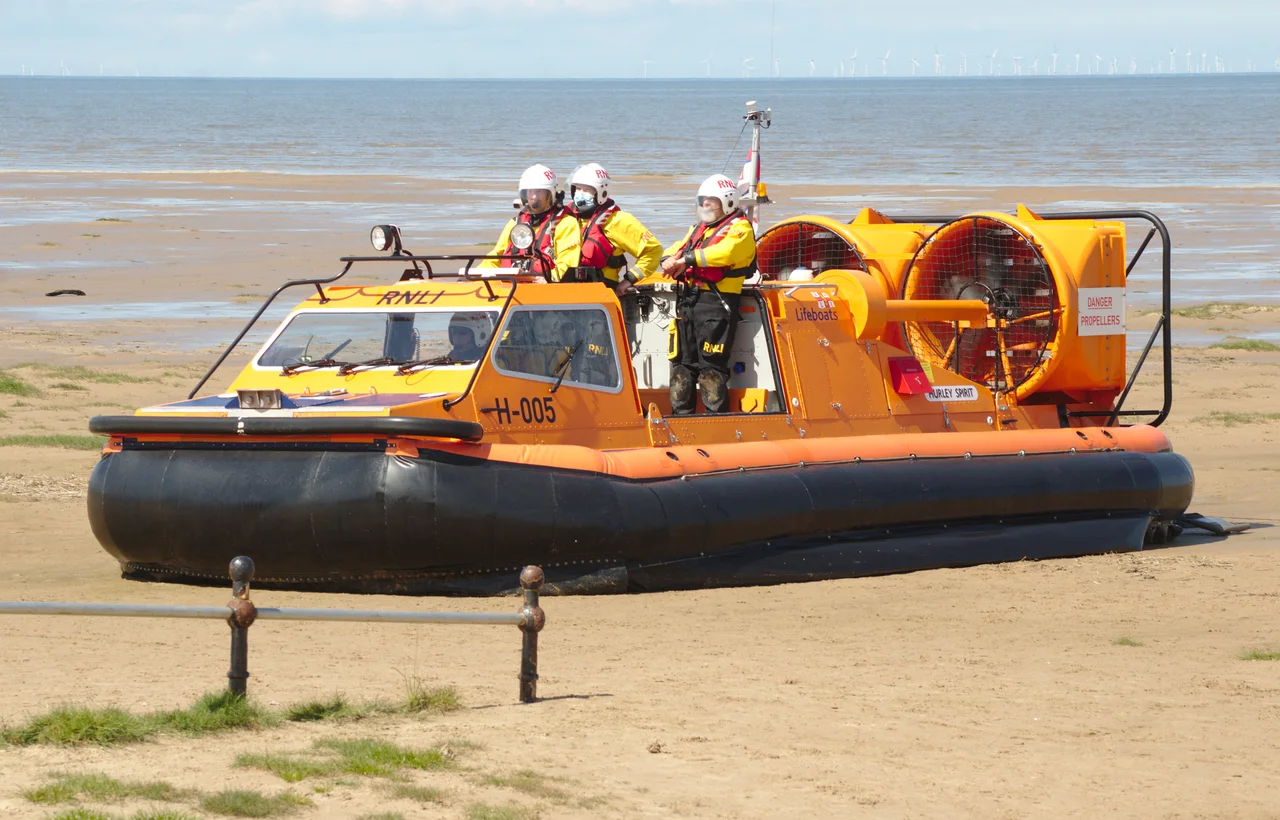
Hoylake today operates the all-weather lifeboat 13-06 Edmund Hawthorne Micklewood, a Shannon-class boat placed on service in December 2014, along with the H-class hovercraft Hurley Spirit. The hovercraft matters here because of the geography. The Hoyle Bank and the Dee mudflats expose miles of soft sand at low water, and conventional lifeboats simply cannot reach casualties stranded on the drying flats. The hovercraft can. It skims over wet sand, water, and mud alike, and several Wirral and Merseyside stations rely on the same capability. Launches at Hoylake still go down the beach by tractor - the all-weather boat carried out by a launching carriage across the open sand of North Parade, the same shoreline the Greathead boat used in 1803.
Two Centuries on North Parade
The current station building sits on the North Parade promenade where lifeboats have been launched for more than two hundred years. The old wooden boathouse of 1803 is long gone, replaced in stages through the nineteenth and twentieth centuries as boats grew larger and launch carriages heavier. The memorial outside lists the men of the Traveller and the later casualties. The crews still come from Hoylake and the neighbouring Wirral towns - many descend from earlier generations of the station, names like Dodd and Jones recurring across decades of awards and rolls. Two centuries of muster, two centuries of launching into the same shifting sands at the mouth of the same dangerous estuary, and the boat still goes when the pager sounds.
From the Air
Hoylake Lifeboat Station stands at 53.399°N, 3.177°W on the north shore of the Wirral Peninsula, facing the Irish Sea across the wide sands of Hoyle Bank. Best viewed at 1,000-2,000 feet AGL, with the long beach and the offshore sandbanks visible at low tide. Nearest airports are Liverpool John Lennon (EGGP) 12 nm east-south-east, Hawarden (EGNR) 15 nm south, and Manchester (EGCC) 35 nm east. The Mersey estuary lies to the east; Hilbre Island and the Dee estuary lie to the south-west, with West Kirby on the Dee side of the peninsula.
Nearby Stories
- Dolwyddelan Castle 4.6 km away
- Silver Jubilee Bridge 5 km away
- PS Rothsay Castle 11 km away
- Horseshoe Pass 12 km away
- Battle of Bamber Bridge 16 km away
- Combermere Abbey 17 km away
- Birkdale Palace Hotel 21 km away
- Celtic Array 40 km away