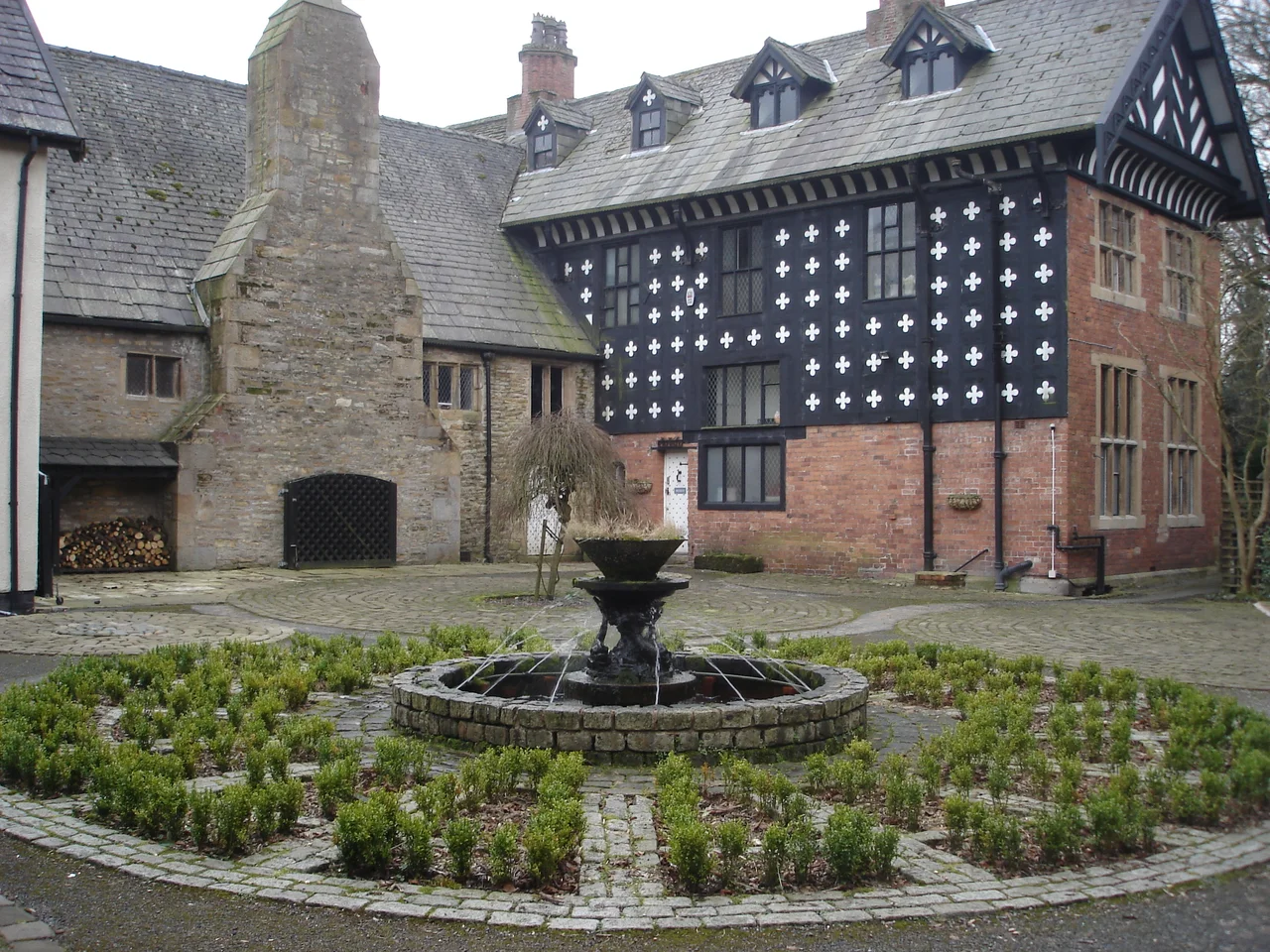

Samlesbury Hall
In 1322 a Scottish army crossed the border under Robert the Bruce's lieutenants and burned its way south through Lancashire. The Great Raid devastated everything in its path. Three years later, a knight named Gilbert de Southworth started building a new manor house six miles east of Preston, possibly to replace something the raiders had taken. He was 55 years old by the standards of the day, married into the d'Ewyas family who already held half the manor, and apparently determined to put up something that would last. Seven hundred years later, his Great Hall is still standing — having survived being stripped for parts, run as a coaching inn, taught a Pestalozzian girls' school, sat empty for sixteen years, and been bought by builders who planned to knock it down for the timber.
Built After the Burning
Gilbert de Southworth of Warrington married Alice d'Ewyas and acquired half of Samlesbury manor with her hand. He is credited with building the Great Hall around 1325. The d'Ewyas family had held the land before him; Gilbert's contribution was to put up the timber-framed centrepiece that still defines the place. His great-grandson Thomas added the south-west wing later. The chapel came around 1465, and a connecting structure linked it to the main hall about 1525 — by which point the sun had drifted in the sky enough that the alignment was less than a right angle. Manor houses needed certain things to count as manors: a household of servants, a chapel and a priest, a fishpond for Fridays, a mill, a grain store. Samlesbury accumulated all of them across two centuries of Southworth tenure.
Catholics and Crisis
The Southworths held Samlesbury until 1677, when Edward Southworth sold to Thomas Bradyll. The family had been notorious recusants, refusing to abandon Catholicism through the centuries of post-Reformation persecution. Jane Southworth was one of the women tried in 1612 as a Samlesbury witch — the cases that ran parallel to the better-known Pendle witch trials. Her co-accused were convicted but Jane was acquitted; the case against her had been organised by a Catholic priest hoping to discredit her Protestant family connections, and the judge saw through it. John Southworth, born at the Hall in 1592, became a priest and was hanged, drawn and quartered at Tyburn in 1654 for the offence of being a Catholic clergyman during the Commonwealth. He was canonised in 1970 as one of the Forty Martyrs of England and Wales. His preserved remains are kept at Westminster Cathedral.
The Bradyll Years and the Bradyll Arms
Thomas Bradyll never lived at Samlesbury. He stripped what he wanted of its interior fittings to use at his main residence at Conishead Priory on the Furness coast, then rented the building out to handloom weavers. In 1830 the hall was converted into a coaching inn called the Bradyll Arms — a medieval Great Hall serving beer to travellers between Preston and Blackburn. By 1850 the next owner, John Cooper, had leased it to Mary Ann Harrison as a co-educational boarding school. She established a Pestalozzian Institution there, following the methods of the Swiss educational reformer Johann Heinrich Pestalozzi: learn by doing, child-centred teaching, no rote memorisation. It anticipated Maria Montessori's better-known approach by about fifty years. The boys and girls of mid-Victorian Lancashire learned reading, writing and natural science in a building built before the Black Death.
Saved From the Wreckers
Joseph Harrison, a prosperous Blackburn industrialist, bought the hall in November 1862 and substantially renovated it. His eldest son William lived there until January 1879, when a fall on the ice gave him brain and leg injuries that produced severe depression. He took his own life later that year. His father Joseph died fifteen months later. Ownership passed to a younger son, Henry, mayor of Blackburn in 1880-81, who lived in town. The hall passed to tenants and then in 1909 fell empty. It stayed empty for sixteen years. In 1924 a building firm bought it intending to demolish it and use the timber for a housing estate. A public subscription was raised. In 1925 the hall was purchased back and placed in the hands of the newly formed Samlesbury Hall Trust, which has managed it ever since.
A Working Medieval House
Today, Samlesbury Hall is Grade I listed and welcomes more than 50,000 visitors a year. It is open daily except Saturdays, when it is often booked for weddings and private events. The Great Hall, the chapel, the long gallery and the gardens are all accessible. The chapel still faces approximately east, as a chapel had to, but the connection to the main hall sits at the imperfect angle that gives away the 140-year gap between their construction. The kitchen serves Lancashire-grown produce. The grounds include a tearoom in a wooden barn, a craft centre, and the sort of low-key honey-from-the-bees, pies-from-the-farmer commerce that keeps small heritage trusts solvent. A nineteen-stone speedboat called Bluebird K7, which broke world water-speed records before crashing on Coniston in 1967 and killing Donald Campbell, was built nearby; the Samlesbury connection is one of many in the area.
From the Air
Samlesbury Hall is six miles east of central Preston at 53.7695N, 2.5727W, on the A677 road between Preston and Blackburn. The hall is a black-and-white half-timbered structure with formal gardens, visible from low altitude. Nearest airports: Warton (EGNO) 12 nm west, Blackpool (EGNH) 18 nm west, Manchester (EGCC) 23 nm south. M6 motorway 4 nm west; M65 starts 2 nm east. River Ribble winds north of the site through Samlesbury Bottoms. Best viewing altitude 1,500-3,000 ft.
Nearby Stories
- Winwick rail crash 1.4 km away
- Hoylake Lifeboat Station 4.4 km away
- Murder of Lindsay Rimer 7 km away
- Mellor Mill 7 km away
- Embsay and Bolton Abbey Steam Railway 7.8 km away
- Piel Castle 11 km away
- Ashton Memorial 13 km away
- Hoylake 35 km away