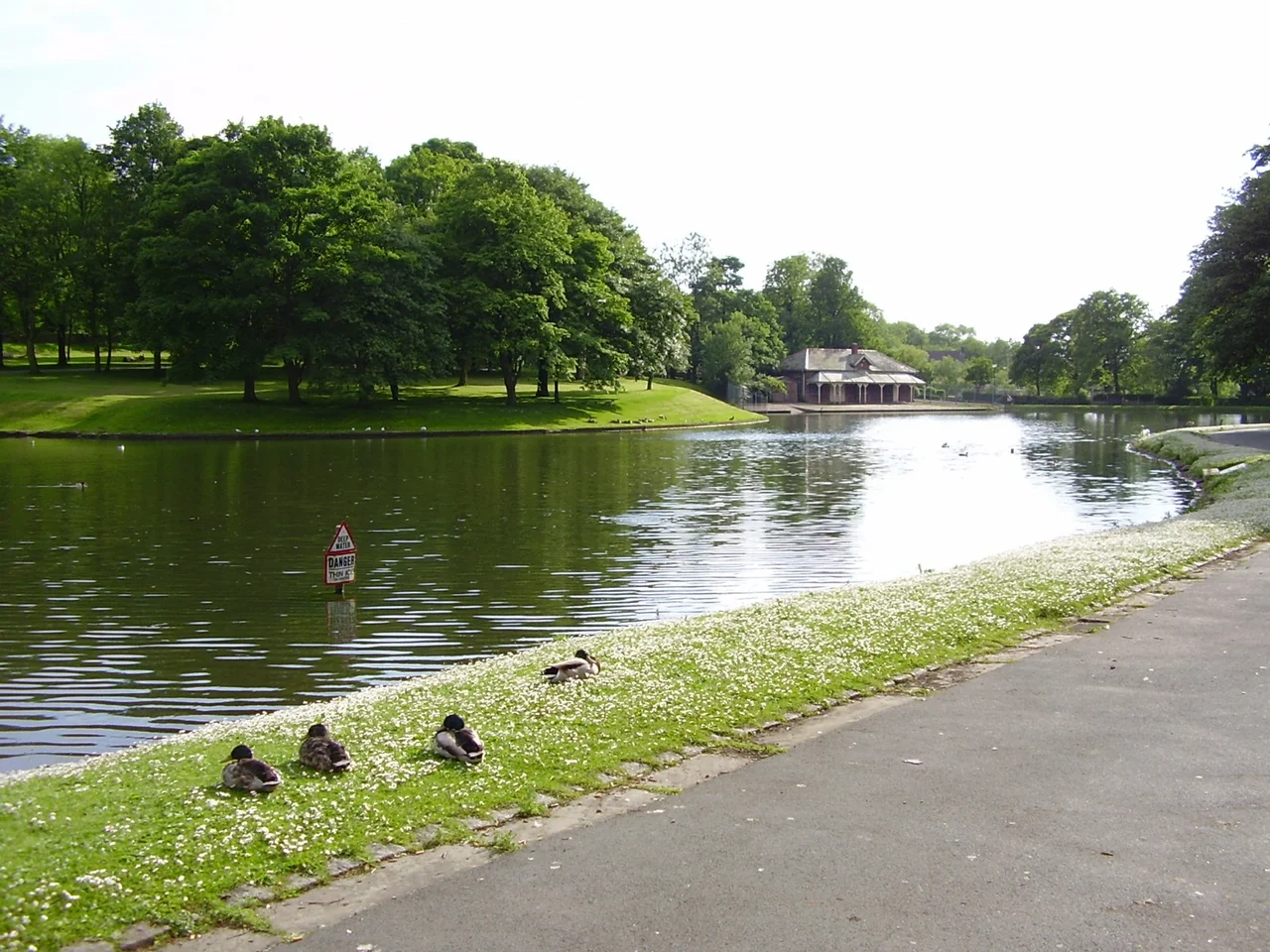

Blackburn
In 1907 there were 79,405 looms running in Blackburn. By 1976 there were 2,100. Almost no other British town can show that arc as starkly: a place that grew from fewer than 5,000 people in 1750 to 130,000 by 1900, that called itself the weaving capital of the world, and then watched the cotton trade leave for India and Lancashire's mill towns leave for nothing for the next six decades. Modern Blackburn, a unitary authority of 154,922 people now sharing its borough with neighbouring Darwen, is what happens when a one-industry town outlives the industry. The motto granted in 1852 to the borough is Arte et Labore. By skill and by labour. Both still apply.
Black Burn
The name probably means what it sounds like. The River Blakewater runs through the centre of town, and an Old English burn means stream; black burn becomes Blackburn. The town shows up as Blacheburne in the Domesday Book of 1086 and as Blakeburneshyre as the name of the wider district. There is little evidence of prehistoric settlement in the Blakewater valley itself, though Bronze Age urn burials have been found in the hills around the town. There was a Roman military road, linking Bremetennacum (Ribchester) to the major fort at Mamucium (Manchester) running just east of the modern town centre, and an inscribed Roman stone dedicating a temple to Serapis was dug up at All Hallows Spring on Railway Road in 1654. The Christian record goes back to 596 AD, when the area's church was first noted in the Anglo-Saxon missions to Northumbria.
The Weaving Capital
Cotton arrived in Blackburn as a cottage industry, paid by the piece, with handloom weavers working in their own houses. After 1775 spinning mills started to be built; the first purpose-built spinning mill went up in 1797 and by 1824 there were twenty-four. The town's most famous local invention was the spinning jenny of 1767, made by James Hargreaves, who lived in nearby Oswaldtwistle. The railway arrived in 1846. Power looms took over from handlooms in the mills, and between 1850 and 1870 sixty-eight weaving-only mills and four combined mills were built. The 1826 Power-Loom Riots, when unemployed handloom weavers destroyed 212 looms at Jubilee Factory in 35 minutes and another 25 at the Houghton mill the same afternoon, marked the violent passage from one technology to the next. By 1870 the town held 2.5 million spindles. By 1890 the Chamber of Commerce was warning Blackburn against having only one string to its bow.
The Long Decline
The warning was prescient. In 1904 the cotton trade slumped and so did engineering, brewing and building. By 1908 another slump idled a quarter of Blackburn's looms. The First World War cut off Indian trade and the Indian government raised tariffs after the war; by 1922 forty-seven mills were stopped and 43,000 looms lay idle. Foundry and Limbrick Mills became the first permanent closures. Twenty-six more mills closed between 1930 and 1934. The post-war boom of 1948 to 1950 brought new automatic looms that allowed one weaver to control twenty or twenty-five looms; the boom did not last. By 1960 only thirty mills were still operating. By 1975, after the closure of Albion and Alston mills cost 400 jobs, the number of textile workers had fallen to 6,000. The town that had spun its identity into cotton thread for two hundred years had to learn how to be something else.
A Town Reinvented
Modern Blackburn is a mixed place. The 2011 census recorded the wider borough of Blackburn with Darwen at 150,030 people, with about 30 per cent of the town's population identifying as something other than white British. A significant Muslim community, largely with roots in the Indian subcontinent, settled the town through the second half of the twentieth century and now sits alongside the town's older Christian and post-industrial working-class communities. In 2015 the Scottish designer Patrick Grant rescued Cookson and Clegg, a Blackburn factory founded in 1860 that was facing closure, and launched Community Clothing the following year to put work back into British mills. The first British Textile Biennial was held in Blackburn in 2019. The 2021 Blackburn Master Plan, a £250 million revitalisation programme aiming at 500 new homes and 1,000 new jobs, was followed by £200 million in government, council and private investment announced in 2022 for the town centres of Blackburn and Darwen.
What the Hills See
Geographically, Blackburn is hill country. The town sits at 401 feet above sea level in a plain ringed by hills. Revidge to the north climbs to 715 feet. Billinge Hill to the west, in Witton Country Park, reaches 804 feet. The Royal Blackburn Hospital stands at 663 feet on the east side of town. The underlying rock is Coal Measures and Millstone Grit, the same gritstone that has been quarried for centuries for millstones, building stone and road surfaces. The Pennine glaciers of the last ice age covered most of the area with boulder clay and outwash gravel. The Ribble Valley lies north, the West Pennine Moors south, and the town centre, between them, has always taken its weather from whichever direction the Atlantic happened to push it. Daniel Thwaites founded his brewery here in 1807. The company is still operating, now headquartered at Sykes Holt in Mellor. Some things in Blackburn do not move.
From the Air
Located at 53.745N, 2.477W in East Lancashire, about 9 nm east of Preston and 21 nm north-northeast of Manchester. Manchester Airport (EGCC) lies 23 nm to the south-southeast and Blackpool (EGNH) 24 nm to the west. At 2,500 to 3,000 ft AGL, look for the M65 motorway running east-west through the town, the M6 spur three miles north of the centre, and the chimneys (most now decorative) of the surviving Victorian mills. Witton Country Park's wooded ridge sits west of the town centre. The Pennines rise to the east. Lancashire weather: frequent overcast, low ceilings, southwesterly winds and steady light rain are common.
Nearby Stories
- Winwick rail crash 1.4 km away
- Hoylake Lifeboat Station 4.4 km away
- Murder of Lindsay Rimer 7 km away
- Mellor Mill 7 km away
- Embsay and Bolton Abbey Steam Railway 7.8 km away
- Piel Castle 11 km away
- Ashton Memorial 13 km away
- Hoylake 35 km away