.JPG)
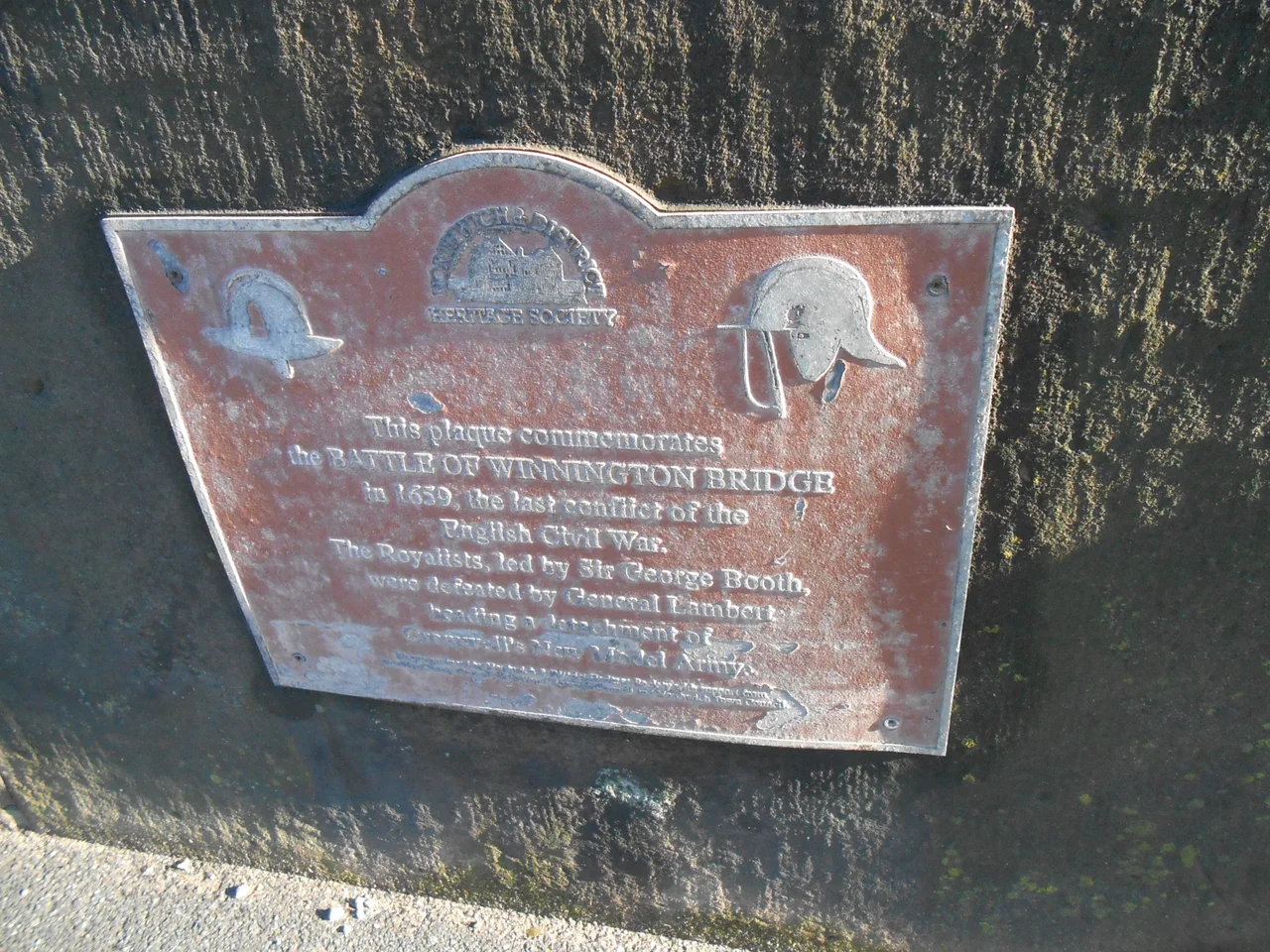
Battle of Winnington Bridge
Sir George Booth had brought four thousand men to Cheshire to restore the king, and on the morning of 19 August 1659 he watched them break apart on the slopes above the River Weaver. The pikes that did not work, the powder he had left behind in Chester, the cavalry that one observer said "trotted away, which is the civilest term" - none of it ended in a heroic last stand. It ended in a single hour, in a single fatality on the Parliamentary side, and in the quiet capitulation of a rebellion that had wanted to bring Charles II home from exile. Historians call Winnington Bridge the last battle of the English Civil War. The label is generous. What happened here was less a battle than the moment the long argument finally went hoarse.
The Rebellion That Almost Wasn't
By 1659 the Commonwealth of England was visibly disintegrating. Oliver Cromwell had been dead for less than a year, his son Richard had resigned the Protectorate in May, and the political vacuum invited conspiracies on every side. A national Royalist plot took shape under John Mordaunt, 1st Viscount Mordaunt, designed to coordinate risings across the country and bring Charles II back from exile. The national plan collapsed almost immediately. Only Sir George Booth, mustering his men at Warrington on 1 August, managed any local success. Booth had been a Parliamentary colonel during the First Civil War, and the irony was not lost on his contemporaries: the man now leading a Royalist rebellion had spent his earlier career fighting against the cause he now embraced. He seized Chester, attracted three to four thousand followers, and watched Liverpool and parts of north-east Wales declare for the king.
Lambert's March
Parliament moved fast. General John Lambert, one of the most capable commanders of the New Model Army, left London on 6 August following two infantry regiments that had set out the day before. By the 10th he had reached Coventry. On the 14th his infantry met cavalry at Market Drayton, and by the 15th the main army was at Nantwich. Robert Lilburne was driving south through Lancashire. A 1,500-man brigade under Jerome Sankey was ordered to sail from Dublin to Beaumaris and lock down the western flank. Booth, realising he was isolated, began negotiating with Lambert while simultaneously trying to withdraw to the safety of Chester. He did neither thing well. On 18 August Lambert's rapid advance pinned the rebels against the edge of Delamere Forest, and only a hasty retreat ordered by Roger Whitley prevented them from being overrun. That night the two armies slept within striking distance of each other: Lambert at Weaverham, Booth a few miles east at Northwich.
An Hour at the Bridge
On the morning of 19 August Booth's rebels had drawn up north of the River Weaver, holding the bridge at Winnington and placing additional skirmishers on its approaches. The main body sat on high ground protected by steep slopes and a ditch at the base of the hill. Lambert attacked aggressively from Hartford, driving in the outposts and pushing his foot to the bridge itself. Hewson's regiment crossed against almost no resistance. Mordaunt, who was not present, later wrote that Booth's infantry was a shambles: "some had no match, others no ball," and most of the powder had been left in Chester "by an absurd mistake." Much of the rebel infantry, commanded by Sir Edward Broughton of Marchwiel, fled into enclosed fields where Lambert's exhausted foot soldiers could not pursue and where hedges sheltered them from cavalry. With the bridge taken, Lambert pushed his cavalry up the narrow lanes toward Booth's main force. The rebel cavalry broke after the briefest of skirmishes.
Forced and Hired
Two men of note died. Captain Edward Morgan of Golden Grove, Flintshire, was killed covering the retreat, and Thomas Legh, the younger brother of Piers Legh of Bruche, also fell. Lambert reported a single fatality on his side and around thirty rebel casualties. Two hundred prisoners were taken and held overnight in Northwich church. The most quoted line of the day belongs to Lambert himself, who declined to pursue the fleeing infantry with the dismissive observation: "alas, these are forced and hired." Lambert thought they had been conscripted or paid into a cause not their own, and he saw no glory in killing such men. Whether he was right or merely magnanimous, his judgement was politically shrewd. Chester opened its gates on 21 August. Liverpool surrendered shortly after. Within a week the rest of Cheshire and Lancashire was back in Commonwealth hands. Booth tried to escape disguised as a woman and was arrested; he was eventually pardoned. The Commonwealth itself collapsed nine months later, and Charles II came home not by force but by invitation. The Restoration arrived in 1660 without firing another shot. Winnington Bridge, then, was the last battle of a war that the country no longer wanted to fight.
From the Air
Located at 53.27°N, 2.54°W on the River Weaver, just west of Northwich in Cheshire. From the air, look for the bend in the river where Winnington meets Hartford, north of the modern A533. The wooded slopes above the river where Booth deployed are still recognizable, though much of the surrounding land is now residential and industrial (including the Brunner Mond/Tata Chemicals complex). Recommended altitude 2,000–3,500 ft for tactical understanding of the terrain. Nearest airports: Manchester (EGCC) 13 nm east-northeast, Liverpool (EGGP) 20 nm west-northwest, Hawarden (EGNR) 22 nm southwest. Best viewing in low afternoon sun when the slope into the river is shadowed.
Nearby Stories
- Anson Engine Museum 1.3 km away
- West Kirby 2.9 km away
- Battle of Nantwich 6.2 km away
- Winter Hill Air Disaster 8.3 km away
- Horseshoe Pass 8.8 km away
- Caverswall Castle 12 km away
- Murder of Lindsay Rimer 15 km away
- Piel Castle 50 km away