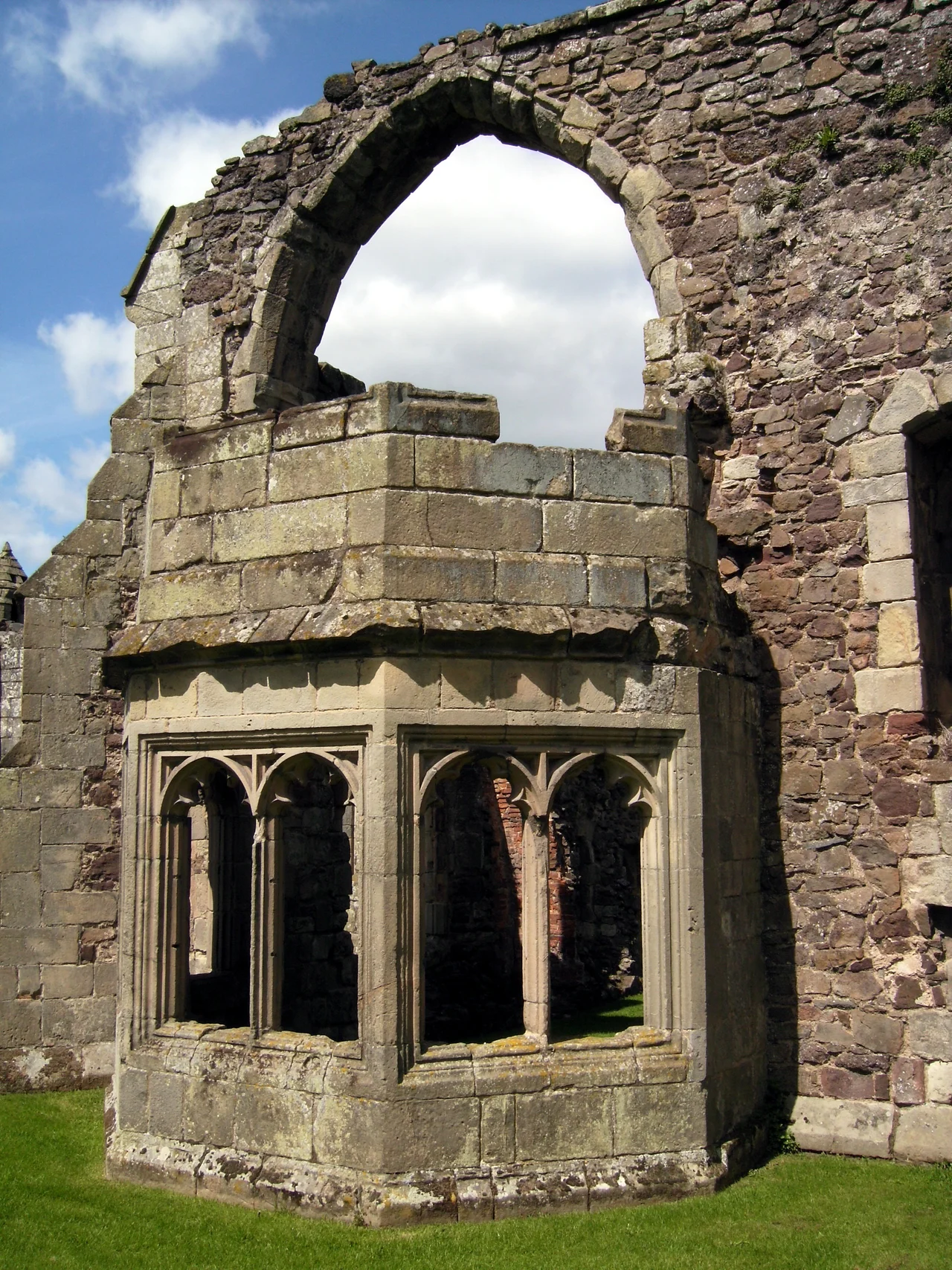

Haughmond Abbey
When the first Augustinian canons settled at Haughmond - probably some time in the late eleventh or early twelfth century - they did so on the slope of a small wooded ridge a few miles east of Shrewsbury. They built modestly at first, perhaps as a hermit community gathered around an early prior named Fulk. The site offered exactly what an Augustinian house needed: enough land for a small farm, fresh water from a stream below the ridge, and a powerful local patron prepared to defend their interests in court. The patron was Alan FitzFlaad, founder of the FitzAlan dynasty, and his successors as earls of Arundel would protect the abbey through four centuries of fortune and disaster.
FitzAlan Country
Alan FitzFlaad arrived in England through Henry I's military retinue and built his Shropshire estates around the lands of the dispossessed sheriff Rainald de Bailleul. His son William FitzAlan took up the patronage of Haughmond and granted a fishery at Preston Boats - on the Severn about three kilometres south of the abbey - some time around 1135. By the time of William's grandson, the FitzAlans were earls of Arundel, marcher lords with castles at Clun and Oswestry, kingmakers in the wars on the Welsh frontier. They funnelled gifts to Haughmond throughout the twelfth and thirteenth centuries: land, mills, tithes, advowsons. Wroxeter church, with its old Roman city ruins, was given to the abbey in 1155. In return the canons prayed for the FitzAlans, buried them in their church, and quietly accumulated one of the largest monastic estates in the West Midlands.
The Empress and the Charter
William FitzAlan picked the wrong side at the wrong time. When civil war broke out between King Stephen and Empress Matilda in 1138, FitzAlan held Shrewsbury Castle for Matilda. Stephen besieged it, took it, and hanged the surviving garrison. FitzAlan fled into exile. He was not back in his Shropshire lands until 1153 or 1155 - after Matilda's son, the future Henry II, had effectively won the war. During those years Matilda confirmed grants to Haughmond, probably from Oxford in the summer of 1141. The abbey, with its usual prudence, also obtained Stephen's confirmation of the same lands. By 1153 a third confirmation came from Henry himself at Leicester. The strategy of triple confirmation was followed by other Shropshire houses too. It worked. Whichever side won the war, Haughmond's title to its estates would be unimpeachable.
What the Canons Built
Construction in the late twelfth and thirteenth centuries gave Haughmond a substantial complex: an aisled church about 60 metres long, a cloister to the south, a chapter house, refectory, and abbot's lodging. Much of the church has gone - only its outlines and fragments of the west front remain - but the domestic buildings to the south of the cloister survive remarkably intact. The abbot's lodging in particular is one of the best preserved monastic residences in England, with a grand hall, private chambers, and a fine timber roof. The chapter house has a beautiful late Norman doorway with three orders of zigzag moulding, and inside it are statues of saints carved into the arches. A statue of St John the Evangelist - the abbey's patron, whose image appeared on its great seal - watches from one of the niches.
The Dissolution and After
Haughmond was dissolved in September 1539 - one of the larger Shropshire monasteries to fall in the second wave of Cromwell's suppression. The abbot, John Smarte, signed the surrender. The site was granted to Sir Edward Littleton, then sold to Sir Rowland Hill, the Lord Mayor of London, in 1545. Hill's family converted the abbot's lodgings into a country house - a fairly normal fate for surviving monastic buildings - and the abbey remained a private residence into the seventeenth century. During the Civil War the house was held for Parliament, attacked by Royalists, and largely destroyed by fire around 1645. The ruins were then quietly raided for building stone for centuries. In 1933 they were placed in the care of the state, and they are now an English Heritage site, open free of charge throughout the year.
Visiting the Ruins
Stand in the cloister garth on a summer evening and the place quiets to almost nothing - the click of jackdaws on the broken church wall, the wind in the old yew trees, the distant rumble of a tractor in a field. The ridge behind shelters the site from the prevailing westerlies. The original twelfth-century church was a working monastery for four hundred years; the seventeenth-century country house added on top of it lasted another hundred and twenty. Then came two centuries of stone-robbing and weeds. What is left is a kind of stratified ruin - medieval Augustinian here, Jacobean fireplace there, eighteenth-century cottage round the back. A small visitor centre staffed by volunteers tells the story. Most visitors come for an hour. The site catches the late light beautifully. It is one of the quiet pleasures of the Shrewsbury countryside.
From the Air
Haughmond Abbey ruins lie at 52.733°N, 2.680°W, about 6 km east-northeast of Shrewsbury, on the gentle western slope of Haughmond Hill. The site is approached by minor roads off the B5062 Shrewsbury-Newport road. Visible from the air as a complex of low ruined walls and an English Heritage car park on the edge of mixed woodland. Nearest airfields are RAF Shawbury (EGOS) 7 km north, Wolverhampton Halfpenny Green (EGBO) 33 km southeast, and RAF Cosford (EGOC) 28 km east. The Wrekin (407 m) lies 13 km southeast as a prominent visual reference.
Nearby Stories
- Ludlow 5.7 km away
- Llangollen 6.7 km away
- Murder of Shawn Seesahai 8 km away
- Avoncroft Museum of Historic Buildings 8.1 km away
- Caverswall Castle 8.4 km away
- Combermere Abbey 9.4 km away
- Battle of Maes Moydog 11 km away
- Cwmhir Abbey 16 km away