
Builth Castle
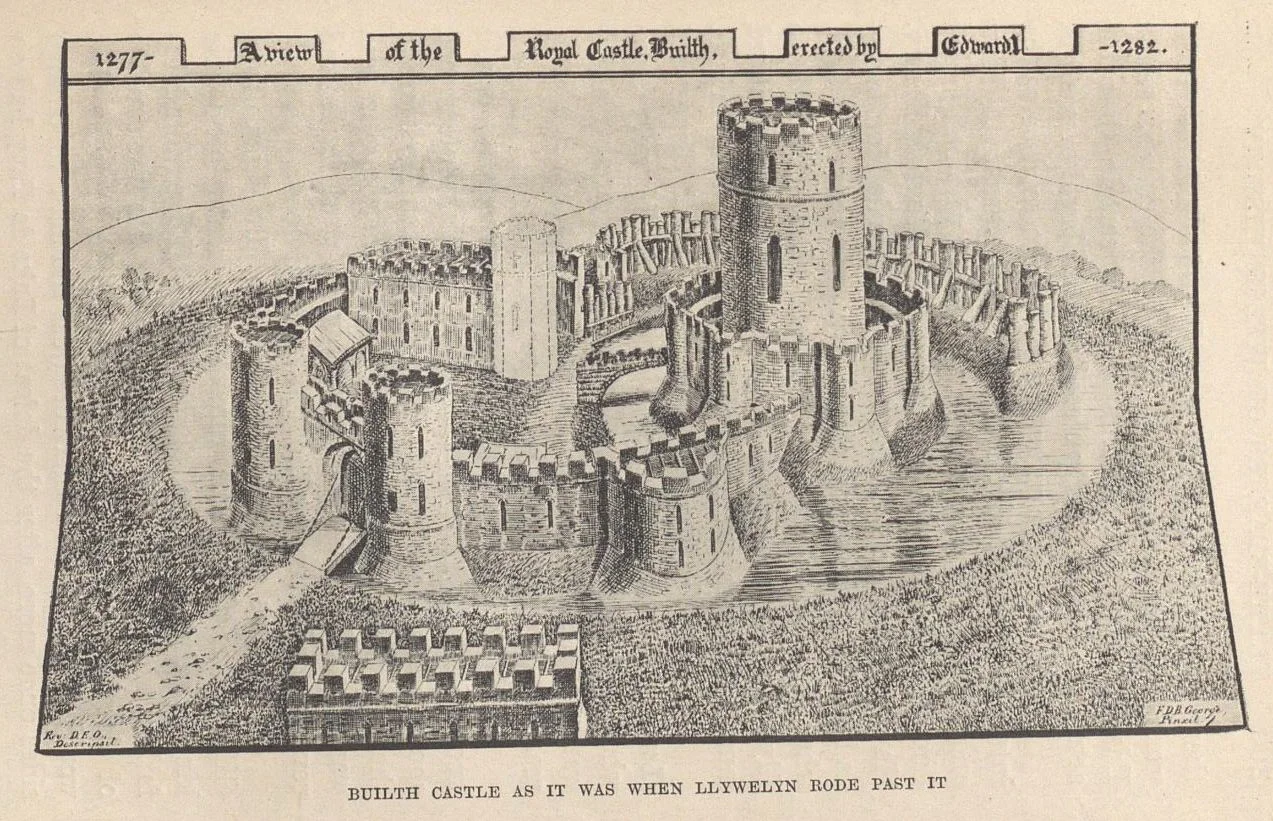
There is nothing to see at Builth Castle now. A grassy mound rises about thirty feet above the meadow east of the town, ringed by ditches and embankments, and on top of it there is empty air where for several centuries there stood one of Edward I's stone fortresses. The stones are gone, carried off to build the houses and barns of Builth Wells. What remains is the shape: the great motte, the two baileys around it, the lines in the ground where curtain walls once stood. The shape has been on this hill since long before Edward; the Welsh and the Normans had been fighting over it for two hundred years when the English king arrived in 1277 to build a stronger castle than any that had stood here before. He started in confidence and stopped, unfinished, in August 1282. Four months later Llywelyn ap Gruffudd was dead a few miles up the river, possibly turned away from Builth's gates the night before he died.
Edward's First Welsh Castle
Builth Castle was begun in 1277, the first castle Edward I commissioned in Wales after his first war against Llywelyn. The site he chose was already fortified: a pre-existing motte-and-bailey castle with two baileys and a surrounding wall, taken from the Normans by various Welsh princes over the previous century and most recently destroyed by Llywelyn in 1260. Construction proceeded on the same earthworks. Edward's master masons enclosed the site with a 270-yard wooden palisade, then began the stone walls. Records show the total cost reached £1,666, a modest figure for the period because the earthworks were already there. Work continued until August 1282. Then it stopped. Llywelyn had been killed nearby in December of that year, and Edward had shifted his attention to his great northern castles at Conwy, Caernarfon, and Harlech. Builth was finished, but only just; the stonework that should have completed the design was never laid.
The Night Llywelyn Did Not Come In
On the night of 10-11 December 1282, the Welsh chronicles say Llywelyn approached Builth Castle hoping to find shelter or perhaps to negotiate. The garrison turned him away. The Welsh stories that grew up after his death called the men who refused him "the traitors of Builth" - bradwyr Buellt - a name that stuck for centuries. Whether the incident actually happened is debated. The earliest source, the Wigmore Chronicle, does not mention it. But by the 15th century the story was firm: Welsh poets cursed Builth as the town that closed its gates to the last prince. The next morning Llywelyn rode west to his meeting with the Marcher lords, the meeting that was a trap, and by dusk he was dead in a wood at Aberedw. The castle stood. The town shrank under the shadow of what it might have done differently.
Mortimers and the Black Prince
Edward I gave the castle to his son, the future Edward II, in 1301. Between 1310 and 1315 it was held as castellan by Roger Mortimer, the magnate who would later become Queen Isabella's lover and de facto regent of England before being executed by Edward III in 1330. Mortimer had rented Builth back from Isabella for 170 marks per half-year. After his fall the castle passed through Alice de Lacy and her unfortunate sequence of husbands - including Hugh de Freyne, whom the records describe as her abductor and rapist before he secured legal recognition as her husband. The castle passed eventually to the Black Prince, who restored the rental arrangement with the Mortimers. Each generation kept the lease alive, more for the income from the lordship than for the strategic value of the castle itself, which by the late 14th century was an outdated stone box on an exposed mound.
Glyndŵr at the Gate
When Owain Glyndŵr's rebellion swept through mid-Wales in the early 15th century, his forces attacked Builth Castle. The garrison was commanded by Sir John Oldcastle, the original of Shakespeare's Falstaff, although the Falstaff of the plays bears almost no resemblance to the actual Oldcastle - a Lollard religious reformer who was later burned at the stake for heresy. The siege of Builth was inconclusive; the castle was repaired in 1409 at a cost of £400. By the 16th century, the antiquary John Leland recorded the castle as still standing but increasingly neglected. During the reign of Henry VIII it caught fire and burnt out. From then on the ruin was a quarry. Local people came up the hill and carried away whatever stones they could lift. By the 19th century the masonry was almost entirely gone, the lead salvaged, the iron sold.
The Mound on Castle Road
What stands today is the shape of what Edward built and nothing of the material. The motte rises with the original twin baileys still visible as flat lawns around it. The ditches are filled in but recognisable. From the top of the mound you can see the Wye flowing east through the modern town of Builth Wells, and the hills rising west toward Cilmeri where Llywelyn died, and the long curve of road that leads to Aberedw where his body was found. The Castle Mound is a Scheduled Ancient Monument now, managed by Cadw. There is a footpath and a small interpretation board. The view is good. The stones are all in the walls of the town below.
From the Air
Located at 52.15N, 3.40W on the eastern edge of Builth Wells in central Powys, where the River Irfon joins the Wye. From the air, look for the small market town of Builth Wells in the broad valley, with the green mound of the castle earthwork on the hill above the town's east side. The Wye flows east toward Hay and Hereford; the Cambrian Mountains rise to the north-west. Nearest airports: Welshpool (EGCW) approximately 30nm north; Hereford/Shobdon (EGBS) approximately 22nm east; Pembrey (EGFP) approximately 50nm south-west. Recommended viewing altitude: 1,500-3,000 ft for the town, the river, and the castle mound together. Valley fog is common in autumn and winter along the Wye.
Nearby Stories
- Carreg Cennen Castle 4.7 km away
- Monmouth 8.1 km away
- Museum of Cider 9.2 km away
- The South Wales Valleys 9.2 km away
- Cambrian Mountains 12 km away
- National Library of Wales 14 km away
- Talley Abbey 18 km away
- Caratacus' last battle 19 km away