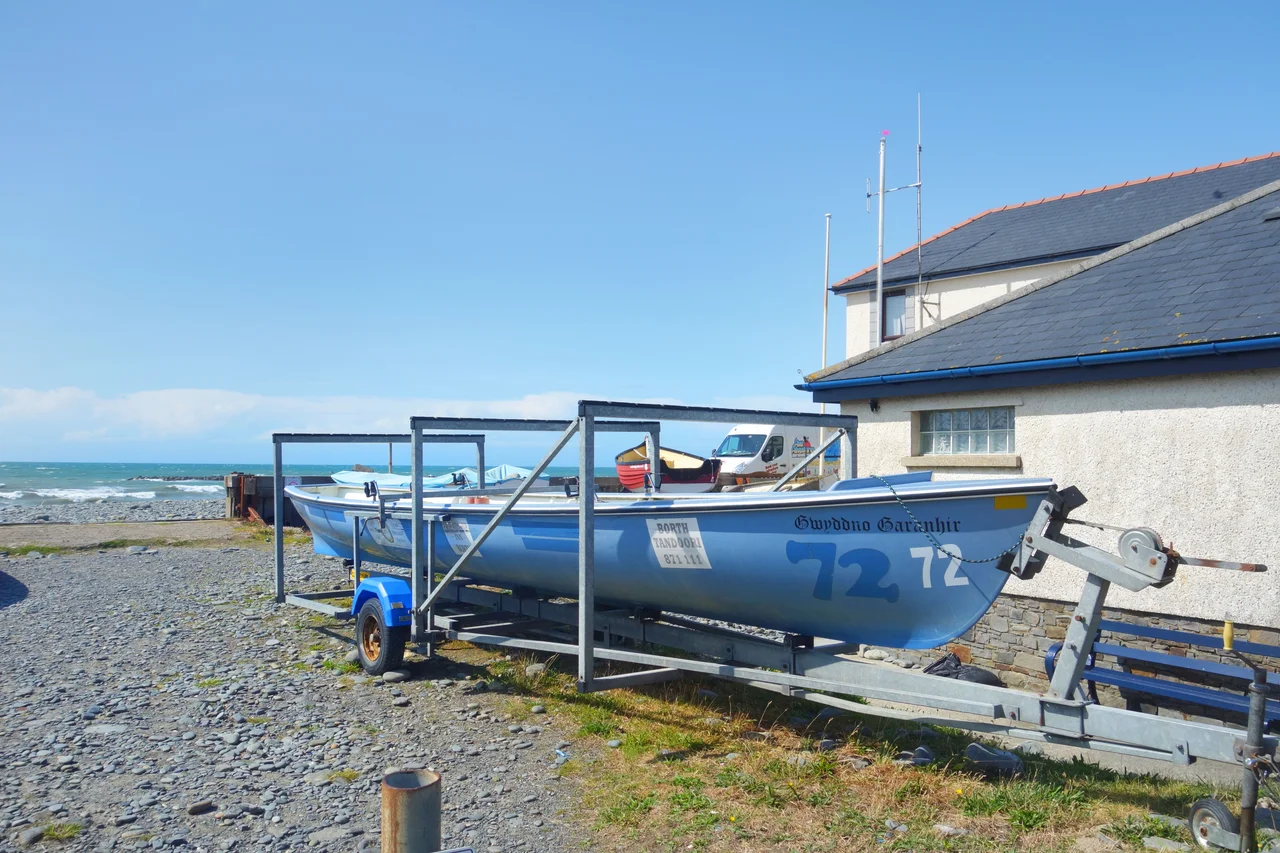

Borth Lifeboat Station
Aran Morris remembered the Arctic. He had served on the convoys that hauled supplies to Murmansk during the Second World War, watching shipmates vanish into water cold enough to kill in minutes. When he came home to Borth on the Ceredigion coast, he could not stop counting the minutes. Twenty, every time. That was how long it took the lifeboat from Aberystwyth or Aberdyfi to reach a swimmer in trouble on Borth beach. Morris and a local councillor named Gethin Evans campaigned until somebody listened. In June 1966, the RNLI opened a new inshore lifeboat station at the southern end of the village. Twenty minutes, finally, had become ten.
Before the RNLI
The 1966 station was not the first lifeboat at Borth, only the most lasting. Between 1830 and 1850 a private boat operated from the village, kept by locals who knew the truth that maps could not communicate: that Cardigan Bay turns vicious in onshore winds, that the long shelving beach drags swimmers sideways with rip currents, and that a fishing smack caught in a westerly gale had nowhere to run. No detailed record of that first boat survives. Whoever crewed her, whoever they pulled from the surf, their names are gone. When the RNLI took over a century later, they were starting fresh rather than continuing a tradition, but the need had not changed in the intervening decades. It had only grown, as Borth filled each summer with day-trippers who underestimated the bay.
The Storm of December 2000
The phone call came on 10 December 2000. The Borth lifeboat May was returning from a training exercise when the radio crackled with news that a helm from a neighbouring station had gone overboard during the same kind of drill, swept into shallow water that the bigger Atlantic 75 lifeboat could not enter. Helm Amos Bewick turned May around. With crew members Martyn Davies and Alex Shepard, he drove the small D-class through worsening weather, twenty minutes of seas that wanted to roll them, ten more minutes of searching, and then the man was aboard, alive. Bewick held the boat steady while Davies and Shepard fought to keep it upright. For seamanship that day, the RNLI gave Bewick its Bronze Medal. Davies and Shepard received Service Certificates. Bewick continued to volunteer for another seventeen years.
The People in the Boathouse
A volunteer lifeboat station is built less of brick than of names. Borth's wall of awards reads like a small village's century: Ronald Davies, helm, vellums in 1978 and 1987. Dilwyn Owen and Richard Jeremy, crew certificates the same year a new boathouse went up to replace the rotting wooden Hardun shed. Louis Paul De La Haye and Andrew William Doyle, letters of thanks from the Chairman of the Institution. Richard Jenkins, 1998. Ronald James Davies, MBE in 2004 for managing the station. Aran Morris himself, MBE in 2008, the man who would not let go of the Arctic now honoured by the country he had served. The current boat, Annie Lizzie, arrived in 2024. Different name, same purpose.
What the Station Is For
Bodyboarders in rip currents. Walkers cut off by the tide on the long flat sands toward Ynyslas. Yachts dismasted in summer squalls off the Dyfi estuary. Dog-walkers who slipped from cliffs south of the village. The Borth crew launches into the same Cardigan Bay that lapped at the submerged forest of Cantre'r Gwaelod five thousand years ago, the bay that locals will tell you sometimes still rings with the bells of the drowned. The boat goes out because the alternative is to leave a person to drown. There is no other reason. There has never been any other reason. Borth Lifeboat Station does not exist because the sea got safer. It exists because Aran Morris, who knew what cold water does to a body, could not stand the math.
From the Air
Located at 52.48N, 4.05W on the High Street of Borth, a long, narrow village strung along the sandy beach 7 miles north of Aberystwyth. From the air, look for the line of pastel houses backing onto a featureless beach with the green wetlands of Cors Fochno immediately inland and the Dyfi estuary opening to the north. Nearest airports: Aberporth (EGFA) approximately 32nm south; Welshpool (EGCW) approximately 40nm east; Caernarfon (EGCK) approximately 45nm north. Recommended viewing altitude: 1,500-2,500 ft for a clear view of the beach, the village, and the boathouse near the southern end of the strand. Coastal weather can change quickly; westerlies build sea state rapidly across Cardigan Bay.
Nearby Stories
- Cambrian Mountains 6.1 km away
- Battle of Orewin Bridge 7.1 km away
- Church of the Holy Cross, Mwnt 9.1 km away
- Cymer Abbey 10 km away
- Plas yn Rhiw 10 km away
- Talgarreg 19 km away
- HMS Whirlwind (R87) 23 km away
- Battle of Oswestry 34 km away