
St Mary Magdalene's Church, Battlefield
On 21 July 1403, the armies of Henry IV and Henry Percy met north of Shrewsbury. The fighting cost both sides heavily, and when it was over - with Hotspur dead on the field and the king victorious - the bodies of perhaps a thousand soldiers lay in the meadows of Hateley Field. Three years later, the parish rector of nearby Albright Hussey persuaded the local lord of the manor and eventually the king himself that a chantry chapel should rise on the spot, staffed by chaplains whose job was to sing daily masses for the souls of the dead. They built the church on top of what is almost certainly the mass burial pit. The chaplains chanted for the dead until 1548. The church survives, lonely and red-sandstone, on a slight rise in a Shropshire field that is still called, six centuries later, Battlefield.
The Battle in the Meadow
The Battle of Shrewsbury was one of the first major engagements in English history to involve massed longbow fire from both sides, and the casualties were horrific - skeletons exhumed from the area in recent archaeological surveys show arrow-wounds and bone-deep blade injuries consistent with the brutal close fighting of medieval infantry combat. Sir Henry Percy, nicknamed Hotspur and immortalised in Shakespeare's Henry IV plays, fell with an arrow to the face when, as legend has it, he raised his visor to drink. The remaining rebels broke. King Henry IV had won his crown four years earlier by deposing Richard II, and the Percy rebellion represented his most serious challenge in the early years of his reign. The dead were probably buried in mass pits dug close to where they had fallen - standard medieval battlefield practice in an era before regimental graves or named cemeteries.
Roger Ive's Quiet Idea
The initiative for the church appears to have come not from the king but from Roger Ive, the parish rector of nearby Albright Hussey - a man described in the records as forceful, capable, and persistent. On 28 October 1406, Henry IV granted Richard Hussey, the lord of the manor, a licence to transfer two acres of Hateley Field to Ive, free of military and other secular services. The land was specifically intended for a chantry to sing masses for the souls of the king, his ancestors, and those killed in the battle. The negotiations dragged on for four years. By 1409 the king had decided to make the project his own: he incorporated the chapel as a perpetual chantry, granted it the income from St Michael's Church on Wyre in Lancashire, and on 27 May 1410 issued a royal charter establishing a community of five chaplains and a master who would pray daily for the dead. Henry V continued his father's patronage. The chaplains were known thereafter as a college - and Battlefield became, formally, the College of St Mary Magdalene.
Life in the Chantry
The chaplains lived together in a three-storey building beside the south side of the chancel - traces of this living quarters still survive in the masonry. They ate two meals a day in a common dining hall, under a strict rule of obedience to the master. They could not leave the college without permission. They could not keep wives or concubines - violation meant permanent expulsion. Roger Ive's will, made in October 1444, lays out their daily duties: a Placebo and Dirige each day for the souls of Henry IV, Henry V, Richard Hussey and his wife Isolda, the chaplains' predecessors, and the soldiers killed at Shrewsbury. Two masses daily. The Liturgy of the Hours, sung according to the Use of Sarum, the dominant English medieval rite. The college library was considerable enough that one parchment volume - a teaching book of 294 folios bound in oak and white skin - survives today in the library of Trinity College, Cambridge, suggesting the chaplains may also have run a small school for local boys.
Dissolution and Decay
The college lost its tax exemption under the Tudors. Henry VIII's Valor Ecclesiasticus of 1535 recorded a gross income of £56 1s 4d - small by the standards of major monastic foundations, but enough to keep six chaplains in modest circumstances. The college was not dissolved with the smaller monasteries in 1536. It survived a further twelve years before being closed early in 1548 under Edward VI's Dissolution of Colleges Act. The last warden, John Hussey, was pensioned off at 20 marks a year. The church became the parish church of Albright Hussey, but the parish was small and poor, and the building was simply too large for its new role. Over the following two centuries the church fell into serious decay. From the mid-eighteenth century onwards, repeated attempts at restoration came and went. A major Victorian restoration was controversial - antiquarians of the time argued bitterly over scope, materials, and authenticity - but it kept the church standing through into the modern era.
What Stands Today
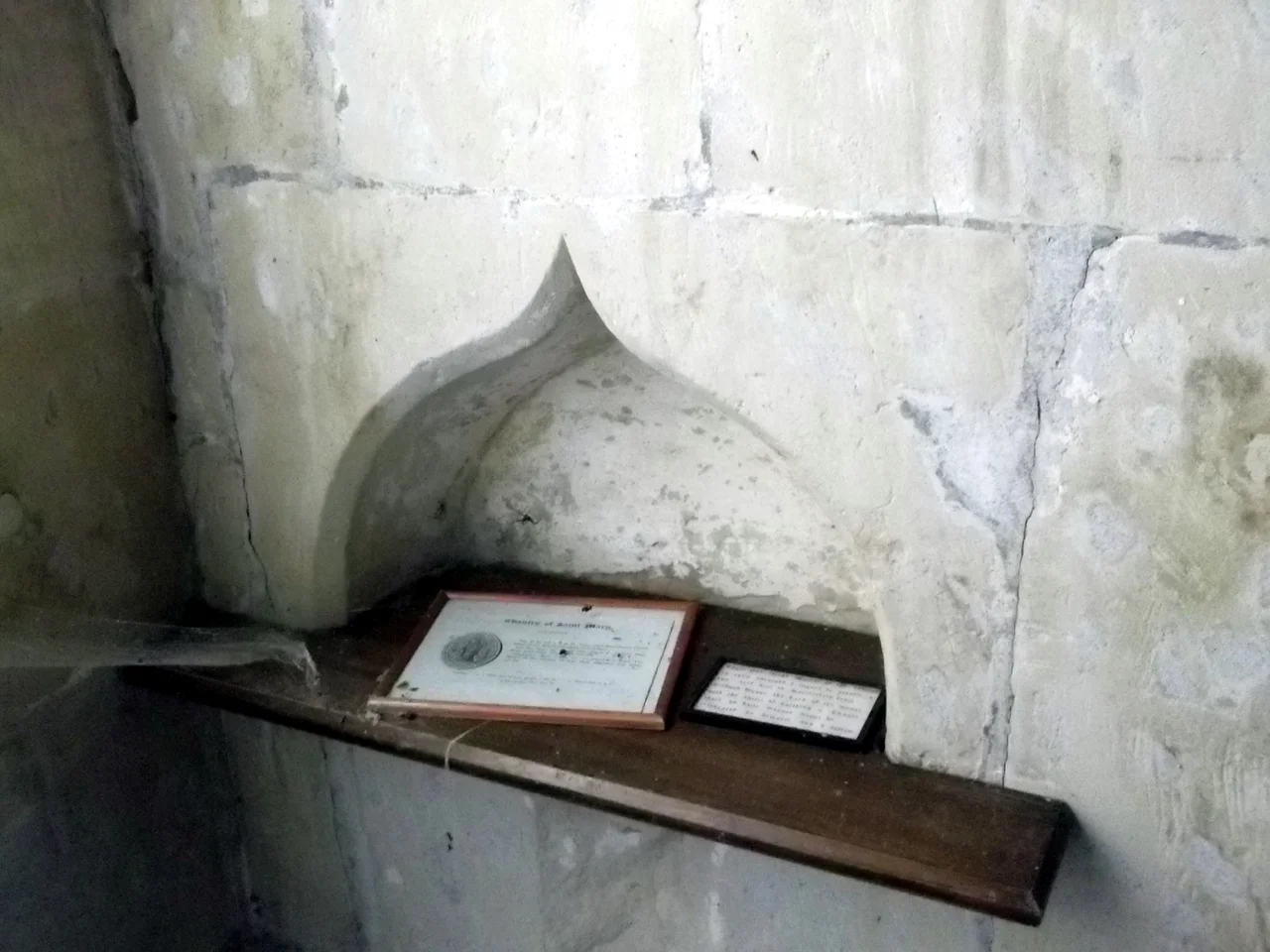
St Mary Magdalene's is now a redundant Anglican church, no longer used for regular worship, cared for by the Churches Conservation Trust. It is listed Grade II* on the National Heritage List for England - the second-highest grade of historic protection. The fabric is medieval, with later restoration work overlaid. Inside, original features survive: the piscina where the chaplains washed the communion vessels, the sedilia where the officiating priest sat between phases of the mass, the carved stonework that the Victorian restorers found worth preserving. The chantry seal, marked SIGILLUM COMMUNE DOMINI ROGERI IVE PRIMI MAGISTRI - the common seal of Lord Roger Ive, first master - still attests to the founder's central role. Outside, the church sits alone on its slight rise in the Shropshire farmland, surrounded by the meadows where the fighting happened. Visitors who walk the paths around it are walking, in all likelihood, over the bones of the soldiers for whom the building was raised. The chaplains stopped chanting in 1548. The dead they sang for are still here.
From the Air
Located at 52.7836 N, 2.7008 W approximately three miles north of Shrewsbury, Shropshire. The church sits in open farmland on a slight rise marking the site of the Battle of Shrewsbury (1403). From altitude, the red sandstone church appears as an isolated structure in patchwork fields, with the modern A49 trunk road running nearby. Best viewed at 1,500-2,500 feet AGL on clear days. Nearest airfields: Sleap (EGCV) 6 nm northeast, RAF Shawbury (EGOS) 5 nm east. The town of Shrewsbury and the looping River Severn provide strong visual references. The battlefield itself is a Registered Historic Battlefield, with interpretive trails accessible from the church car park.
Nearby Stories
- Priory of St. Thomas near Stafford 3.1 km away
- Battle of Tipton Green 3.8 km away
- Peckforton Hills 4.5 km away
- Brindley Water Mill 5.6 km away
- Dolforwyn Castle 6.1 km away
- Caratacus' last battle 9.2 km away
- Moel Famau 9.8 km away
- Llangollen 16 km away