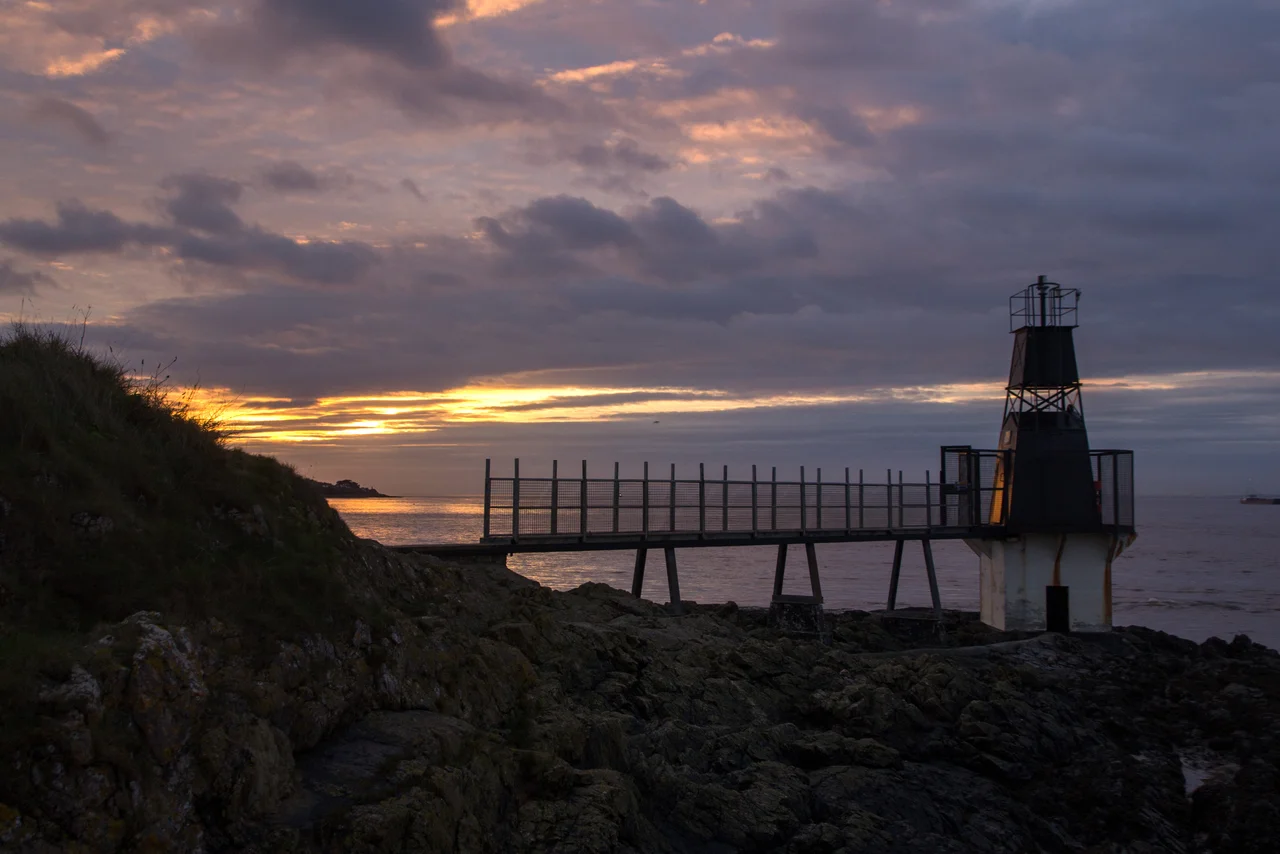

Portishead Point Lighthouse
It is not what you expect from a lighthouse. No tapering white tower, no spiral stair, no keeper's cottage tucked against a windswept cliff. The Portishead Point Lighthouse - locals call it Battery Point - is a black metal pyramid, nine metres tall, perched on a low concrete base on the Somerset shore. Functional, geometric, almost industrial. The kind of structure a child might draw if asked to invent a lighthouse from first principles and given only a triangle. Yet it has been doing its job, blink by blink, since 1931, marking the point where the Bristol Channel narrows toward its great commercial port.
The pyramid on the point
Chance Brothers of Smethwick built the light in 1931 as an unwatched automatic. No keeper would ever live here. The pyramid form was chosen for honest reasons - cheap, strong, easy to assemble - and the result has a certain interwar bluntness about it, the same aesthetic that built electricity pylons and seaside shelters. The lighthouse sits where the Severn Estuary squeezes itself into the Bristol Channel, a place where the tides are among the highest in the world and the mudflats stretch for miles at low water. Ships bound for Avonmouth and the Port of Bristol thread past this point. The light tells them where the safe water ends.
The fog signal that almost wasn't
The original plan called for a diaphone fog signal - the kind that gives a great, lowing two-tone groan that can travel for miles across water. Coastal lighthouses across Britain used them. But the people of Portishead, when they learned what was coming, were not having it. A diaphone next door, blasting its mournful note every few minutes through foggy nights, was more than the town would accept. They objected. The authorities listened. A fog bell was commissioned instead - more genteel, more parish-church than industrial siren. Gillett & Johnston of Croydon, better known for casting carillons, made a two-tonne bell in 1938, and it was installed the following year. It is a small triumph of local complaint over engineering convenience.
Where the bell rests now
The bell no longer sounds. Fog warning at sea has long since moved on to radio and electronic signals, and the great cast object that once tolled across the water for ships in the murk now stands on dry land on Wyndham Way, close to the town's High Street. People walk past it on their way to the shops. Children climb on it. The bell that once meant safety to mariners has become, gently and without ceremony, a piece of public sculpture. The lighthouse itself is maintained by the Bristol Port Company and was refurbished in 2012 - the light still flashes its rhythm into the wet Somerset evenings, doing the work the bell once shared.
A view down the channel
From Battery Point on a clear day, the view stretches across the estuary toward Wales: the coast of Monmouthshire visible as a low green line, the Severn Bridges suspended on the horizon, the great cranes of Avonmouth standing to the east. Container ships and tankers slide past. At low tide, the mudflats glow chocolate brown in the sun. The ketch Irene, a Bristol Channel trading vessel built in 1907 and still sailing, sometimes passes the point - one of the last working survivors of the small coastal traders that this lighthouse was built to guide. The pyramid is small, but its sightlines are huge.
A modest local institution
Portishead Point Lighthouse will not appear in many guidebooks. It is too plain, too purely useful. But it stands in the affection of the town the way a postbox or a milestone might - a thing whose presence is so woven into local life that nobody quite notices it until they imagine the headland without it. The bell on Wyndham Way is its companion artifact, the two of them telling a small, quiet story about how a community talked its lighthouse into a quieter kind of warning. The result, eighty-odd years on, is still working.
From the Air
Portishead Point Lighthouse at 51.4939 N, 2.7719 W on the south shore of the Bristol Channel, near the mouth of the Severn Estuary. Best viewed from low cruising altitude (1,500-3,000 ft) tracing the Somerset coast. Visual landmarks: the M5 Avonmouth Bridge to the east, the Severn Bridges to the north-east, the Welsh coast across the channel. Nearest airports: Bristol (EGGD) approximately 8 nm south-east, Cardiff (EGFF) across the channel to the south-west.
Nearby Stories
- Cosmeston Medieval Village 1.4 km away
- Glastonbury Festival 3.5 km away
- Tintern Abbey 3.6 km away
- Quantock Hills 4.8 km away
- Ebbw Vale Steelworks 10 km away
- New Wardour Castle 12 km away
- Windmill Hill, Avebury 16 km away
- Cotswolds 18 km away