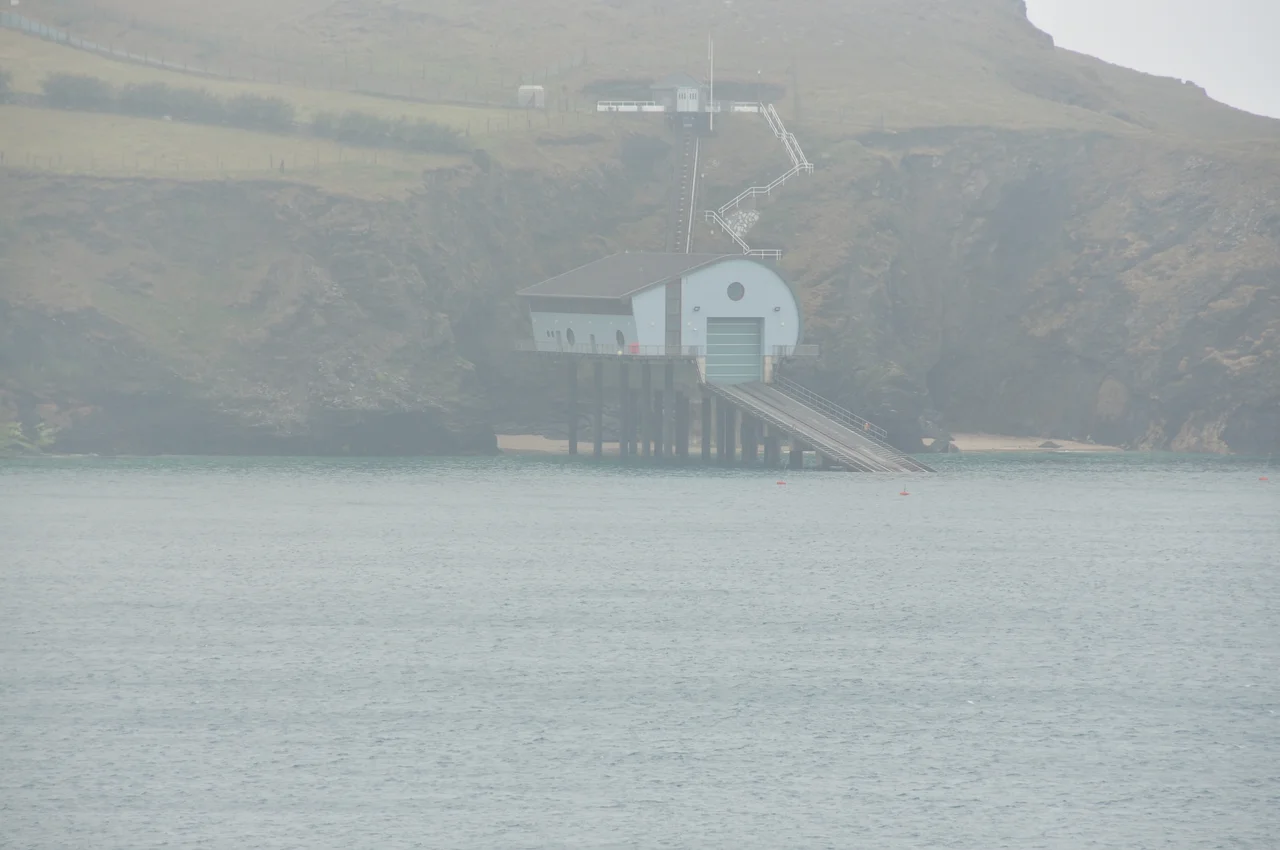

Padstow Lifeboat Station
The Doom Bar sits across the mouth of the River Camel like a trap. It is a shifting sandbank, sometimes underwater and sometimes visible at low tide, and for at least three centuries it has caught ships sweeping in toward what should be a safe harbour. Padstow's lifeboat station exists because of this sandbank. Founded by a public meeting in November 1829 - funded by Lloyd's of London, local subscription, and a national institution that would later become the RNLI - the station was built to launch boats into the very water that was killing the ships. The cost has been borne in lives. Thirteen Padstow lifeboat crew have died in two separate incidents trying to save others.
Penny per Ton
The first lifeboat at Padstow was built in 1827, a small double-ended boat by a local builder. It cost £50 - £10 from the National Institution for the Preservation of Life from Shipwreck, the rest from local subscription. Two years later the Padstow Harbour Association for the Preservation of Life and Property from Shipwreck was founded at a public meeting. Lloyd's of London paid in. So did shipping companies that worked the coast. Manby's mortars - small black-powder cannons that fired a line out to ships in trouble, so that crews could winch themselves to safety - were stationed at Hawker's Cove on the Camel estuary. The boathouse there put the lifeboat as close to the Doom Bar as the geography allowed. Padstow Quay was not close enough; in a real gale, the time it took to row out of the harbour was time the dying did not have.
Albert Edward and the Georgiana
On 6 February 1867 the lifeboat Albert Edward went out into a gale to reach the schooner Georgiana, bound from Rouen to Cork and caught at the worst possible point of her passage. The lifeboat capsized. Five of her crew - Daniel Shea, William Intross, Thomas Varco, Andrew Truscott and Michael Crennel - drowned in the cold winter water before they could be reached. The five people aboard the Georgiana, the people the lifeboat had been launched to save, managed to scramble ashore after their schooner ran aground. The lifeboat righted itself, drifted, and was eventually recovered and repaired. The memorial to the five drowned men was placed on the wall of Padstow church. They were the first of thirteen.
Peace and Plenty, 1900
On 11 April 1900 the ketch Peace and Plenty of Lowestoft dragged her anchor in a gale near the Camel estuary. The Trebetherick Rocket Brigade - working from shore with a line-throwing rocket - rescued five of her crew, but three drowned. The lifeboat Arab was anchored beside the ketch, paying out cable to draw closer, when a single large wave swamped her and broke nine of her ten oars. The crew managed to get the Arab ashore, but the boat was wrecked. The steam lifeboat James Stevens No. 4 then launched to relieve them, and capsized as she left the estuary. The four men in the engine room - John Martin, James Old, Joseph Stephens and Sydney East - could not escape the flooding compartment. Four of the deck crew - David Grubb, John Bate, James Grubb and Edward Kane - also drowned. Eight men dead from a single launch. Memorials to seven of them stand in Padstow Cemetery; the eighth was buried at St Merryn.
Trevose Head
Silting at Hawker's Cove and across the Doom Bar made the old station increasingly impractical. Lifeboats had often been hauled overland by horse-drawn carriage to launch sites better suited to the weather, with farmers lending the horses. By the 1960s the silting had won. Hawker's Cove closed on 31 March 1962. A new boathouse was built at Trevose Head, on the cliffs west of Padstow, with a roller slipway that launched the lifeboat down a 1-in-5½ incline straight into the sea. It became operational on 23 October 1967, and the composer Malcolm Arnold - who had moved to Cornwall with his wife Isobel in 1965 and came to identify deeply with the county - wrote the Padstow Lifeboat March to mark the occasion. The march is now standard at brass band concerts across Britain. A newer boathouse was built alongside in 2006, with a slightly steeper 1-in-5 slipway. The Spirit of Padstow has launched from it ever since.
Why People Still Volunteer
The RNLI runs on volunteers. Padstow's coxswain Alan Tarby received the Thanks of the Institution Inscribed on Vellum in 2007 for a long double service on 25 June - the lifeboat first towed in a damaged yacht, the Coresande, then was diverted to rescue a small boat called Fly that had gone aground near the Doom Bar. The conditions were too rough to return to Trevose Head that night, so the crew moored in Padstow harbour at 23:35. Luke Chown and Christopher Murphy received Framed Letters of Thanks for the work they did aboard the Coresande. Tarby received another Framed Letter of Thanks for a service to a yacht on 29 April 2013. The Spirit of Padstow has been the station's lifeboat since 2006, and the volunteers who crew her know exactly what the Doom Bar has done to the people who came before. They go anyway.
From the Air
Padstow Lifeboat Station sits at 50.55°N, 5.02°W on the cliffs of Trevose Head, on the north Cornish coast just west of Padstow town. The Trevose Head Lighthouse is the most prominent visual marker nearby and stands a short walk from the boathouse. Newquay Cornwall Airport (EGHQ) is twelve miles south-south-west. From the air, the lifeboat slipway runs directly into the sea from the headland - a long ramp pointed at the open Atlantic. The mouth of the River Camel and the Doom Bar sandbank are visible a couple of miles east of the station, especially at low tide when the bar shows clearly across the entrance to Padstow harbour.
Nearby Stories
- Jamaica Inn 2.8 km away
- Bude 3.3 km away
- Truro 3.5 km away
- Pendeen Lighthouse 13 km away
- Eddystone Lighthouse 24 km away
- HMHS Glenart Castle 35 km away
- Morvah 42 km away
- Hook Lighthouse 173 km away