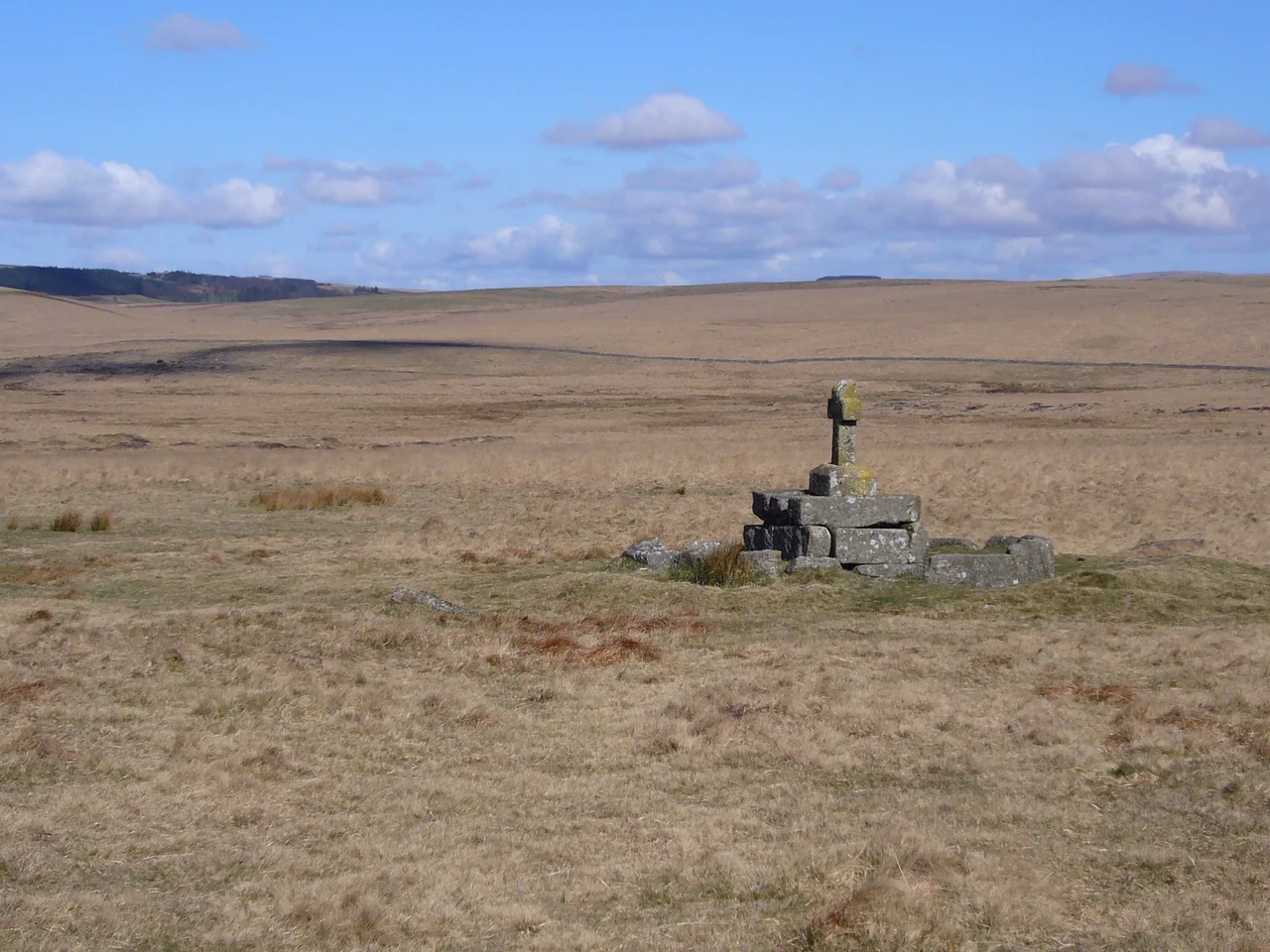

Childe's Tomb
Caught in a Dartmoor snowstorm, the hunter Childe knew he was going to die. According to the legend Tristram Risdon recorded in 1630, he killed his horse, slit it open, and crawled inside the warm carcass for shelter. He froze to death anyway. Before he died, he wrote a note: whoever found his body and buried it in their church would inherit his estates at Plymstock. The monks of Tavistock Abbey found him. The men of Plymstock heard about it and laid an ambush at a bridge over the Tavy. The monks took a different route, built a new bridge to cross the river, reached Tavistock with the body, and claimed the estate. The story is almost certainly a folk tale. But the cross is real, and the kistvaen beneath it is older still.
On the Edge of the Mire
Childe's Tomb stands on the south-east edge of Foxtor Mires, about 500 metres north of Fox Tor, in some of the loneliest country on southern Dartmoor. Foxtor Mires is the inspiration for Grimpen Mire in Conan Doyle's Hound of the Baskervilles, and the comparison is not unkind to either: it is a genuinely treacherous bog, a quaking expanse of reed and sphagnum that has swallowed travellers and livestock for millennia. The cross sits beside the line of an east-west medieval route known as the Monks' Path, which connected Buckfast Abbey on the eastern moor with Tavistock Abbey on the western. A traveller who strayed from the path in bad weather could easily blunder into the mire. The cross was a landmark. The cairns that lay along the same path were landmarks. Together they made the difference between getting home and not.
What the Tomb Actually Is
Beneath the cross is a kistvaen, a Bronze Age stone burial chamber that long predates the medieval Christian monument above it. The cross was originally raised on a pedestal of three granite steps. The lowest step was made of four stones, each six feet long and a foot square. The two upper steps were eight shorter stones of similar shape, with an octagonal block about three feet high above them, and a cross set into the top. The whole structure stood inside a circle of granite stones set on edge, which had once encircled a cairn over the kistvaen. According to Risdon, an inscription ran around the base reading 'They fyrste that fyndes and bringes mee to my grave, The priorie of Plimstoke they shall have', a doggerel verse that gives the legend its punch line. The stones with the inscription are gone. The kistvaen is still there.
What the Farmworker Did
In February 1809, a man called Thomas Windeatt from Totnes leased a 582-acre 'newtake' in the valley of the River Swincombe, intending to enclose and improve a stretch of Dartmoor. This was a fashionable thing to do in the early nineteenth century, encouraged by Sir Thomas Tyrwhitt's improvements at Tor Royal near Princetown and made possible by new turnpike roads across the moor. In 1812 Windeatt began building a farmhouse on his land, Fox Tor Farm, and his workmen robbed the nearby Childe's Tomb of most of its stones for the construction. The pedestal was torn up. The doorsteps of the farm were made from the stones of the tomb's base. Some of them, the moorman William Crossing was later told, were also used to make a clapper bridge over a stream nearby, allegedly with the original inscription on their undersides. Crossing arranged to lift the clapper bridge in 1902 to check. No inscription survived. But he did find nine of the twelve pedestal stones, and the broken socket stone for the cross.
The First Save
In 1890 the tomb was re-erected under the direction of E. Fearnley Tanner, the honorary secretary of the newly-founded Dartmoor Preservation Association. The restoration was, in Tanner's own words, dissatisfying: several stones were missing, and he could not recreate the monument's original character. The base and cross now standing are replacements made in Holne in 1885. But the act of restoration mattered more than the perfection of the result. This was one of the very first preservation projects undertaken by the Dartmoor Preservation Association, an organisation that has since saved hundreds of the moor's monuments, crosses, antiquities, and rights of way. Childe's Tomb was, in a sense, the case that proved the point: that the moor needed defenders, that its history could be quarried away in a single afternoon, that someone had to stand up for the stones. Devon folk singer Seth Lakeman wrote a song called 'Childe the Hunter' for his 2006 album Freedom Fields. The story is still being told. Out there on the edge of the mire, on a winter morning when the wind comes up from the southwest, you can almost see why.
From the Air
Childe's Tomb is at 50.52 N, 3.94 W, in the southern interior of Dartmoor National Park about 12 miles northeast of Plymouth and 4 miles south of Princetown. The surrounding country is bleak open moorland with Fox Tor immediately to the south and the broad, treacherous Foxtor Mires immediately to the north. From the air the granite cross is too small to see, but the mire shows as a darker green patch among heather and grass. Plymouth City Airport (EGHD) closed in 2011; Exeter (EGTE) is about 27 nm northeast and Newquay Cornwall (EGHQ) 50 nm west. Best low-level viewing is 2,500 to 4,000 feet AGL in clear conditions, with the bleakness of central Dartmoor opening out beneath.
Nearby Stories
- Bodmin Moor 4.1 km away
- South Devon Railway sea wall 4.8 km away
- Tiverton Castle 12 km away
- Hope Cove Lifeboat Station 14 km away
- Caerhays Castle 20 km away
- Holsworthy 22 km away
- HMS Formidable (1898) 32 km away
- HMS Montagu 41 km away