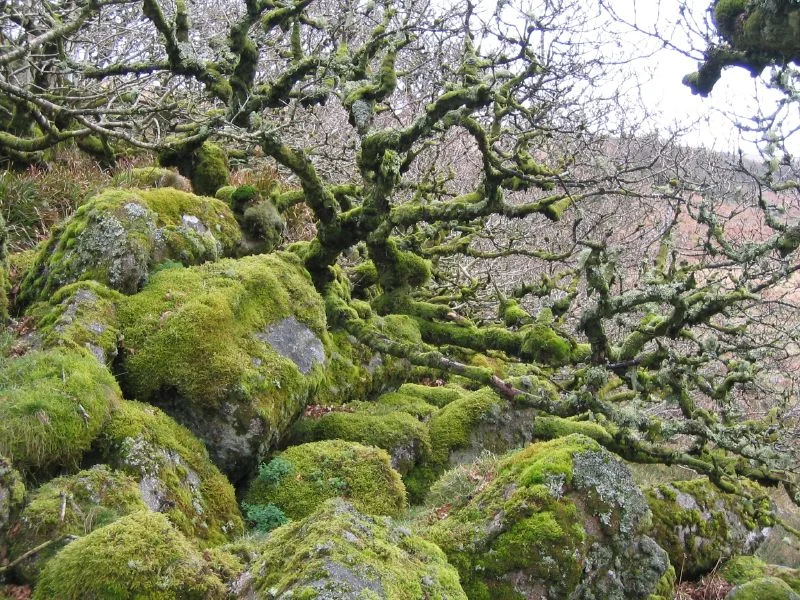

Wistman's Wood
The Devonshire word for what comes off this wood is wisht. It means eerie. It means uncanny. It means pixie-haunted. The Wild Hunt of West Country folklore - a spectral chase of black hounds led by the Devil across the moor - is supposed to start from this 3.5-hectare grove of stunted oaks high in the valley of the West Dart River. The hounds are called Yeth Hounds, or Wisht Hounds, and the wood takes its name from them. Walk into it on a misty morning and the lichens hanging in foot-long rags from every branch, the boulders the size of cars heaped under the canopy, the green light filtered through twisted limbs that have never reached more than about fifteen feet off the ground - all of it produces an effect that a single word in the local dialect once captured precisely.
A Rainforest 380 Meters Up
Wistman's Wood is one of the highest oakwoods in Britain and one of the last fragments of true temperate rainforest left in the country. It sits at about 380 to 435 meters above sea level near Two Bridges in the centre of Dartmoor, in a steep cleave above the West Dart River. The dominant species is the pedunculate oak - the same Quercus robur that grows to enormous timber-tree dimensions in southern English parks - but here the trees are stunted. The oldest examples are 400 to 500 years old. They originated within a degenerating oakwood that survived in scrub form through two centuries of cold climate, then began to grow again. Tree-ring studies show that the older oaks have gradually shifted from a stunted, almost prostrate habit to a more ascending form, while younger straight-grown single-stemmed oaks have established alongside them. The total area of the wood is about 3.5 hectares, divided into three groves the locals call North, Middle, and South.
Lichens, Adders, and the Boulder Floor
What sets Wistman's apart from any other patch of Dartmoor oakwood is the floor and what grows on the branches. The ground beneath the canopy is a chaos of granite clitter - blocks of stone the size of small cars, dropped here by frost-weathering across thousands of years - and the spaces between them are filled with moss, leaf litter, and the kind of cold damp that never quite leaves. The trees themselves carry epiphytes that thrive in clean wet air: hair-like lichens drooping in long fronds, mosses thick enough to muffle sound, ferns rooting on the limbs themselves. A 2022 book by Guy Shrubsole, The Lost Rainforests of Britain, helped popularize the term for what Wistman's actually is - a temperate rainforest, defined by humidity and continuity, not by latitude. The wood is also one of the strongholds of the European adder on Dartmoor, and visitors who clamber across the boulders in summer are advised to watch where they put their hands.
The Buller Stone and the Felled Oak
How old are the oldest trees actually was a question that exercised 19th-century naturalists. In 1866 a man named Wentworth Buller obtained permission from the Duchy of Cornwall to settle the question by simply cutting down one of the oldest oaks and counting its rings. The tree he felled came out at about 168 years - a number that disappointed the romantics but said more about the tree he chose than about the wood as a whole. A boulder to the east of the grove, the Buller Stone, still commemorates this experiment, and the practice of cutting Wistman's oaks to count them has not been repeated. In 1978 the English novelist John Fowles published The Tree, an extended essay on naturalism that uses Wistman's Wood as one of its central examples of how human attempts to fix or describe nature inevitably miss what nature actually is.
Protected, and Expanding
Wistman's Wood was designated a Site of Special Scientific Interest in 1964, an early recognition of its value. It is also a National Nature Reserve, a Nature Conservation Review site, and one of the primary reasons for the Dartmoor Special Area of Conservation designation. The wood is owned by the Duchy of Cornwall - the estate held by the heir to the British throne, currently William, Prince of Wales. In 2023 the Duchy and Natural England announced a plan to expand Wistman's Wood by acorn-sourced regeneration of the surrounding moorland, with the goal of doubling its area by 2040. Acorns from the existing ancient oaks are being collected to grow new saplings; grazing and human foot traffic in the regeneration zone are being reduced. Work began in October 2023. The two other high-altitude oakwoods on Dartmoor - Black Tor Copse on the West Okement River to the north, and Piles Copse on the River Erme to the south - are being studied as models for what a healthy upland oakwood looks like.
The Wisht Hounds
The folklore attached to the place is older than the conservation status and probably older than any of the living trees. The name comes from the Devonshire dialect word wisht. In its older form the word carried both meanings - eerie, uncanny - and pixie-led, haunted. The Wild Hunt of Devon was said to issue from this wood, a spectral pack of black dogs with eyes of fire racing across the moor at night, sometimes led by the Devil himself. The hellhounds have local names: Yeth Hounds, from Heath; Wisht Hounds, from the dialect word that named the wood. Bronze Age burial cairns and stone rows are scattered on the surrounding moor, including the heaps of Crow Tor and the boundary stones of the medieval Forest of Dartmoor, and the wood has accumulated story upon story for at least three or four thousand years. To walk into the grove from the brilliant open moor, even on a clear summer day, is to step into a different acoustic environment - sounds muffled, light dimmed, time slowed. The old word still applies.
From the Air
Wistman's Wood sits at 50.578N, 3.961W in the upper valley of the West Dart River about 0.7nm north of Two Bridges, near the geographic centre of Dartmoor at roughly 380-435m elevation. The wood itself is a small dark patch about 3.5 hectares in area on the west side of the valley below Littaford Tor - hard to spot directly from any distance but easy to find by reference to the road junction at Two Bridges and the line of the West Dart. Recommended viewing altitude 1,500-3,000 feet AGL. The high tors (Beardown, Crow, Longaford) are useful navigation references. Nearest airport Exeter (EGTE) about 22nm east-northeast; Plymouth (EGHO) about 14nm south-southwest. Dartmoor live-fire training areas to the north and northwest - check NOTAMs. The high moor is notorious for rapid weather changes; the wood itself is often shrouded in mist when surrounding ridges are clear.
Nearby Stories
- Bodmin Moor 4.1 km away
- South Devon Railway sea wall 4.8 km away
- Tiverton Castle 12 km away
- Hope Cove Lifeboat Station 14 km away
- Caerhays Castle 20 km away
- Holsworthy 22 km away
- HMS Formidable (1898) 32 km away
- HMS Montagu 41 km away