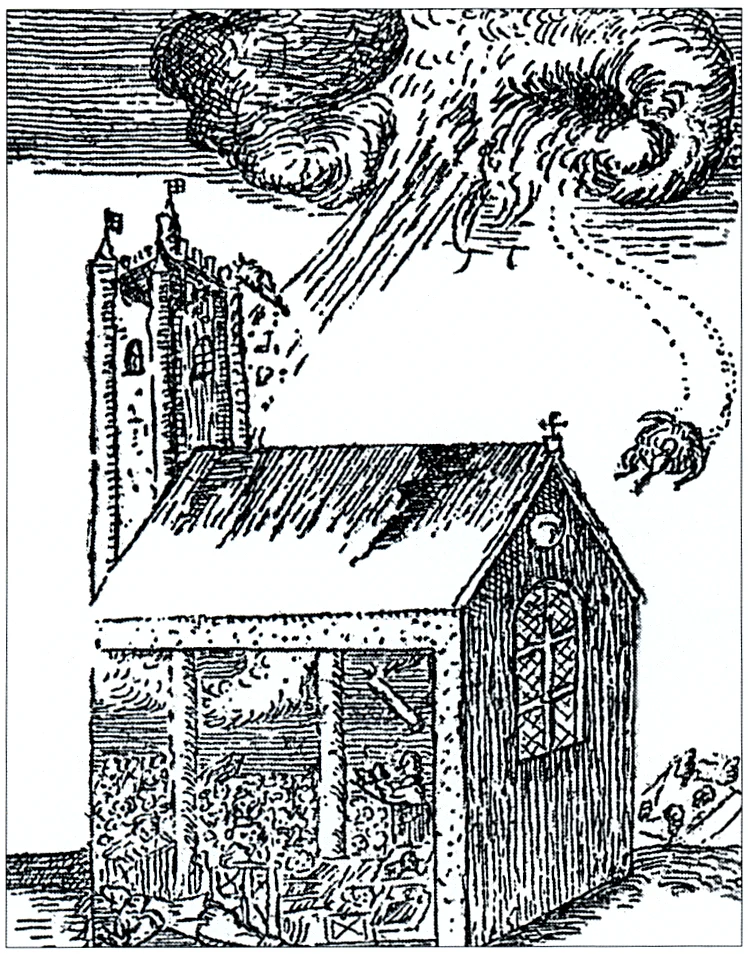

The Great Thunderstorm
It was an afternoon service, ordinary in every way that mattered, until the sky over Dartmoor went strange. The date was 21 October 1638. Inside the granite-walled church of St Pancras at Widecombe-in-the-Moor, roughly three hundred parishioners had gathered to hear the Reverend George Lyde preach. Then a darkness pressed against the windows that should not have come at that hour, and thunder shook the moor like something with intent. Witnesses afterward spoke of a great ball of fire that ripped through a window, tore part of the roof open, and rebounded through the nave. Four of the worshippers never went home. Around sixty more were injured. The church itself was nearly destroyed. What happened that Sunday is now considered one of the earliest recorded accounts of ball lightning in human history.
What the Witnesses Saw
The accounts published within months of the disaster read like reports from a battle. The minister escaped unharmed, but his wife was found with her ruff and the linen next to her skin burned through, her body burnt in what one chronicler called a very pitiful manner. A local warrener named Robert Mead was thrown so violently that his head struck a pillar and left an indentation in the stone; he did not survive. Master Hill, described as a gentleman of good account in the parish, was hurled against a wall and died that night, while his son, sitting beside him, walked away untouched. Some of the dead and burned showed the strange signature that has haunted lightning lore ever since: scorched flesh beneath unscorched clothing. A dog ran out of the church door, was caught up as if by a small tornado, and fell dead in the yard. The village schoolmaster, Roger Hill, who was Master Hill's brother, recorded the catastrophe in a rhyming testament still displayed on boards inside the rebuilt church. The originals were replaced in 1786, but the words carry forward.
The Devil at Poundsgate
Seventeenth-century Dartmoor did not need scientific explanations for what science could not yet name. Within days, a legend had taken hold across the parish, and it has never quite let go. The story said that the storm was no storm at all. The devil himself had come to Widecombe to collect on a bargain. A local gambler named Jan Reynolds (or Bobby Read, in the version told at the Tavistock Inn) had pledged his soul on a condition: if the devil ever found him asleep in church, Jan was lost. That Sunday afternoon, Jan was said to have dozed off in his pew with his pack of cards still clutched in his hand. The devil rode to claim him. He stopped first at the Tavistock Inn in nearby Poundsgate to ask directions. The landlady served a stranger in black with cloven feet, mounted on a jet-black horse. He ordered ale, and it hissed as it went down. He left coins on the bar that, after he rode away, turned to dried leaves. The mug bore a scorch mark for years.
Four Aces on the Moor
The legend continues, as such legends do, with a flight across the sky. The devil tethered his horse to one of the pinnacles of Widecombe Church, seized the sleeping Jan, and rode away into the storm. As they passed over Birch Tor, the four aces from Jan's pack tumbled from his hand and fell to the moor. They are still there, the storytellers insist. If you walk to the Warren House Inn and look out across the heather, you can see four ancient field enclosures cut into the slope of Birch Tor, each shaped, with a little imagination, like a card from a deck. Hearts. Diamonds. Spades. Clubs. The enclosures predate any cartography that could confirm the tale, and that is part of why the tale survives. Dartmoor keeps its old explanations alongside the new ones, and the rhyming boards in the church remember the four real parishioners who died that day, even as the moor outside remembers four imaginary aces.
A Place That Holds Its Stories
Widecombe-in-the-Moor sits in a green basin ringed by tors, a village that gave its name to the folk song every English schoolchild has heard at some point in their life. The church of St Pancras still stands, its 120-foot tower visible for miles across the moor, which is why it earned the nickname the Cathedral of the Moor. The damage from 1638 was repaired over the following years, the boards installed, the prayers continued. What happened on that October afternoon was eventually understood by meteorologists as a probable case of ball lightning, the rare, glowing plasma phenomenon that still resists complete scientific explanation. The villagers who saw it had no such vocabulary. They knew what they had witnessed, and they wrote it down honestly, with names and details, in the language available to them. Four hundred years later, the church doors are open to anyone who wants to read those names.
From the Air
Widecombe-in-the-Moor sits at 50.577N, 3.811W on the eastern flank of Dartmoor in Devon. Cruise the area at 3,000 to 5,000 feet for the best look at the church tower of St Pancras rising from its green basin, with the open heather and tors of Dartmoor stretching to the south and west. Exeter Airport (EGTE) lies about 15 nautical miles to the northeast and makes the natural arrival point. Plymouth City Airport (EGHD) lies further south. Watch for the granite tors of Haytor and Hound Tor to the south-east and Birch Tor, with its ace-shaped enclosures, to the north.
Nearby Stories
- Torcross 2.8 km away
- Cotehele 4.6 km away
- HMS Formidable (1898) 9.1 km away
- Holsworthy 9.4 km away
- Eddystone Lighthouse 11 km away
- Tiverton Castle 18 km away
- 1890 Norton Fitzwarren Rail Crash 24 km away
- Lyme Bay Canoeing Disaster 26 km away