
Trerice
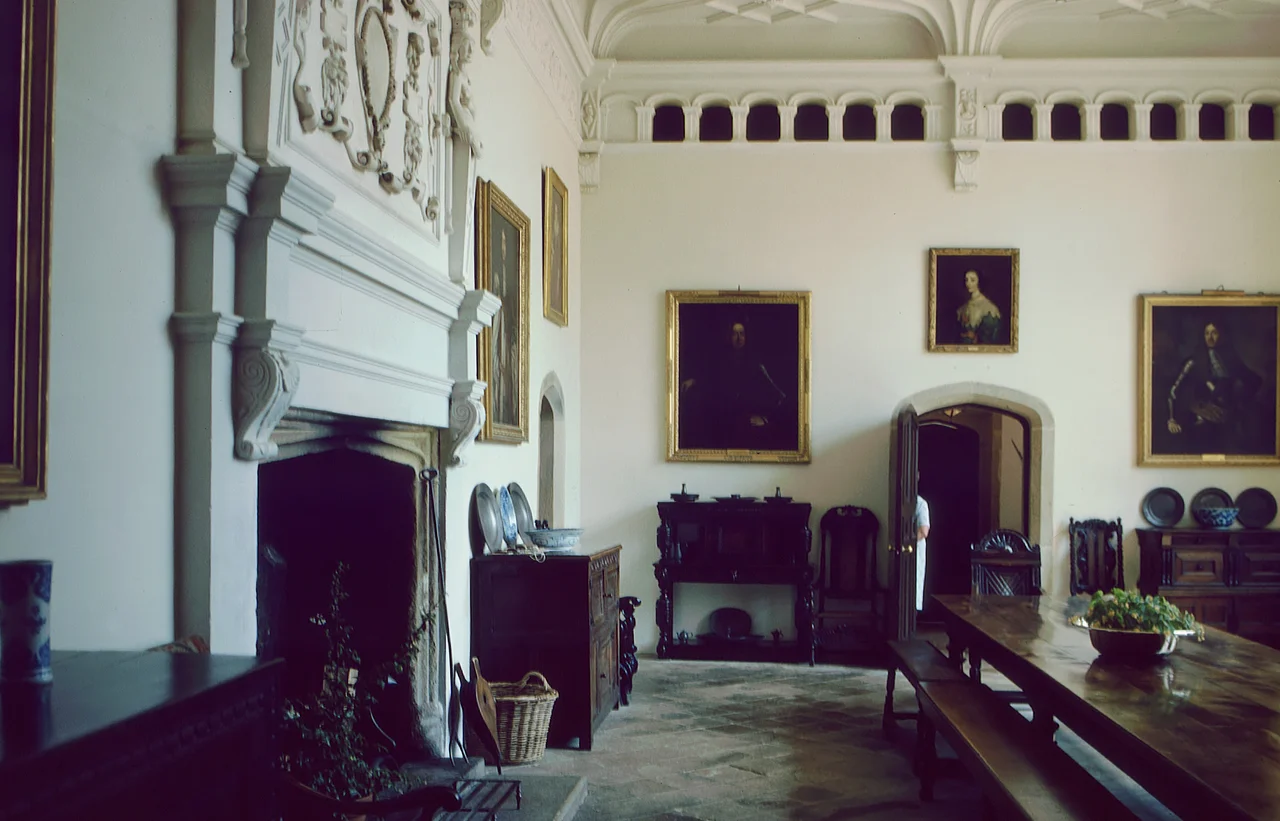
The date 1572 is carved above an overmantel in the Great Hall, and that single number explains nearly everything about Trerice. Sir John Arundell, High Sheriff of Cornwall, raised the main range here between roughly 1570 and 1573, grafting his fashionable E-plan house onto the older tower of an ancestor known as Jack of Tilbury. He could not have imagined that his Elizabethan manor would outlast the male line of his family, the barony they eventually carried, the absentee landlords who came after, and the dilapidation of a long Cornish century. Tucked three miles east of Newquay at Kestle Mill, far enough inland to feel quiet, Trerice survives as a near-intact specimen of the gentry house its builders meant it to be.
The Swallow and the Sheriff
The Arundells are everywhere at Trerice, even when no one is in the rooms. Their canting arms - sable, six martlets argent - turn the family name into a flock of swallows, a pun on the French hirondelle that the family kept through six centuries of Cornish life. The earliest holders, the de Terise family, took their surname from the manor itself, the prefix Tre- being one of about thirteen hundred such Cornish place-names west of the Tamar that mean hamlet or homestead. By the fourteenth century the estate had passed to the Arundells through the marriage of Ralph Arundell to Jane de Flamoke. From that union descended Sheriffs of Cornwall, Vice-Admirals of the West, an Esquire of the Body to Henry VIII, and finally barons - until, in 1768, the male line ran out at last.
Jack-for-the-King
Two Arundells earned nicknames that stuck. The first was Jack of Tilbury, knighted at the Battle of the Spurs in 1513 and twice Sheriff of Cornwall, who probably extended the older tower into the bulky south wing. The second was his great-grandson, Sir John VII Arundell - Jack-for-the-King - who held Pendennis Castle at Falmouth for Charles I during the Civil War and refused to surrender until starvation forced his hand in 1646. The same generation paid in sons: Colonel John Arundell was killed at the Siege of Plymouth in 1644, his brother William died of disease at Bristol in 1643, and only Richard - who became the 1st Baron Arundell of Trerice - lived to see the Restoration. The walls of the Great Hall, with their long windows of small leaded panes, were already standing when those losses fell.
The Table That Cannot Leave
When the Aclands inherited Trerice in 1802, they faced a problem common to absentee landlords - Cornwall was simply too far from Killerton, their Devon seat, to manage comfortably. Yet the 10th Baronet, Sir Thomas Dyke Acland, refused to let the house decline. Shortly before 1844 he restored the Great Hall and the Chamber, and the local newspaper reported that summer that he held his Baronial Court there, with about 150 of his tenantry dining in the noble Hall, which had been brought back to its original Elizabethan splendour. It was during this Acland tenure that the twenty-foot refectory table was built in situ from oak cut on the family's Holnicote estate in Somerset. The carpenters assembled it inside the Great Hall. It has never left the room, because it cannot - it is simply too large to fit through any door.
Decline, Choughs, and Rescue
Cornwall County Council bought Trerice in 1915 and treated it the way authorities often treat awkward old houses - the surrounding land was split into twelve farms and sold or leased, and the manor was left with twenty acres. In the summer of 1940, with German invasion expected, the Newquay unit of the Cornwall Home Guard, nicknamed The Choughs after the red-legged Cornish bird on the county arms, drilled on the parade ground. By 1953 the house was dilapidated, and the National Trust bought it for £14,000. The next chapter is one of the more remarkable preservation stories in Cornwall: John Elton, a former East India merchant who had been the tenant since 1944, took a new 200-year lease at one shilling a year on the condition that he restore the place himself. He spent about £60,000 - three times what he expected - rebuilding the partially demolished north wing and bringing the rest of the house back to life.
What Survives
Trerice today is a Grade I listed Elizabethan manor with the two stone lions on the front lawn separately listed Grade II. The garden holds an orchard of old fruit varieties, the kind of mixed apples and pears that would have been familiar to the Arundells. Inside, the Great Hall's tall mullioned window is one of the finest of its date in Cornwall, with curved gables above that almost feel Dutch. A portrait of Margaret Acland, who died in 1691, hangs where her marriage to the 2nd Baron Arundell once seemed to fail the family - it produced no children but eventually delivered the entire estate to the Aclands. The minstrels' gallery still looks down on the immovable table, the swallows of the Arundells still fly across painted shields, and the date 1572 watches over a hall that has seen more centuries than its builders ever planned.
From the Air
Trerice sits at 50.39°N, 5.04°W in inland Cornwall, three miles east of Newquay. The nearest airport is Newquay Cornwall Airport (EGHQ), about four miles north of the manor and clearly visible from the air. Approach from the north over Watergate Bay and follow the Porth valley inland - the manor is tucked among trees at Kestle Mill, near the village of Newlyn East. Cruising altitude offers a fine view of the surrounding Cornish farmland, with the north coast of Cornwall to the west and Bodmin Moor rising in the distance to the east.
Nearby Stories
- Brane Barrow 0.7 km away
- Polperro 4.9 km away
- Goonhilly Satellite Earth Station 8.2 km away
- Launceston Castle 15 km away
- Pendeen Lighthouse 22 km away
- St Materiana's Church, Tintagel 24 km away
- Battle of Plymouth (1652) 30 km away
- SM U-27 123 km away