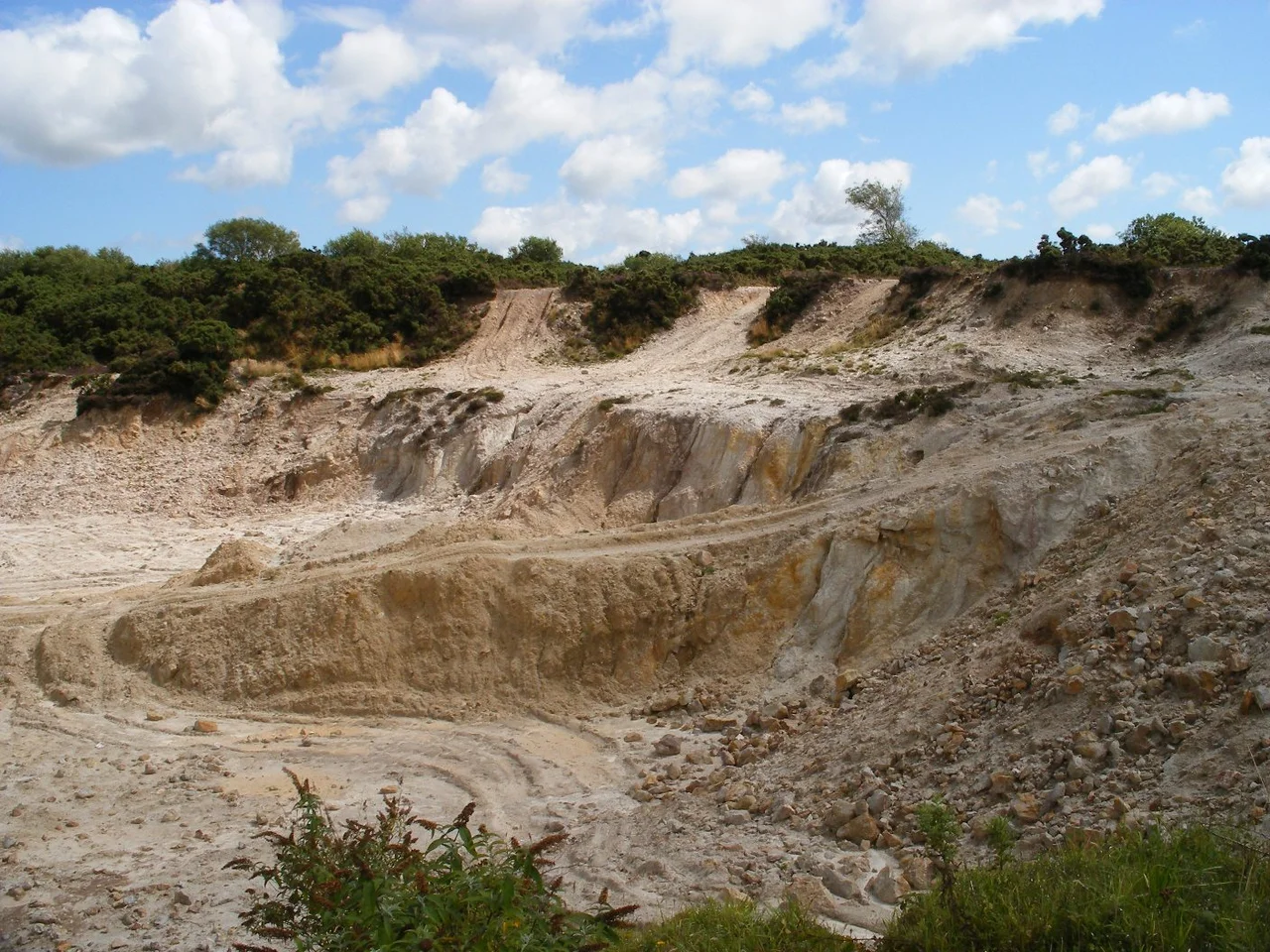

Hemerdon Mine
Twice in the 20th century, Britain went to war and remembered Hemerdon. The tungsten-tin deposit just outside Plympton was discovered in 1867 and largely ignored until 1916, when First World War shortages of tungsten, the metal that hardens armour-piercing shells, made every domestic source suddenly precious. Hemerdon's mill opened in 1917, processed 16,000 tonnes of ore between 1918 and 1919, and shut as soon as the war ended and prices collapsed. The pattern would repeat. In 1939, with Hitler's tanks rolling east and tungsten supplies under threat, the British government remembered Hemerdon a second time. Winston Churchill personally backed the case for wolfram mining as a key industry.
What Lies Beneath
The deposit Hemerdon sits on is geologically unique in south-western England: a sub-vertical Early Permian granite dyke, more than 100 metres wide, intruded between Devonian slates known locally as killas. Mineralising fluids penetrated the fractures and laid down sheeted veins of greisen-bordered quartz, ferberite, and cassiterite. The mineralisation begins at the surface and extends to at least 400 metres down. Hemerdon's resource is over 300,000 tonnes of tungsten metal: the fourth-largest tungsten deposit in the world. The locality is also renowned for high-quality scorodite specimens, considered among the best in Europe. Pharmacosiderite, cassiterite, ferberite, and wolframite of museum-grade quality have all been recovered, secondary arsenate minerals forming in the weathered upper oxidation zones of the ore body.
Two Wars, Two Mills
Hemerdon Wolfram Ltd built a 90,000-tonne-per-year mill in 1939 that began operating in 1941, achieving 55% wolfram recovery. The Ministry of Supply concluded in 1942 that Hemerdon offered Britain's best prospect for large-scale domestic tungsten production. The government took the mine over from its private operator and hastily threw up a much larger plant in 1943, theoretically capable of treating over a million tonnes per year. Labour shortages and mechanical faults dragged actual output far below that figure: about 200,000 tonnes of ore moved through the new plant, yielding 180 tonnes of concentrate. Operations ceased in June 1944, when access to overseas tungsten was restored. Rumours of a Korean War-era restart came to nothing, and following the Westwood Report in 1956 the government sold off the plant in 1959. The concrete roads built around the wartime mills became, until about 1972, the venue for speed hill climbs by the Plymouth Motor and Kart Clubs.
The Mine That Wouldn't Stay Open
From the mid-1960s onward, a succession of companies kept rediscovering Hemerdon. British Tungsten Ltd, owned by Canadian entrepreneur W. A. Richardson, increased the proven resource to 5.6 million tonnes by 1970. Hemerdon Mining and Smelting Ltd partnered with mining giant AMAX in 1977 and ran a $10 million exploration programme that pushed the resource to 49.6 million tonnes by 1980. Permission to mine was sought in 1981, refused after a public enquiry in 1984, and finally granted in 1986. Then the project sat on the shelf for two decades. North American Tungsten plc inherited it in 1997 and discarded it in 2003, the upkeep costs of C$150,000 per year eating almost a third of the company's annual budget. By 2005, sustained tungsten price rises made everything look possible again.
Wolf, and Then Tungsten West
Wolf Minerals, an Australian-listed specialty metals company, acquired the leases in 2007 on a 40-year deal, renamed the project Drakelands Mine 'to recognise the local community,' and started construction in 2014. First ore went into the plant in June 2015. If production had hit projections, Drakelands would have been the largest tungsten concentrate producer in the world. It never did. The plant struggled with ore that turned out to be ferberite rather than wolframite, requiring different extraction chemistry, and Wolf Minerals ceased trading on 10 October 2018, losses estimated around 100 million pounds. Tungsten West plc took over in 2021, floated on the London AIM market, and rebuilt the processing flowsheet from the basics, planning to sell construction aggregate as a by-product to improve the economics. Interim operations restarted in 2023. As of early 2024 the mine still awaited full regulatory permission. The fourth-largest tungsten deposit on Earth has spent more time waiting than working.
From the Air
Hemerdon Mine sits at 50.41 degrees north, 4.01 degrees west, seven miles north-east of Plymouth and adjacent to the large china clay pits at Lee Moor on the south-west fringe of Dartmoor. From the air the open-cast pit and tailings storage areas appear as pale terraced excavations against the darker green of Dartmoor's edge. Plymouth (EGHD) is 6 nm to the south-west; Exeter (EGTE) 32 nm to the north-east. Best viewed at 2,000-3,500 feet, when the geometry of the pit and the wartime mill foundations can be picked out alongside the much larger Lee Moor china clay scars.
Nearby Stories
- Davidstow Circuit 3.7 km away
- Golden Hind 3.9 km away
- Powderham Castle 4.4 km away
- Fowey Lifeboat Station 5.1 km away
- Okehampton Castle 12 km away
- Battle of Plymouth (1652) 19 km away
- Goonhilly Satellite Earth Station 44 km away
- German Submarine U-672 73 km away