
Pembroke, Pembrokeshire
On 28 January 1457, in a chamber inside the outer ward of Pembroke Castle, a thirteen-year-old widow named Margaret Beaufort gave birth to a son. Her husband Edmund Tudor had died of plague three months earlier in a Yorkist prison. The infant was named Harri - Henry, in English - and twenty-eight years later, after marching out of exile in Brittany and winning a battle in a field in Leicestershire, he would crown himself Henry VII of England. The Tudor dynasty began here, in a Welsh town few people in London had ever seen.
The Land's End
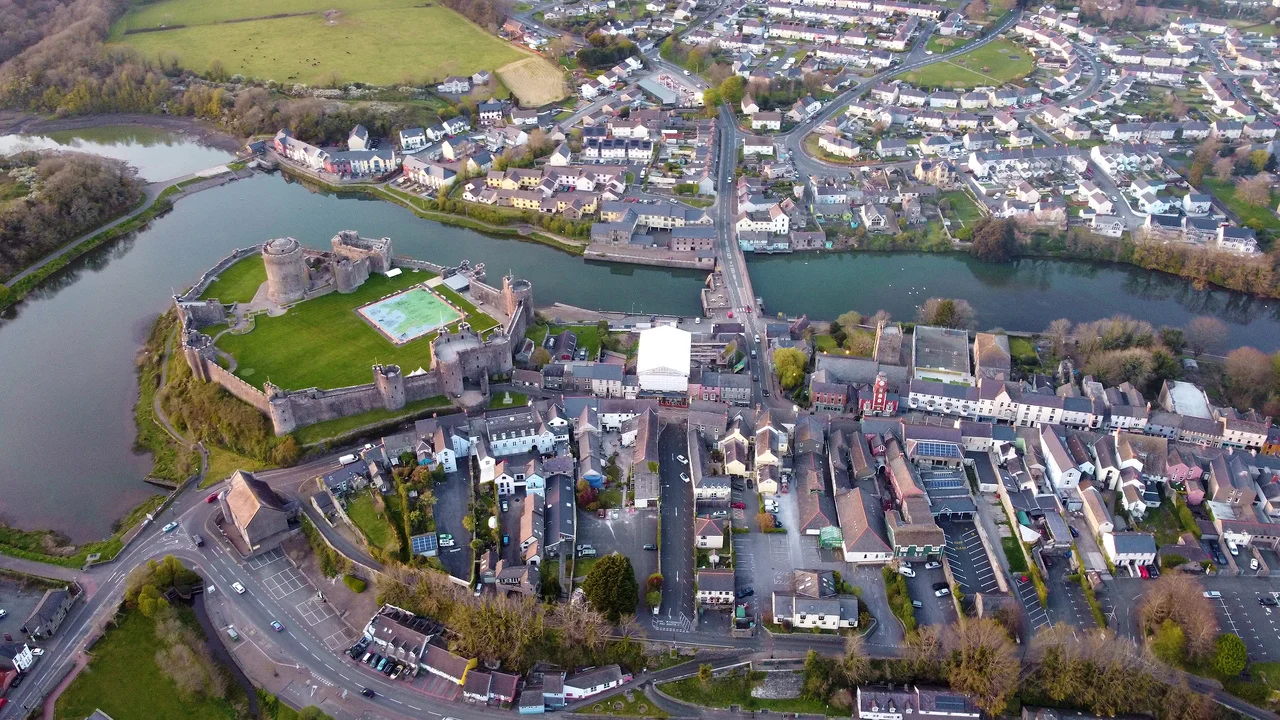
Pembroke means 'Land's End' - or possibly 'headland' - depending on which medieval scribe you trust. Both readings work. The town sits at the western tip of a long limestone peninsula, surrounded by tidal water on three sides, with the River Cleddau finger-painting estuaries through the woodland to the north. The Normans recognised the spot's military logic immediately. Arnulf de Montgomery began the first castle here in 1093, a wooden affair that grew into stone, and Pembroke became the bridgehead of an English-speaking colony so distinct from the Welsh-speaking interior that medieval writers called it 'Little England beyond Wales'. The Landsker line - the cultural and linguistic border between Welsh north and English south Pembrokeshire - still exists today, mostly invisible, occasionally audible in pub conversations.
The Castle That Never Fell
Pembroke Castle was never taken by storm. Not by Welsh princes, not by Owain Glyndwr - whose long rebellion stopped at its walls - and not by King Charles I's Cavaliers during the English Civil War. The castle's final extension around 1254 was followed by perimeter walls around the town itself, and a great deal of those medieval defences survive on their original foundations. The burgage plots laid out by the Earls of Pembroke, narrow strips of land running back from the single curving Main Street, are still walked today by people fetching milk. Even Oliver Cromwell, who eventually broke the town in 1648 after a fifty-day siege, had to wait for the defenders to run out of food. He stayed afterwards at the York Tavern on Main Street, in a building that had begun life as a medieval chapel.
Margaret's Son
Edmund Tudor was twenty-five when he died. Margaret was twelve when he married her and thirteen when their child was born. She would later say the labour was difficult and that she nearly died of it; she had no other children, ever. The baby was raised by his uncle Jasper Tudor at Pembroke, then smuggled into Brittany when the Wars of the Roses turned against the Lancastrian cause. He grew up in exile speaking French and waiting. When he finally returned in 1485, landing at Mill Bay near Dale, he marched north with a small army and met Richard III at Bosworth. The crown that fell from Richard's helmet that day is the one Henry VII wore home. He named his first son Arthur - a deliberate gesture toward the Welsh kingdom's old myths - and made the Tudor rose his badge.
Dock and Powder
Three miles to the northwest, the Royal Navy founded Pembroke Dock in 1814, and the old town suddenly had a much louder neighbour. The dockyard turned out 263 warships before it closed in 1926. Now the conurbation has a combined population near sixteen thousand, with the towns sharing schools, a rugby derby, and a power station rated at 2,000 megawatts that opened in 2012. The school, formerly Pembroke School, was renamed Henry Tudor School in 2018 - a 21st-century reach back to the 15th. The old grammar school crest is gone; the boy born in the castle still gets his name on the gates.
Walking the Walls
Visitors arrive expecting a ruin and find a town. Pembroke Castle is the most complete of any in Wales, restored carefully in the 20th century and still possessing the immense round Great Keep that William Marshal built around 1200. From the battlements you look down on the millpond - originally a tide mill granted to the Knights Templar in 1199, the building that ran on it lasting until a 1956 fire - and across to the Norman walls of Monkton Priory on the opposite hill. Main Street's stone houses press up against the curtain wall on one side and the water on the other. If you stand in the courtyard at dusk and squint, you can almost hear the dynasty being born.
From the Air
Located at 51.676 N, 4.916 W on the south Pembrokeshire coast. Recommended viewing altitude 2,500-4,000 feet. The castle sits at the western tip of a limestone peninsula at the head of the Pembroke River; the millpond and town walls form a clear shape, with Pembroke Dock to the northwest. Nearest airports: EGFE Haverfordwest (8 nm north), EGFH Swansea (38 nm east), EGOV Valley (130 nm north). The Milford Haven waterway carries significant tanker traffic - check NOTAMs for any oil-terminal-related restrictions.
Nearby Stories
- Gower Peninsula 0.2 km away
- St Davids Lifeboat Station 3.6 km away
- Dryslwyn Castle 8.1 km away
- Action of 17 November 1917 8.4 km away
- 102.5 Radio Pembrokeshire 9.6 km away
- Ilfracombe Lifeboat Station 15 km away
- Lighthouses on Lundy 19 km away
- Tehidy Country Park 121 km away