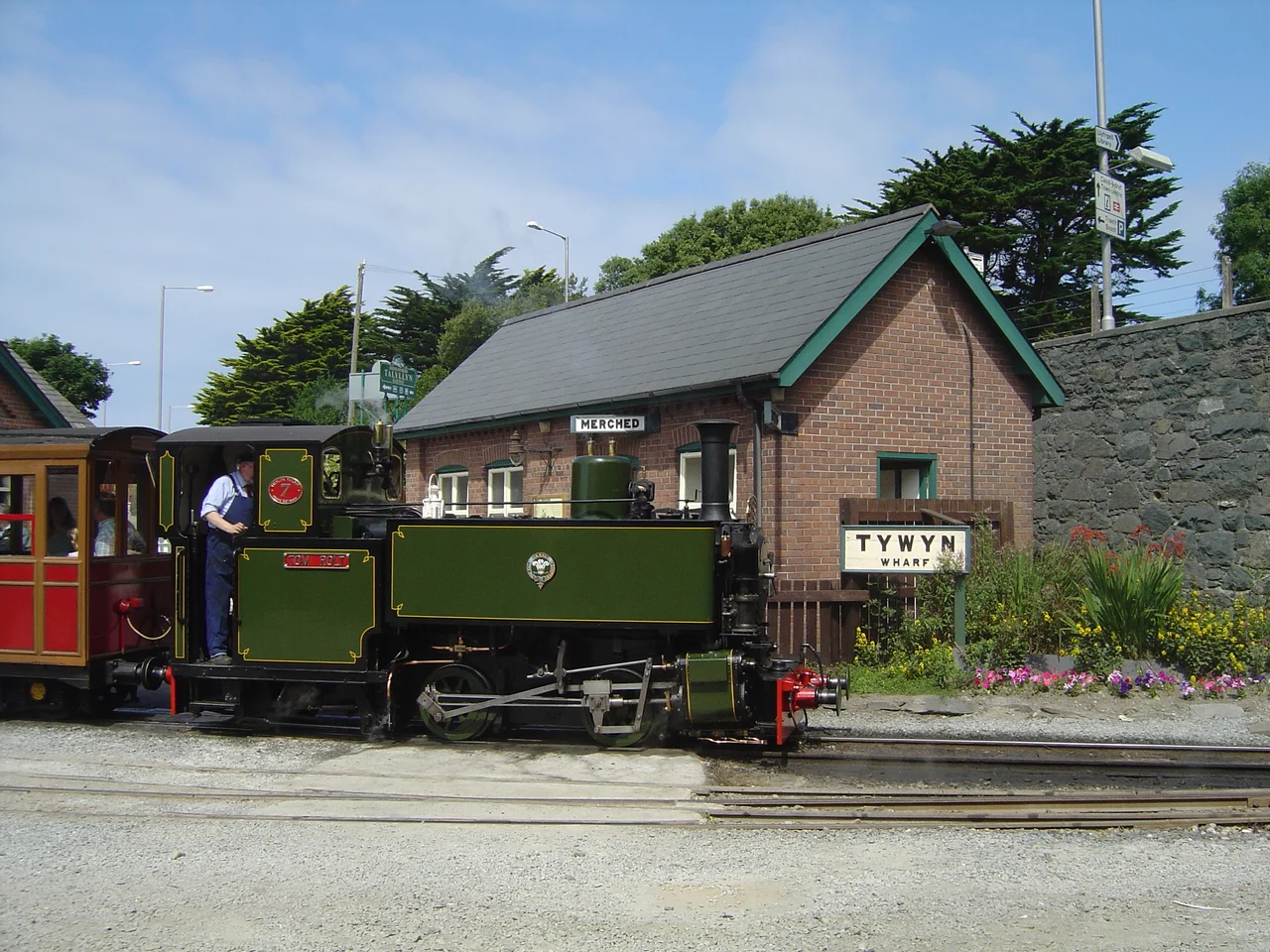

Talyllyn Railway
In the summer of 1949 the author Tom Rolt visited a small slate-hauling railway in mid-Wales and saw something that no one had quite seen before. The locomotives were old, the track was uneven, and the only thing keeping the line alive was the stubbornness of an elderly Welshman named Henry Haydn Jones who had promised never to close it. By 1950 Jones was dead and the line was clearly about to vanish. Rolt wrote a letter to the Birmingham Post. The replies came in. By October 1950, around seventy enthusiasts had gathered in a Birmingham hotel to discuss whether it might be possible for ordinary people, not the state and not a company, to take over a railway and run it themselves. They voted yes. On 14 May 1951, the Talyllyn Railway re-opened under volunteer control, the first preserved railway anywhere in the world. Everything that came after - every heritage line in every country - began with that decision.
Slate from Bryn Eglwys
The railway had opened in 1865 to carry slate from the Bryn Eglwys quarry, seven miles up in the hills above Tywyn, down to the coast where it could be transferred to ships and main-line trains. It was the first narrow gauge line in Britain authorised by Act of Parliament to carry passengers using steam haulage, a quietly important distinction. The original two locomotives, Talyllyn and Dolgoch, are both still in service 160 years later, although so much of their metal has been replaced down the decades that the question of what counts as the same locomotive becomes philosophical. The quarry was opened by William McConnel, a Lancashire mill owner looking for new business after the American Civil War cut off his cotton supplies. The railway was his solution to the transportation problem; for some decades it worked. The slate boom faded in the 1880s, and from then on the line limped along.
Haydn Jones and the Promise
In 1911 the railway was bought by Sir Henry Haydn Jones, the local MP, who had no real expectation of making money from it but was unwilling to see it closed. The quarry collapsed in December 1946 when weakened support columns failed underground; the slate trains stopped. Jones kept the passenger service running anyway, two days a week, on a shoestring. The railway was forgotten when British Railways was nationalised in 1948; nobody at the Ministry of Transport seems to have realised the Talyllyn was still operating. Jones died on 2 July 1950 and his executors had no idea what to do. The line ran out the rest of the summer season and was expected to close forever in October. The committee that Tom Rolt assembled at the Imperial Hotel had two months to figure out how to take over a working railway. They had no manuals. There was no precedent.
The Boy's Own Years
The first volunteer season was, in the words of one historian, characterised by "a Boy's Own comic spirit of adventure, involving enthusiasm, ingenuity and a fair degree of irresponsibility." Dolgoch was the only working locomotive when the Society took over, and Dolgoch needed an overhaul. Two locomotives were bought in 1951 from the closing Corris Railway and named Sir Haydn and Edward Thomas. Sir Haydn promptly began derailing on every curve, because the Talyllyn track had been deliberately laid half an inch wide of gauge for decades to accommodate the long wheelbase of locomotive No. 1. Number 4 arrived unserviceable; the chairman of the Hunslet Engine Company, a Society member, had it overhauled at his works for nothing. The line was relaid to correct gauge in stages. The track was rebuilt. The carriages were rebuilt. Volunteers slept in tents and drank tea brewed on the locomotives. On 22 May 1957 the BBC produced a live broadcast from the railway and that summer's passenger numbers passed 57,500. The Talyllyn was no longer dying.
Skarloey and the Reverend Awdry
One of the early volunteers was a Cheshire vicar named Wilbert Awdry, who had been writing small children's books about an island called Sodor and a tank engine called Thomas. The Talyllyn became the model for Awdry's fictional Skarloey Railway. Locomotive No. 1 Talyllyn became Skarloey in the books; No. 2 Dolgoch became Rheneas. The line's preservation also inspired the 1953 Ealing Comedy The Titfield Thunderbolt, in which a fictional village rescues its branch line from closure. The film made volunteer preservation seem charmingly possible at exactly the moment the Talyllyn was proving that it was. By the 1960s preserved railways had begun to appear across Britain. Today there are dozens. They exist because seventy enthusiasts in a Birmingham hotel decided to try something nobody had tried before, and because it worked.
World Heritage and Nant Gwernol
In 1976 the railway extended itself a half-mile beyond Abergynolwyn to a new station at Nant Gwernol, the first piece of new narrow gauge alignment laid in Britain for many decades. The line that had been built to carry slate finally reached, in a sense, the foot of the incline that the slate had once tumbled down. In 2005 the Wharf station at Tywyn was rebuilt, with the new Narrow Gauge Railway Museum embedded in the complex. In 2021 the Talyllyn was designated a World Heritage Site as part of the slate landscape of north-west Wales, an acknowledgement that what the volunteers had preserved was not simply a railway but the surviving evidence of an entire industrial culture. The line still climbs from Tywyn to Nant Gwernol, twenty-two minutes by steam, past Dolgoch Falls, on the same gauge it has used since 1865.
From the Air
Located at 52.58N, 4.09W with the line running approximately 7.25 miles inland from Tywyn on the Cardigan Bay coast to Nant Gwernol at the foot of Tarrenhendre. From the air, look for the small coastal town of Tywyn and follow the line of cleared track eastward into the deep wooded valley below the Cadair Idris massif. Dolgoch Falls lies at the midpoint of the line. Nearest airports: Llanbedr (EGFD) approximately 12nm north; Caernarfon (EGCK) approximately 30nm north; Welshpool (EGCW) approximately 35nm east. Recommended viewing altitude: 2,500-4,000 ft for the valley sweep and the surrounding Snowdonia peaks. Watch for orographic cloud off Cadair Idris in southwesterly weather.
Nearby Stories
- Penrhyndeudraeth 2.7 km away
- Cwmhir Abbey 11 km away
- Battle of Maes Moydog 13 km away
- HMS Whirlwind (R87) 14 km away
- Strata Florida Abbey 18 km away
- Bardsey Lighthouse 19 km away
- HMS H5 22 km away
- Llangollen Railway 23 km away