.jpg)
Llangollen Railway
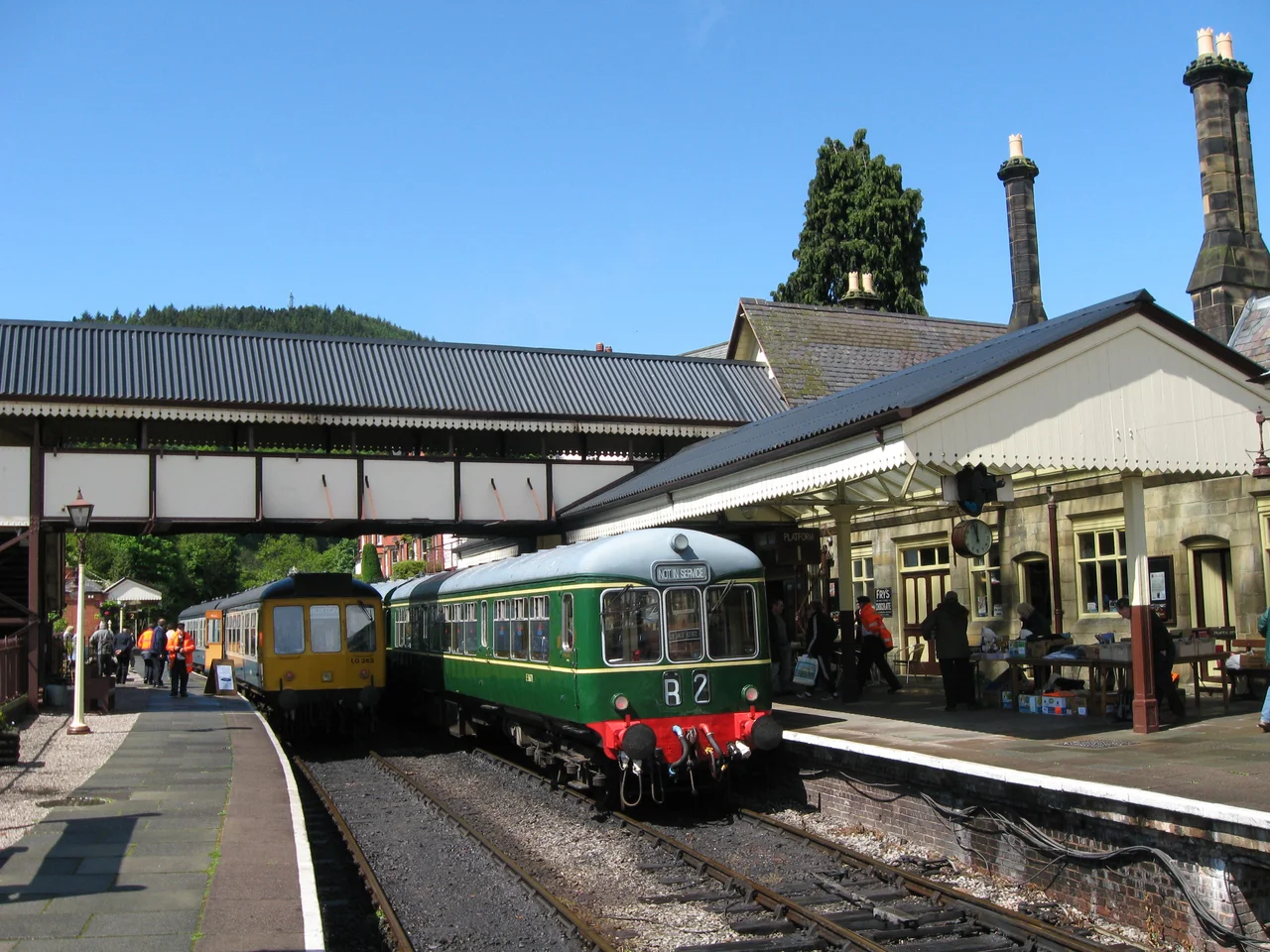
When the volunteers reopened Llangollen station on 13 September 1975, they had exactly sixty feet of track. Not sixty miles, not six hundred feet - sixty. The Ruabon-to-Barmouth line had been gone for a decade by then, lifted in May 1969 as part of the Beeching cuts. What the Flint and Deeside Railway Preservation Society inherited was an empty station building, a lease from the council, and an idea: that the local economy needed something to draw tourists, and that the trackbed up the Dee valley toward Corwen could be put back together. Almost fifty years later, the line runs eleven miles from Llangollen to a brand-new Corwen station opened in June 2023.
From Mining Boom to Mail Coach
Llangollen had been a tourist town since the 1840s, but reaching it required a stagecoach from the Shrewsbury-Chester railway. By the late 1850s, local mining made a proper railway essential. After several rejected schemes - including one by the London and North Western Railway - a plan engineered by Henry Robertson received Royal Assent on 1 August 1859. The Vale of Llangollen Railway opened to freight on 1 December 1861 and to passengers on 2 June 1862, terminating at a temporary station on the town's eastern outskirts. The extension to Corwen, undertaken by the separate Llangollen and Corwen Railway company, required a long tunnel under the Berwyn Mountains. It opened, along with a new central Llangollen station, on 1 May 1865.
Closure and Reopening
The line eventually became part of the Great Western Railway's Ruabon-to-Barmouth route, a scenic east-west crossing of north Wales. Under the Beeching Axe, passenger services ended in early 1965; freight followed in April 1969, and the track was lifted by May. The Flint and Deeside Railway Preservation Society was founded in 1972, initially eyeing the Dyserth-to-Prestatyn branch, but that line still saw small amounts of freight. They turned to the closed Llangollen-Corwen stretch instead. Denbighshire County Council granted them a lease on the station building and three miles of trackbed, and on 13 September 1975 the station reopened with that famous sixty feet of track. Re-laying took years. Mileposts crept westward: a little further each season, station by station, until the trains finally rolled into Corwen permanently in June 2023.
The Receivership
The railway nearly did not make it that far. By 2018 the operating company was making heavy losses - £330,601 that year, then £329,175 in 2019, and another £258,804 in 2020. A March 2020 emergency raised £125,000 in donations and bought time, but the COVID-19 pandemic closed everything down weeks later. The Dee Bridge needed urgent repairs. The line was awarded £161,000 from the National Lottery Heritage Fund in August 2020 but had to launch another emergency appeal in November. On 1 March 2021, with about £350,000 in debt and 'no prospect' of meeting its liabilities, the Llangollen Railway PLC invited its bank to appoint receivers. The line stopped running. Most heritage railways do not come back from this. This one did, because the Llangollen Railway Trust - the charity that had been raising money alongside the company - stepped in and took over operations. The trains were running again by July 2021.
Steam, Diesel and the Berwyns
The line is ten miles of standard gauge from Llangollen to Corwen, climbing gently up the Dee valley between the river and the road. It uses mainly former Great Western Railway steam locomotives and 1950s-built diesel multiple units. As of 2021 only one steam engine was operational - former GWR 2-8-0 No.3802 - though the volunteer crews work on others continuously. The route crosses the Dee Bridge just west of Llangollen station and then runs close to the river through Berwyn, Glyndyfrdwy and Carrog before reaching the new Corwen terminus. In 2002 the line hosted a recreation of the 1829 Rainhill Locomotive Trials - the contest that gave Stephenson's Rocket its fame - a deliberate piece of railway theatre that connected this small Welsh heritage line to one of the founding events of the steam age.
What the Trust Inherits
The Llangollen Railway Trust now runs a working museum that doubles as one of the more useful tourist draws in north-east Wales. Daily summer services, weekends in winter, special trains for Santa, fish-and-chip evenings, and increasingly ambitious gala days mix the work of preservation with the requirement to pay for itself. Whether the line can ever extend further - east towards Ruabon, west toward Cynwyd - depends on whether the original trackbed was protected from development, and in places it was not. For now, the eleven miles between Llangollen and Corwen are the prize. They were lost in 1965, restored over the next sixty years by people who mostly were not paid for any of it, and saved one final time in 2021. It is a story of stubborn, incremental persistence - the kind of thing that volunteer-run railways excel at, when they survive.
From the Air
The Llangollen Railway runs along the floor of the Dee valley between 52.97 and 52.99 degrees north, from roughly 3.16 degrees west at Llangollen to 3.38 degrees west at Corwen. The valley is narrow and steep-sided, with the Berwyn Mountains rising sharply to the south. Cruise at 2,500-4,000 feet for a clear view of the river, the railway and the parallel A5 trunk road. Hawarden (EGNR) lies about 20 nautical miles north-east. Mountain wave is possible over the Berwyns in strong south-westerly winds; the valley itself can channel and accelerate wind unexpectedly.
Nearby Stories
- Helsby 2.9 km away
- Coton Hill Rail Crash 4.4 km away
- Blaenau Ffestiniog 4.8 km away
- Holywell 7.9 km away
- Battle of Maes Moydog 9.6 km away
- PS Rothsay Castle 12 km away
- Barmouth Bridge 12 km away
- Combermere Abbey 13 km away