
Holywell
The water has not stopped flowing for fourteen centuries. It rises at a constant temperature from a fissure beneath the limestone of north-eastern Wales, pools beneath a late-medieval stone canopy carved with the Tudor rose, and runs onward down the Greenfield Valley toward the Dee estuary. Pilgrims have been coming to drink and bathe in it since around the year 660. Catherine of Aragon, Henry V, James II - the well's visitor list reads like a partial English coronation roll. St Winefride's Well is one of only a handful of pilgrimage sites in Britain to have functioned without interruption since the medieval period, surviving the Reformation, the Civil War, and the slow erosion of public faith. The town that grew around it took the obvious name: Holywell in English, Treffynnon - town of the well - in Welsh.
Winefride's Spring
The legend is bloody and exact. Winefride, a seventh-century Welsh girl of noble blood, refused the advances of a chieftain named Caradog. Caradog drew his sword and struck off her head. Where her head fell, the legend says, a spring burst from the ground. Her uncle, the abbot Saint Beuno, restored her - reattaching the head and bringing her back to life. Winefride lived another fifteen years as a nun and founded a religious community at Gwytherin in Conwy. Whatever the historical kernel - and there clearly was a Winefride, a Beuno, a martyrdom - the spring at Holywell became a pilgrimage site by the late seventh century and has been receiving pilgrims ever since. The current chapel canopy over the well, with its fan-vaulted stone roof and its star pattern in the floor, was built in the late fifteenth or early sixteenth century at the expense of Margaret Beaufort, mother of Henry VII.
The Lourdes of Wales
Of the medieval English shrines, most were stripped during the Reformation. Holywell survived. The Catholic priests who served the well in penal times kept the cult alive through the seventeenth and eighteenth centuries, and the Catholic revival of the nineteenth century brought the pilgrimage back into full public practice. By the late nineteenth century the town was billing itself as the Lourdes of Wales - an explicit pitch to the new Catholic pilgrimage market that Lourdes had created in France after 1858. Father Charles Sidney Beauclerk, who served the parish from the 1890s, did much of the rebuilding. The pilgrim hostel still operates, the bathing pool is still in daily use, and pilgrims from across Europe still drop wooden crutches and votive tokens at the well's edge. The site is one of the Seven Wonders of Wales.
Greenfield Valley
What sets Holywell apart from other shrine towns is the second life the spring built for it. The water that comes up at Winefride's well flows downhill through the Greenfield Valley at a constant flow and constant temperature, ideal conditions for water-powered industry. Through the eighteenth and nineteenth centuries the valley filled with mills - cotton, copper, brass, lead - drawing on the spring's predictable hydraulics. Thomas Williams, a lawyer from Anglesey turned copper magnate, built smelters in the valley and processed Anglesey ore into manilas for the African trade, neptunes for salt evaporation, and copper sheathing for ships. The Royal Navy clad its hulls in Greenfield copper. Two copper plates from HMS Victory - Nelson's flagship at Trafalgar - are preserved in the Greenfield Valley Heritage Park museum. The phrase 'copper-bottomed investment' came from the practice of sheathing the wooden hulls of Caribbean traders to protect them from worm and weed.
Town on the Hill
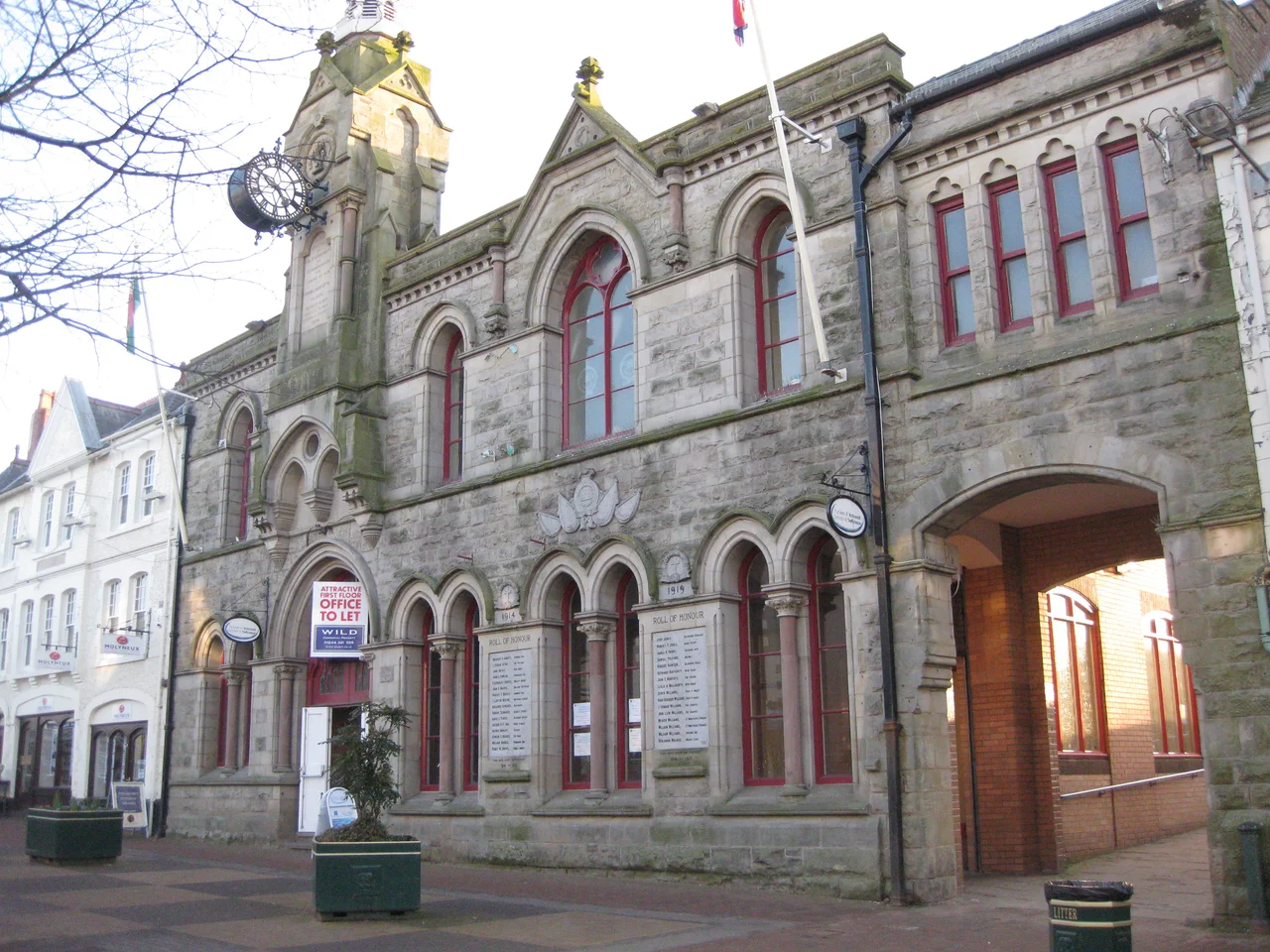
The town climbs the hillside above the well in tight terraced streets, with the Town Hall of 1896 marking the prosperous Victorian moment when industry and pilgrimage together filled the place. St James' Parish Church, grade II* listed, sits at the centre. The Strand, Pen-y-Maes, the Holway, and the town centre divide the modern settlement into four districts, with the near-contiguous village of Greenfield reaching down toward the estuary along the B5121. The Chester and Holyhead Railway came through in 1848 with a Francis Thompson station at Holywell Junction in Greenfield, and a steep branch line climbed up to a town station in 1912. Both stations closed in the mid twentieth century - Holywell Town in 1954, the junction station in 1966 - and the branch line is now a tarmacked path through the valley. There is a campaign to reopen the junction station.
Faces of Holywell
The grammar school produced an unusual concentration of public figures. Emlyn Williams, the playwright and actor, studied there in the 1920s. Jonathan Pryce - High Sparrow, Mr Dark, two Bond villains - was a Holywell Grammar pupil in the 1950s. Ann Clwyd, who served as MP for Cynon Valley for thirty-five years, went there too. The naturalist Thomas Pennant lived at nearby Downing Hall and corresponded with Gilbert White. Frederick Rolfe, the eccentric novelist who called himself Baron Corvo, was born here and died in Venice in 1913. Four Welsh international footballers - Mike England, Ron Davies, Barry Horne, and Gerry Hitchens (who is buried here) - either came from or retired to the town. The waters apparently flow through more than just the pilgrim pool.
From the Air
Holywell sits at 53.274°N, 3.223°W on the limestone slopes above the Dee estuary in north-east Wales. The town climbs a steep hillside facing north-east toward Greenfield and the estuary, with the parish church and Town Hall marking the centre. Best viewed at 2,000-3,000 feet AGL. Nearest airports are Hawarden (EGNR) 12 nm south-east, Liverpool John Lennon (EGGP) 15 nm north-east, and Caernarfon (EGCK) 40 nm west. Look for the Dee estuary to the north and the line of the A55 coast road - Holywell stands on the south side of the estuary at the foot of the limestone scarp that runs west to Prestatyn.
Nearby Stories
- Dolwyddelan Castle 4.6 km away
- Silver Jubilee Bridge 5 km away
- PS Rothsay Castle 11 km away
- Horseshoe Pass 12 km away
- Battle of Bamber Bridge 16 km away
- Combermere Abbey 17 km away
- Birkdale Palace Hotel 21 km away
- Celtic Array 40 km away