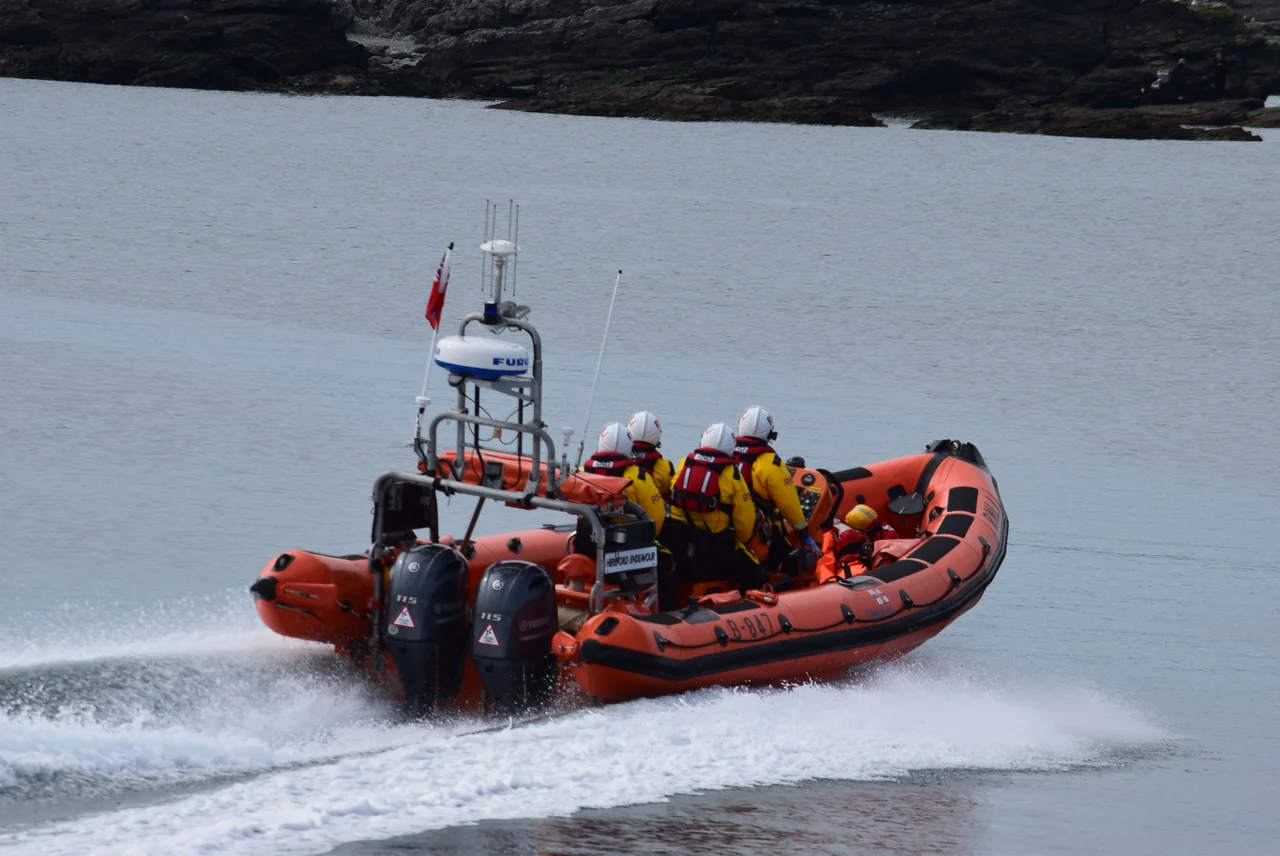

Trearddur Bay Lifeboat Station
On 20 May 2021, the wind off Holy Island reached gale Force 9 from the southwest - sustained 47 miles an hour, gusts well past 60, breaking seas of three to four metres. A female surfer caught out by the rising weather was being driven by waves and current toward the Cod Rocks, a low reef that has been killing swimmers and small craft at Trearddur Bay for as long as anyone has lived there. She had become exhausted; the surf was forcing her under the water repeatedly. The Trearddur Bay RNLI Atlantic 85 lifeboat launched into conditions at the operating limit of the class. What happened next put the helm, Lee Duncan, into the small group of British lifeboat crew to have been awarded the RNLI Silver Medal - and made the rescue the first ever in which the Atlantic 85, a workhorse design in service since 2005, earned its highest honour.
An Idea From the Sixties
The RNLI's inshore lifeboat programme began in 1964. The service had spent more than a century building bigger, slower, all-weather boats for the long deepwater rescues - the lifeboats of legend, with their oilskinned crews and gold medals. But by the post-war years, the rescue work was changing. Holiday weekends brought sailors, surfers, paddlers, dinghy crews, all needing help in the half-hour window between trouble and tragedy that the heavy boats simply could not close. So the institution distributed twenty-five small, fast inflatable inshore lifeboats around the British coast, manned by three or four people, launched from a beach trailer in a few minutes. Trearddur Bay - a long shallow bay on the west coast of Holy Island, with its surfers, holiday-makers and famously treacherous tide-races around Cod Rocks - was an obvious candidate. The station opened in May 1967. The first rescue came on 4 June. The boathouse was built in 1971.
Two Boats, Constant Service
Today the station operates two inflatable lifeboats. The bigger Atlantic 85, Hereford Endeavour (B-847), has been on station since 2010 - rigid-hulled, twin-engined, capable of 35 knots, designed to work in conditions and at distances the smaller boat cannot. The smaller D-class, Clive and Imelda Rawlings II (D-885), arrived in 2024; it is a single-engined inflatable for inshore work in calmer conditions and tight spots. A new boathouse went up in 1993 with crew room, workshop, fuel store and a small souvenir shop run by volunteers - the kind of building that doubles as the social centre of the local lifeboat community. The crew are volunteers in the old sense: plumbers, teachers, hoteliers, retired soldiers, people who drop what they are doing and run for the boat when the pager goes off, no matter the weather or the hour.
Medals and the Cod Rocks
The Cod Rocks have a long entry in the station's casualty log. In 1971, John Burns and Edmund Williams won RNLI Bronze Medals for rescuing two people clinging to a capsized dinghy on those same rocks. In 2001, Christopher Pritchard was honoured for pulling three people off a capsized speedboat. In 2006, Terry Pendlebury was commended for helping save two divers. And in May 2022, in a ceremony at the Royal Festival Hall, Lee Duncan accepted the Silver Medal for the May 2021 surfer rescue while his three crewmates - Dafydd Griffiths, Leigh McCann and Michael Doran - received Bronze Medals. The citation describes Duncan bringing the lifeboat in close enough to the rocks to lift the casualty out of the water while keeping the boat from being smashed by the same surf that was drowning her. The Atlantic 85 had been in service for sixteen years; this was the first time a crew aboard one had been judged to have performed at the highest standard the RNLI recognises. The surfer survived. So did the crew. The boat went back out the next time the pager sounded.
From the Air
Trearddur Bay Lifeboat Station sits at 53.281N, 4.620W on the southwest coast of Holy Island, about 2 nm south of Holyhead. From the air, the long arc of Trearddur Bay is unmistakable - white sand, blue-green water, the village strung along the foreshore. The Cod Rocks are the cluster of dark rocks at the south end of the bay. Nearest airfield is RAF Valley (EGOV) 4 nm southeast; Caernarfon (EGCK) 17 nm south-southeast. Holyhead Mountain rises 220 m to the north - expect orographic turbulence in any northwesterly. The bay is overlooked by Trefignath neolithic tomb 1 km east, and by South Stack Lighthouse 3 nm to the north.
Nearby Stories
- Snowdon Mountain Railway 8 km away
- German submarine U-1051 8.3 km away
- German submarine U-246 11 km away
- Trwyn Du Lighthouse 13 km away
- Irish Sea Bridge 20 km away
- HMS Manners (K568) 34 km away
- HMS Tyler 47 km away
- Birkdale Palace Hotel 79 km away