_27.JPG)
Ruthin Castle
The stone itself gives the place its name. Rhudd-din - the red fort - rises on a sandstone ridge above the Vale of Clwyd, the rock so saturated with iron oxide that it glows almost orange at sunset. Dafydd ap Gruffydd began building here in 1277, brother to the last sovereign Prince of Wales and, for a brief moment, an ally of the English king who would soon undo his family. Within six years, Dafydd would be hanged, drawn, and quartered at Shrewsbury for rebelling against that same king. His castle survived him by nearly four centuries before Oliver Cromwell's men brought it down.
A Brother's Bargain
Edward I gave Dafydd this land in 1277, in gratitude for the help Dafydd had given the English crown against his own brother, Llywelyn ap Gruffudd, Prince of Wales. The gift came with the cantref of Dyffryn Clwyd - a working administrative district, not just a hilltop. Whether an Iron Age fort already stood on the red ridge or whether Dafydd's masons were the first to cut into the sandstone is unclear. What is certain is that the castle rose quickly, with twin-towered gatehouses and curtain walls built to Edwardian specifications. Within four years, Edward's queen Eleanor was in residence. Within six, Dafydd had switched sides again, joined a Welsh rebellion against Edward, lost his castle, and lost his life. The bargain held only as long as both men needed each other.
The Greys of Ruthin
After Dafydd's execution, the lordship passed to Reginald de Grey, Justiciar of Chester. The Grey family would run this corner of Wales for the next 226 years - a stretch of inheritance that turned the castle into a working seat of marcher power rather than just a frontier garrison. The arrangement nearly broke Wales. In 1400, a land dispute between Reginald Grey, 3rd Baron Grey de Ruthyn, and a neighbouring Welsh landholder named Owain Glyndŵr escalated into open rebellion. On 18 September 1400, Glyndŵr's men burned Ruthin to the ground, sparing little beyond the castle walls themselves. What had begun as a quarrel over fields became the last great Welsh uprising against the English crown.
Eleven Weeks and the Mines
By the English Civil War, the castle had fallen into disrepair, and its garrison rushed to make it defensible as parliamentary forces closed in. In 1646 the siege came. Eleven weeks the defenders held out behind the red walls, refusing terms, refusing surrender. They gave in only when the besiegers announced they intended to dig mines beneath the foundations and bring everything down at once. After the surrender, Cromwell's forces completed the work in slow motion. They slighted the castle - the formal term for organised demolition meant to deny a fortification to any future enemy - methodically pulling down towers, breaching walls, and leaving only enough stone standing to mark where the place had been.
Hospital, Hotel, Haunting
The ruins sat picturesque for nearly two centuries before the Victorians did what Victorians did: they built a country house among the broken walls. In 1923 the rebuilt castle became Britain's first private hospital for the investigation of obscure internal diseases, a strange medical institute tucked into a medieval shell. The hospital closed around 1950. Since the 1960s the place has been the Ruthin Castle Hotel - banqueting in the medieval hall, peacocks on the lawn, the original red sandstone walls forming three sides of the courtyard. Prince Charles slept here in 1969 the night before his investiture as Prince of Wales at Caernarfon. The hotel claims a resident ghost, and the television programme Most Haunted brought its cameras here in 2018 to investigate her.
Reading the Stone
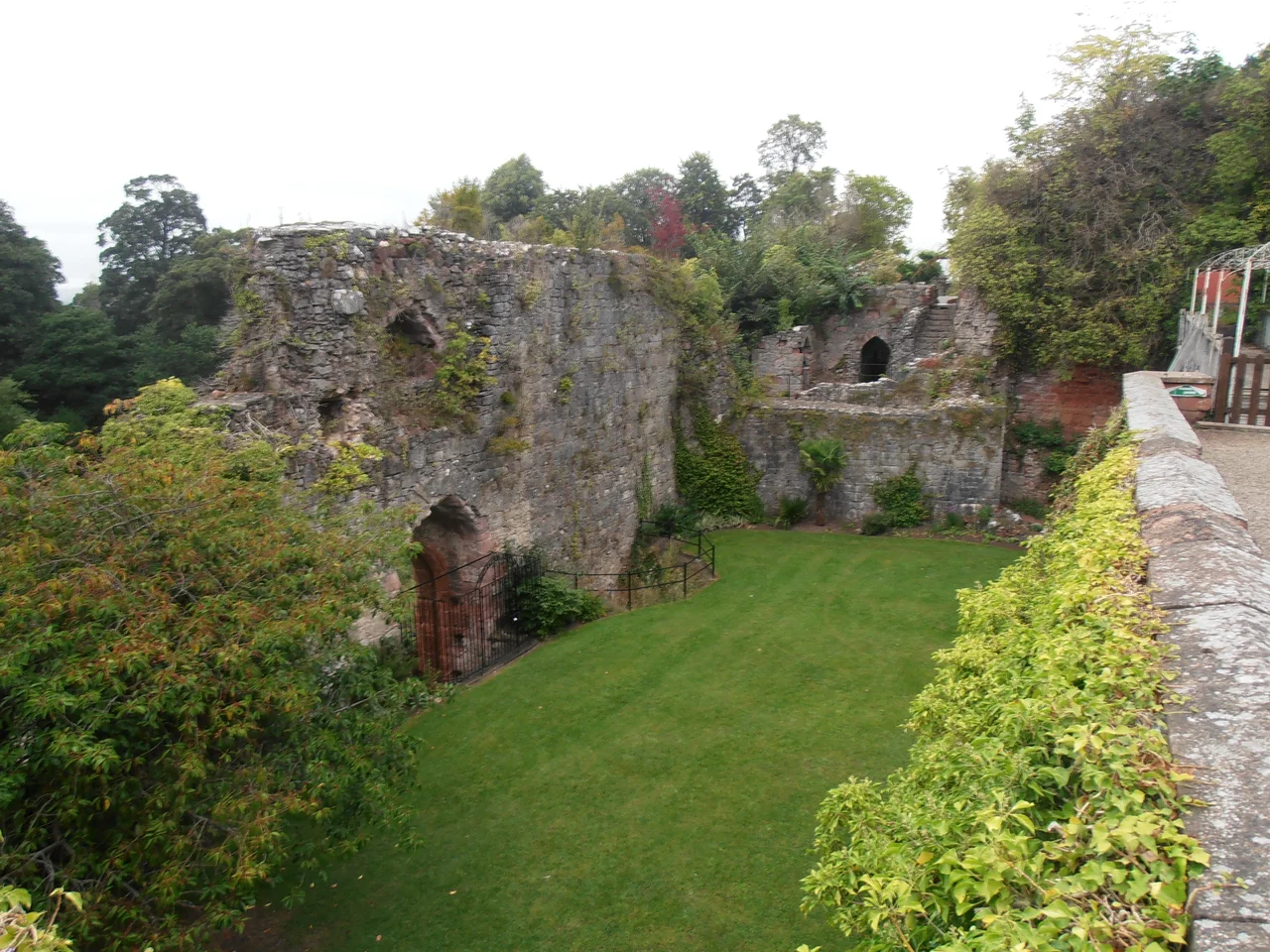
What survives today is a curated ruin wrapped around a working hotel. The original gatehouse, the chapel wall, fragments of the eastern range - red sandstone weathered to rose pink, some courses still showing the marks of medieval masons. The Iron Age earthworks beneath have never been fully excavated. Walk the grounds at dusk, when the stone catches the last light, and the layered logic of the place becomes visible: prehistoric ridge, Welsh princely seat, English marcher fortress, civil-war casualty, Edwardian hospital, twenty-first-century hotel. Six centuries of conquest, rebellion, demolition, and adaptive reuse, all on the same red hill above the same green valley.
From the Air
Ruthin Castle sits at 53.112°N, 3.312°W in the Vale of Clwyd of north Wales. The red sandstone ridge and its surviving towers are best viewed at 1,500-3,000 feet AGL, with the cleared lawns of the hotel and the wooded valley making the site distinctive against the surrounding pastureland. Nearest airports are Hawarden (EGNR) about 25 nm east and Caernarfon (EGCK) 35 nm west. Liverpool John Lennon (EGGP) lies 30 nm northeast. Weather in the Clwyd valley is often clearer than the coast - look for the cluster of medieval stone in the south of the vale.
Nearby Stories
- Carnedd Llewelyn 7 km away
- Tarporley 9.7 km away
- Battle of Winwick 14 km away
- RAF Shawbury 16 km away
- Cymer Abbey 17 km away
- New Brighton Lifeboat Station 19 km away
- Battle of Oswestry 20 km away
- Celtic Array 52 km away