
Tarporley
Every Christmas, in a low-slung Cheshire village of red-brick houses and Georgian inns, members of England's oldest surviving hunt club still gather as they have since 1762. The Tarporley Hunt Club outlasted the empire that birthed it, two world wars, and the legal ban on fox hunting itself. Its members no longer chase foxes across the Forest of Delamere, but they still meet, still toast, still keep alive a continuity that links a small village to nearly three centuries of unbroken ritual. Tarporley does this kind of thing quietly. The bypass on the A49 lets traffic skim past without noticing, and that suits the place perfectly.
Pears, Peasants, and Half a Pound
Open the Domesday Book to 1086 and you will find Tarporley listed as Torpelei, a name medieval scholars have argued over ever since. One reading gives "a pear wood near a hill called Torr," which is charming enough that the local Church of England primary school adopted the pear tree as its emblem. A less romantic alternative suggests Old English roots meaning roughly "a peasant's wood-clearing," from thorpere (someone who lives at a thorp) and leah (a forest glade). Either way, the entry tells a darker story. In 1066, the settlement belonged to Wulfgeat of Madeley and was assessed at one pound. Twenty years later, after the new Norman lord Gilbert the Hunter took possession, the value had halved to ten shillings. Eight households remained: four villagers, two smallholders, and two enslaved people. The collapse was not unique. William the Conqueror's Harrying of the North in 1069 and 1070 had scorched the region, killing and starving the population to enforce control, and Cheshire's small farming communities were still struggling to recover when the Domesday clerks rode through.
The Hunt That Outlived the Hunt
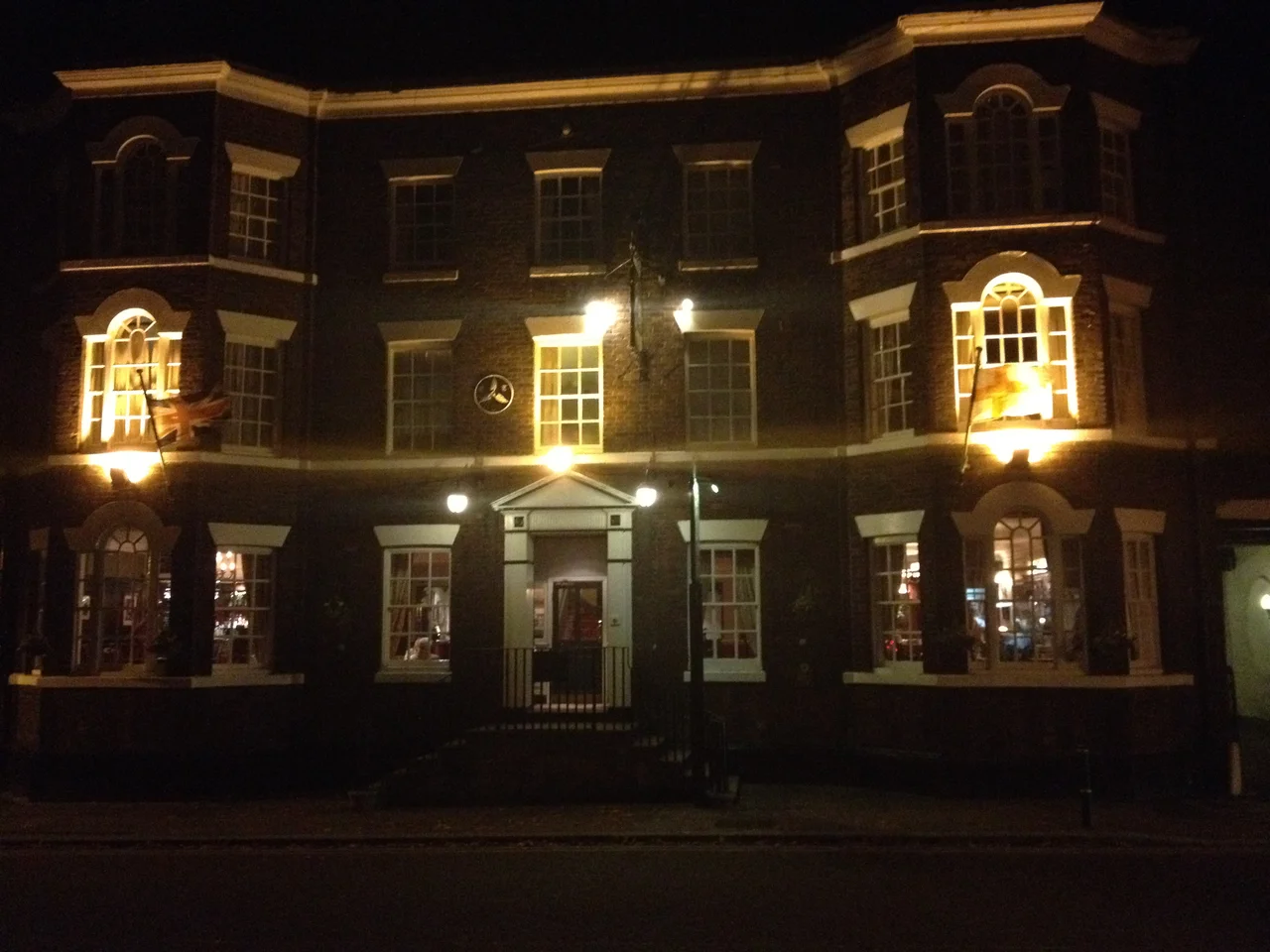
The Tarporley Hunt Club was founded in 1762 in the Swan Hotel, still standing on the High Street, when local gentry decided they needed an institution as much as a quarry. Membership was capped, ritual was precise, and the club's annual dinners became a fixture of Cheshire's social calendar. Pink coats, silver cups, and the kind of toasts that turn into traditions: the Tarporley Hunt Club outlasted Napoleon, the Crimean War, the Edwardian sunset, and finally the 2004 Hunting Act, which made fox hunting with hounds illegal in England and Wales. The club continues to meet, the Christmas gathering remains the central ritual, and members still take dinner in the Swan as their predecessors did under candle flame two and a half centuries ago. The hounds no longer run, but the ledger of names goes on.
From Local Board to Cheshire West
Tarporley's modern history is the kind of administrative shuffle that consumes English villages quietly. In 1863 the parish was declared a local government district under its own elected board. In 1894 it became an urban district, with the council meeting at the Public Hall on Forest Road. That hall is gone now, replaced by a private house numbered 37. The urban district itself was abolished in 1936 and split into three rural parishes, then folded into Northwich Rural District, then into Vale Royal in 1974, then into the unitary authority of Cheshire West and Chester in 2009. Each reorganisation moved decision-making slightly farther from the village green. The population, meanwhile, climbed from 674 in 1801 to 2,614 in 2011, the slow accretion of commuters who chose Tarporley for the look of it and stayed for the bypass that kept the lorries away.
Bows, Arrows, and a Botanist
Long before the Hunt Club's first dinner, people lived here. A Neolithic stone axe, a flint scraper, and a Bronze Age barbed-and-tanged arrowhead have been found within the parish boundaries: thousands of years of small lives leaving small traces. Among the better-known recent residents was Maria Elizabetha Jacson, who lived locally after 1787 when her father became rector. She wrote books on botany at a time when women authors of scientific works were a quiet rarity. Henry Shaw, the Victorian taxidermist who worked in Shropshire, was born here. So was Tom Oliphant, a British Touring Car Championship racing driver, and the footballer Will Goodwin. None of them are household names, but Tarporley has never tried for fame. It has tried, instead, for continuity, and continuity it has.
From the Air
Located at 53.16°N, 2.67°W in central Cheshire. From the air, look for the village set between the wooded Peckforton Hills to the south and the open Cheshire Plain. The A49 runs east of the village; the church spire of St Helen's is the main visual landmark. Recommended viewing altitude 2,000–3,500 ft for detail, higher for context with Delamere Forest. Nearest airports: Liverpool John Lennon (EGGP) 18 nm northwest, Hawarden (EGNR) 14 nm west, Manchester (EGCC) 20 nm northeast. Cheshire weather is typically maritime, often hazy in summer.
Nearby Stories
- Battle of Winwick 2.1 km away
- Astley Deep Pit Disaster 3.8 km away
- Moel Famau 6.5 km away
- Sandon Hall 6.7 km away
- RAF Tern Hill 8.2 km away
- Brindley Water Mill 8.7 km away
- Battle of Maes Moydog 31 km away
- Piel Castle 70 km away