_p4.048_-_Sandon_Hall,_Staffordshire.jpg)
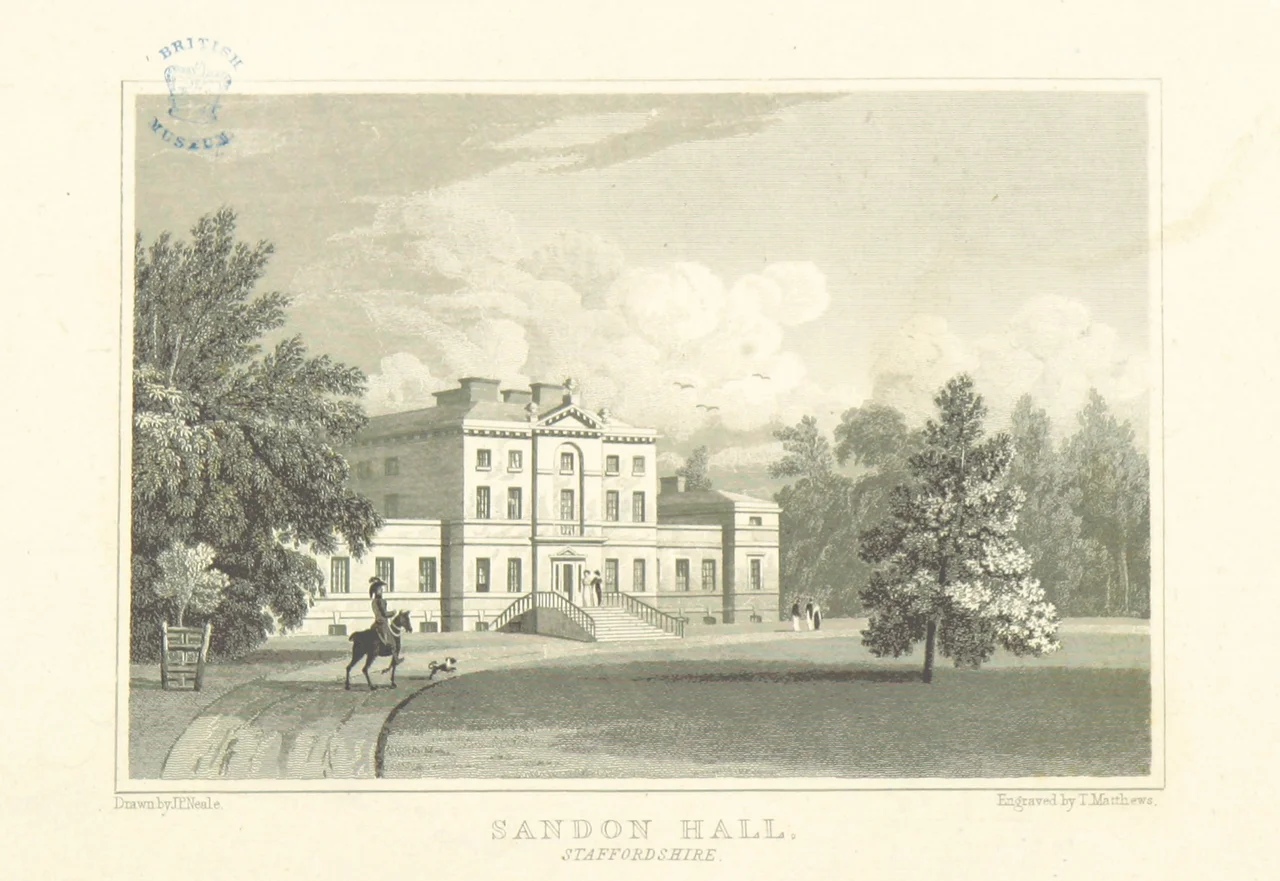
Sandon Hall
In November 1712, two men met before dawn in Hyde Park to settle a dispute about Sandon. James Hamilton, 4th Duke of Hamilton, had inherited the Staffordshire estate through his wife. Charles, Lord Mohun, claimed it through his. The lawsuit had dragged on for years, and one of them was about to die for it. They both did. The Hamilton-Mohun duel killed both principals within minutes and became one of the most notorious in English history, fuel for Walter Scott's pen and Thackeray's Henry Esmond. The house they fought over was already old then, already on its third rebuild, already passing from hand to hand through marriages and deaths and the kind of legal entanglements that ruined families. Today's Sandon Hall, set in 400 acres of parkland five miles northeast of Stafford, is the version that rose from a fire in 1848.
Before the Conquest
The manor's documented life begins with Aelfgar, Earl of Mercia, who held Sandon before 1066. The Conquest stripped him of everything. William the Conqueror gave the estate to Hugh d'Avranches, Lord Hugh Lupus, the fearsome Earl of Chester, who passed it down through his baron William de Malbanc of Nantwich. From there it moved by daughters and great-granddaughters into the hands of the Vernons and eventually the Staffords, a chain of inheritances stretching across three centuries before the Erdeswicke family arrived. Margaret Stafford carried the manor to Thomas Erdeswicke through marriage in 1339, the twelfth year of Edward III's reign. The Erdeswickes would hold Sandon for almost three centuries and bury their dead in the parish church, where their tombs still stand.
An Antiquary and a Conspirator
Sampson Erdeswicke, who died in 1603, was Staffordshire's first great antiquary, the man who wrote down the county's history before the slow erosion of memory could finish it. In 1593 he made a marriage that would entangle Sandon in one of the most violent plots in English history. His bride was Mary Neale, widow of Everard Digby Esquire of Tilton-on-the-Hill. Her son by that earlier marriage was the recusant Catholic Everard Digby, hanged, drawn, and quartered in January 1606 for his part in the Gunpowder Plot. Sampson and Mary's own heir, Richard Erdeswicke, served as Member of Parliament for Staffordshire but accumulated debts faster than rents could pay them. In 1624 he sold Sandon to his half-brother George Digby. The sale was completed in 1631. Richard died nine years later in Fleet debtors' prison and was buried at St Bride's, Fleet Street.
Wyatt, Fire, and the Pitt Column
After the Hamilton-Mohun duel scattered the estate, Sandon passed through the Hamilton dukedom for half a century. The 9th Duke, Archibald, demolished the old moated manor house in 1769 and replaced it with a new building by Joseph Pickford of Derby. The Hamiltons held it less than a decade. In 1776 the estate was bought by Nathaniel Ryder, the first Baron Harrowby, whose family has owned it ever since. The Ryders found Pickford's house unsatisfactory and hired Samuel Wyatt to extend and improve it. William Emes laid out flower gardens in the early 1780s. In 1806 they erected a Doric column to William Pitt the Younger, who had died that January at the age of 46, exhausted by his second premiership and the long war with Napoleon. Then in 1848 the house burned. Dudley Ryder, the 2nd Earl of Harrowby, hired William Burn to rebuild in neo-Jacobean style, and the result is what stands today, completed in 1852.
The Hall Now
Conroy Ryder, the 8th Earl of Harrowby, and his countess Caroline live at Sandon today. Like many great houses, the place earns its keep by adapting. A public wing has been renovated. Fifty acres of gardens are now available for weddings, where couples can exchange vows beside the Pitt column without quite realizing they are commemorating a Prime Minister who exhausted himself opposing Napoleon. Sandon parish church still holds the Erdeswicke tombs and the long memory of antiquaries, gunpowder plotters, dead duke, and Mercian earls. Most of the visitors come for the flowers.
From the Air
Located at 52.86N, 2.07W, five miles northeast of Stafford on the A51. From the air the parkland is easy to spot: 400 acres of mature trees around a pale stone house, with the Pitt column rising as a vertical accent in the south park. The Trent and Mersey Canal threads through the valley to the west. East Midlands Airport (EGNX) lies 32 nm east, Birmingham International (EGBB) 28 nm south. A circuit at 2,000 feet on a clear day reveals the parkland's full extent and the neo-Jacobean roofline reflecting whatever light the Staffordshire sky permits.
Nearby Stories
- Donington Park 2.3 km away
- Hamstead Colliery 3 km away
- Brindley Water Mill 7.3 km away
- RAF Tern Hill 7.3 km away
- Sherwood Observatory 13 km away
- Peckforton Hills 16 km away
- Caratacus' last battle 21 km away
- Battle of Naseby 32 km away