
Battle of Winwick
Two nights without sleep, two days without food, soaking wet, and almost out of dry gunpowder. That was the condition of the Scottish infantry when they turned at a small stream near Winwick on the morning of 19 August 1648 and decided to fight. They had run from Preston, marched all night through the rain, watched their cavalry abandon them at Warrington bridge, and now Cromwell's troopers were closing on the road behind. So they took shelter behind a hedge-lined bank above Hermitage Brook and prepared to make a stand. By nightfall, a thousand of them would be dead, two thousand prisoners, and the Second English Civil War would be effectively over.
The Long Retreat
The fight at Winwick was the end of a chase that had begun two days earlier and 25 miles to the north. At Preston on 17 August, Cromwell's much smaller Parliamentarian army had ambushed the strung-out Royalist column commanded by the Duke of Hamilton, cut off Marmaduke Langdale's English corps and broken its back in four hours of close fighting. By nightfall around a thousand Royalists were dead and four thousand captured. The survivors, mostly Scots, decided to flee south in the dark. To move fast they abandoned their baggage, their ammunition train and their artillery. None of it was destroyed before daylight, and all of it fell into Parliamentarian hands. By the time the Scots reached Wigan after another night march, men were falling asleep in their saddles. One Parliamentarian officer described the road, fields and ditches between Preston and Warrington as littered with the dead.
The Position at Red Bank
About nine miles south of Wigan, between the villages of Newton and Winwick, the road dipped down to cross Hermitage Brook. A steep bank rose on the south side of the valley, locally known as the Red Bank, and the ground around the ford was thick mud. Hedges lined the slope above the stream. For an army with no powder left and almost no cavalry support, it was as good a position as anything in Lancashire. The Scottish commanders placed pikemen at the ford and the other crossing points, lined the hedges with what musketeers still had dry powder, and sent the cavalry on ahead three miles to Warrington to secure the bridge over the Mersey. The plan was simple: hold the infantry attack long enough for a clean withdrawal across the river. The plan went wrong almost immediately. The cavalry crossed the bridge without waiting, leaving the infantry exposed.
Three Hours of Push of the Pike
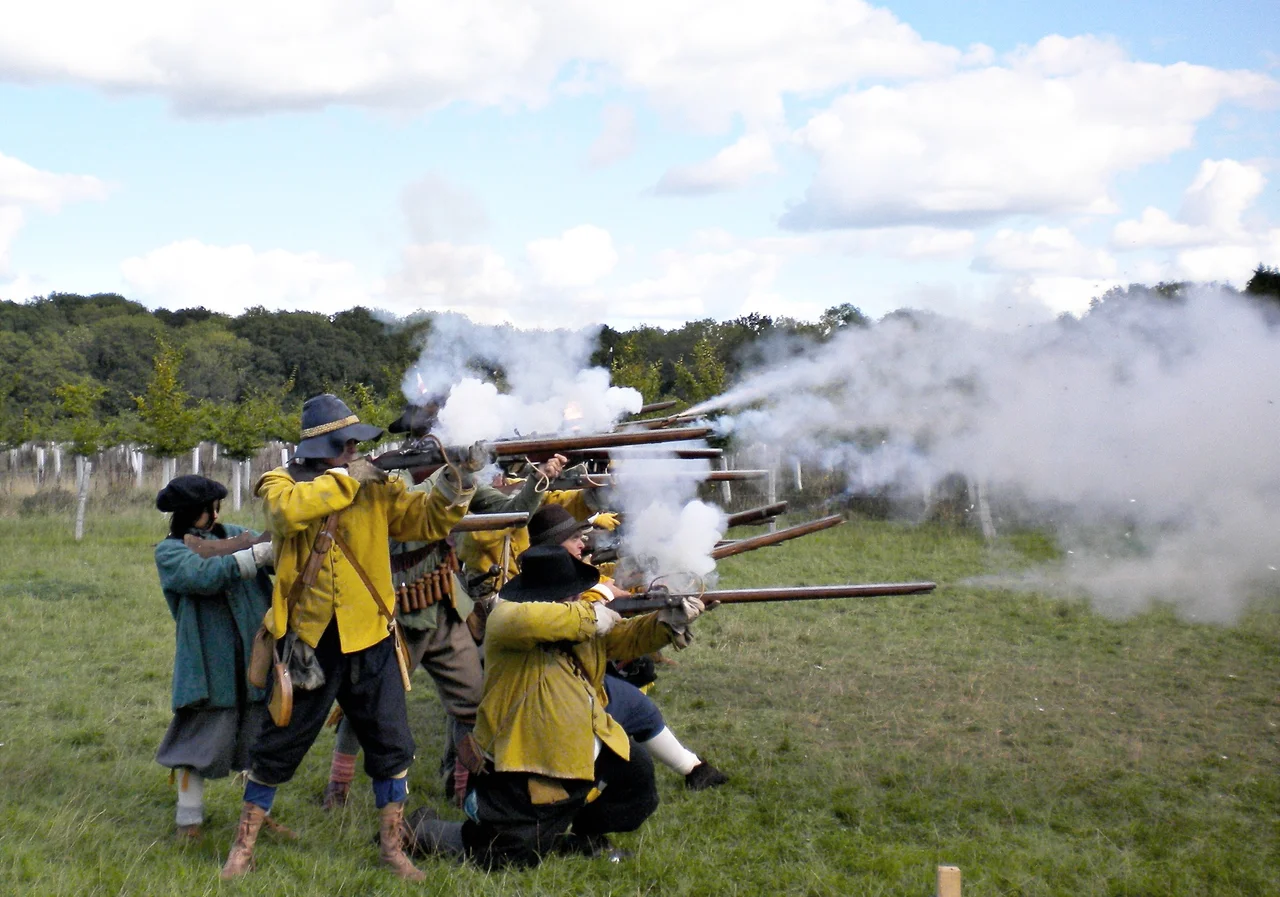
The Parliamentarian advance guard rode straight into the Scottish position and was, in the words of Lieutenant John Hodgson, snaffled and put to retreat. A pause followed while Parliamentarian infantry caught up. Then Colonel Thomas Pride's regiment led the first push of the pike up the muddy slope and was thrown back. They came on again. For more than three hours the lines met across the brook in close-quarter fighting that contemporaries on both sides described as ferocious. Cromwell himself, not a man given to acknowledging difficulty, wrote of his troops charging very hard upon them. The Scottish musketeers had little powder left and what they had was wet; much of the fight came down to pike work, sword and musket butt. The historian Trevor Royle later wrote that both sides fought with equal ferocity and determination.
The Flank March
Cromwell broke the stalemate by sending his infantry on a wide loop to the east, through woods and dead ground. Local people, Lieutenant John Sanderson recorded afterwards, showed his men the best route. As the Parliamentarian column emerged on the Scottish right flank, the exhausted defenders saw it and their line collapsed. About half broke towards Winwick village and were chased down by 300 Parliamentarian cavalry. Many were cut down on the road; the rest threw down their weapons and crowded into the parish church, where they were taken prisoner. The remaining 2,600 followed their vanished cavalry toward Warrington. When they reached the bridge they discovered Hamilton had abandoned them with a message saying he would preserve himself for a better time. Their commander, William Baillie, turned to his staff and begged any of them to shoot him through the head.
What the Battle Ended
Winwick was the last battle of the Second English Civil War. News of it reached the Royalist garrison at Colchester within days, and they surrendered to Fairfax on 27 August on harsh terms. Hamilton was caught at Uttoxeter on 24 August and beheaded the following March. Cromwell, who called the victory at Winwick nothing but the hand of God, marched on to Edinburgh. Within five months Charles I had been tried, convicted and executed; within nine months England was a republic. The battlefield itself, listed by Historic England on the Register of Historic Battlefields in 2018, is the only surviving battlefield of the Second Civil War still in good condition. The line of Hermitage Brook and the climb of the Red Bank above Hermitage Green Lane can still be traced through the modern fields and edge-of-village housing.
From the Air
Located at 53.44N, 2.605W near the village of Winwick, just north of Warrington in Cheshire and about 16 nm east of Liverpool John Lennon Airport (EGGP). Manchester Airport (EGCC) lies 13 nm to the east. The site sits within sight of the M6 motorway as it runs north toward Wigan. From 3,000 ft, look for the village church of St Oswald and the line of Hermitage Brook running west to the Sankey valley. Weather is typically overcast Lancashire conditions with regular low cloud below 2,000 ft.
Nearby Stories
- Delamere Forest 4.5 km away
- Macclesfield Canal 4.7 km away
- Top Withens 6 km away
- Moel Famau 13 km away
- Hoylake Lifeboat Station 14 km away
- Whalley Abbey 15 km away
- Brindley Water Mill 18 km away
- Piel Castle 30 km away