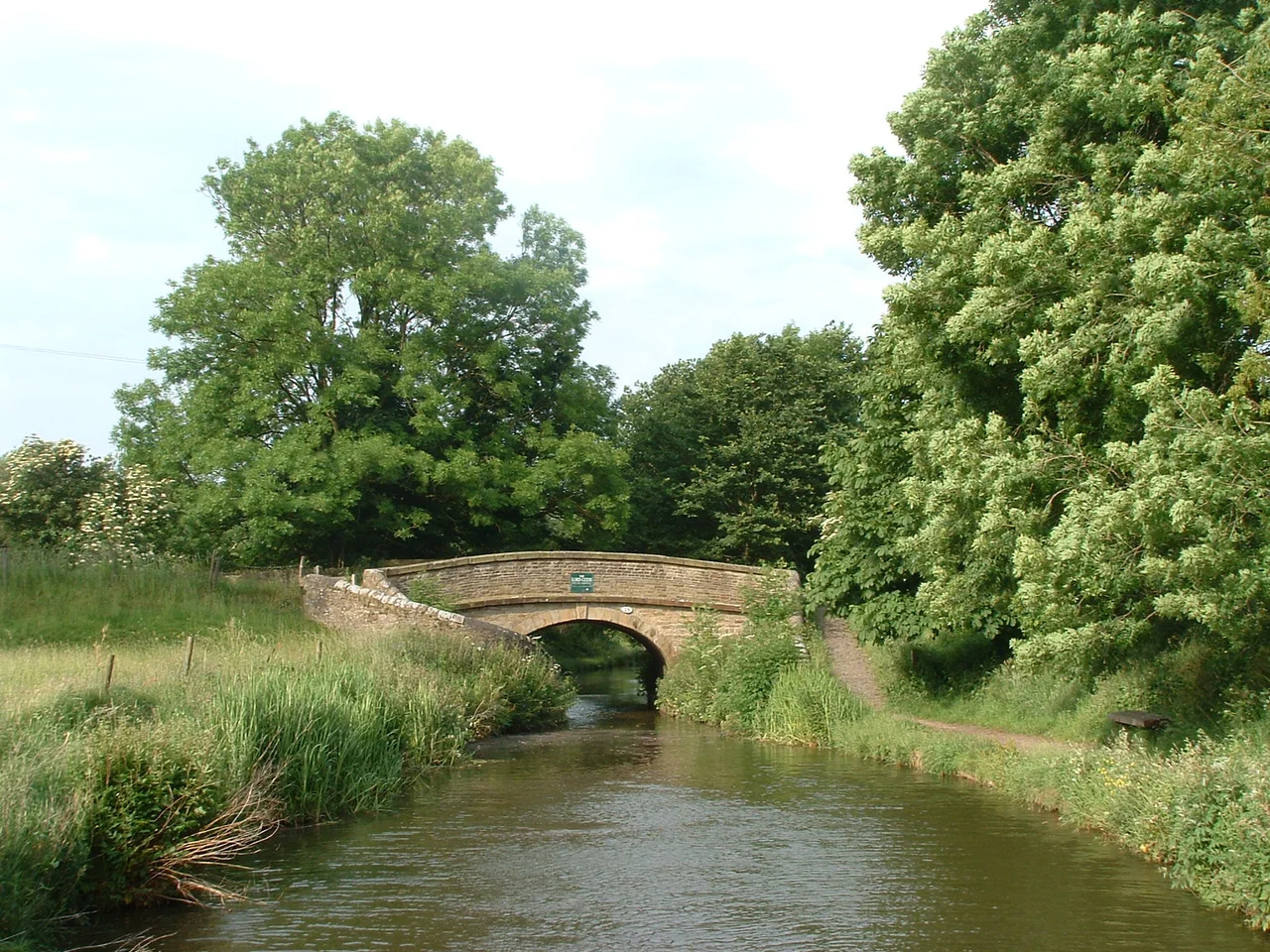

Macclesfield Canal
By 1824, when the gentlemen of Macclesfield finally placed an advertisement in the Courier proposing yet another canal scheme, the world had already begun to move on. Stephenson's Rocket was five years away. The Liverpool and Manchester Railway was being surveyed. At the very first public meeting at the Macclesfield Arms, someone in the room raised his hand and suggested they build a railway instead. The committee took a vote anyway. They chose canal. They were wrong, in the long run, but they were also right: the thing they built, a Thomas Telford canal of cuttings and embankments and elegant snake bridges, is still here.
Sixty Years of Trying
The Macclesfield Canal was a long time coming. The first proposal arrived in 1765. A more serious attempt followed in 1796, when Benjamin Outram, then engineering the nearby Peak Forest Canal, surveyed possible routes. But the financial euphoria of Canal Mania had ended, and there was no money. Further proposals failed in 1810, between 1814 and 1818, and again in 1824. There was even a doomed earlier scheme by Charles Roe, the Macclesfield silk manufacturer who had discovered the great copper mine at Parys Mountain in Anglesey. Roe wanted a canal to carry his ore from Liverpool to Macclesfield for smelting. The bill passed Parliament but was thrown out by the House of Lords through the influence of the Duke of Bridgewater, whose own canal had just opened. Roe gave up the copper business. Sixty years later, his successors finally got their water route.
Telford's Straight Line
Thomas Telford surveyed the route in 1825 and proposed a 26-mile canal level all the way from Marple to a point beyond Macclesfield, then dropping by a single concentrated flight of locks to meet the Trent and Mersey near Harecastle Tunnel. The act of Parliament passed on 11 April 1826. Construction began that December at Bollington with a ceremonial cutting of the first sod. Telford himself contributed £1,000, chose the contractors, and then largely walked away. The civil engineering was managed by William Crosley, who had resigned from the Lancaster Canal to take the job. Crosley built it in Telford's signature "cut and fill" style: deep cuttings through hills, tall embankments across valleys, the route held as straight as the geography would allow. He also reduced the number of planned reservoirs from five to two, at Bosley and Sutton, and shortened the canal by two miles in the process.
Twelve Locks in One Mile
All twelve of the Macclesfield Canal's locks are squeezed into the Bosley flight, where the canal drops 118 feet in roughly a mile. Unusually, each lock has twin mitred gates at both ends rather than the single upper gate typical of narrow canals. Below the bottom lock, a fine stone aqueduct, completed on 23 October 1830 and containing 10,212 cubic feet of stone, carries the canal over the River Dane on a single 42-foot semi-circular arch. The formal opening on 9 November 1831 was choreographed with theatrical precision: ceremonial processions of boats from Marple and Congleton timed to converge on Macclesfield simultaneously, a gun salute, the Band of the Macclesfield Cavalry playing God Save the King. The total cost came to about £320,000, only £25,000 over the original estimate, an almost unheard-of result for a Victorian infrastructure project.
Snake Bridges and Mills
The canal is famous for its roving bridges, the elegant single-arched structures that carry the towpath from one bank to the other without requiring the boat horse to be unhitched. Locally, they are called snake bridges. The towpath slopes up over the bridge and curls back under it on the opposite side, so the horse and tow rope flow smoothly across. They are listed Grade II, along with all twelve locks, five aqueducts, fourteen milestones, and most of the bridges. The canal passes the huge surviving mills of the industrial era, Goyt Mill at Hawk Green, Clarence Mill at Bollington, Adelphi Mill, and Hovis Mill in Macclesfield, where the famous flour was originally produced. Most have been converted now to offices, apartments, and small industrial units. At Gurnett Aqueduct, near the road to Macclesfield, a plaque marks the cottage where the canal builder James Brindley served his apprenticeship from 1733 to 1740.
From Coal to Pleasure Boats
The canal was sold to a railway company by 1846 and passed through successive corporate owners: the Manchester, Sheffield and Lincolnshire Railway, the Great Central, the LNER, and finally British Waterways. Commercial carrying continued, remarkably, until 1954. The High Lane Arm became one of the earliest leisure-boating bases in Britain, and in 1943 the North Cheshire Cruising Club was formed there, the first cruising club on the British inland waterways. When closure of the Ashton and lower Peak Forest canals threatened to isolate the northern end in the 1960s, vigorous campaigning by the Inland Waterways Association produced the Transport Act 1968, which secured the network's future. The whole canal was designated a Conservation Area in 1975. Today it forms part of the Cheshire Ring, a 95-mile cruising route with 92 locks that can be completed in a week, and the Peak District Boundary Walk follows the towpath near Lyme View Marina.
From the Air
The Macclesfield Canal runs roughly north-south for 26 miles between Marple (53.40°N, 2.06°W) and Hall Green near Kidsgrove (53.10°N, 2.24°W). Reference point at 53.48°N, 2.10°W is near Macclesfield itself. Best viewed at 2,000-4,000 feet AGL; the canal threads along the western edge of the Pennines, with the Bosley flight visible as a tight cluster of locks beneath Bosley Cloud. Nearest airports: Manchester (EGCC) 12 nm northwest of Macclesfield, East Midlands (EGNX) 35 nm southeast, Liverpool (EGGP) 30 nm west. The Peak District National Park rises immediately to the east.
Nearby Stories
- Lundhill Colliery Explosion 1.2 km away
- Pretoria Pit Disaster 2.1 km away
- Weaver Hall Museum and Workhouse 3.6 km away
- Haworth 4.9 km away
- Peckfield Colliery disaster 5 km away
- Markham Colliery disaster 5.4 km away
- Litton Mill 11 km away
- Forest of Bowland 20 km away