
Weaver Hall Museum and Workhouse
The Poor Law Amendment Act of 1834 made the principle explicit: relief should be unpleasant. If you wanted help from the parish, you had to enter a workhouse, and the workhouse should be worse than the worst job a free labourer could endure. That was the theory. The building that became Weaver Hall opened in 1839 to put that theory into Cheshire brick, and for nearly a century the Northwich Union Workhouse swallowed the destitute of sixty-five parishes. The schoolroom is still there, the boardroom of the Board of Guardians is still there, and what hangs in the air now is not deterrence but memory: the long, awkward question of how a society treats the people who fall through it.
The Salt Capital That Sank Into Itself
Before Weaver Hall was a museum about anything else, it was a museum about salt, and salt is what made Northwich. Brine had been pumped from beneath the Cheshire Plain since Roman times, but the Victorian boom turned the town into what Thomas Ward and John Brunner described as "the salt capital of the world." Ward and Brunner, two local proprietors, donated the original library and museum to the town in 1887 because, as they saw it, Northwich needed to understand itself. The salt that built the town also undermined it. Centuries of brine extraction hollowed the ground beneath the streets, and mine subsidence became an existential threat. The first combined library and museum building collapsed because of it. A replacement was put up in 1909, and although the library still occupies that building today, the museum collection eventually had to find somewhere structurally safer.
What the Workhouse Was For
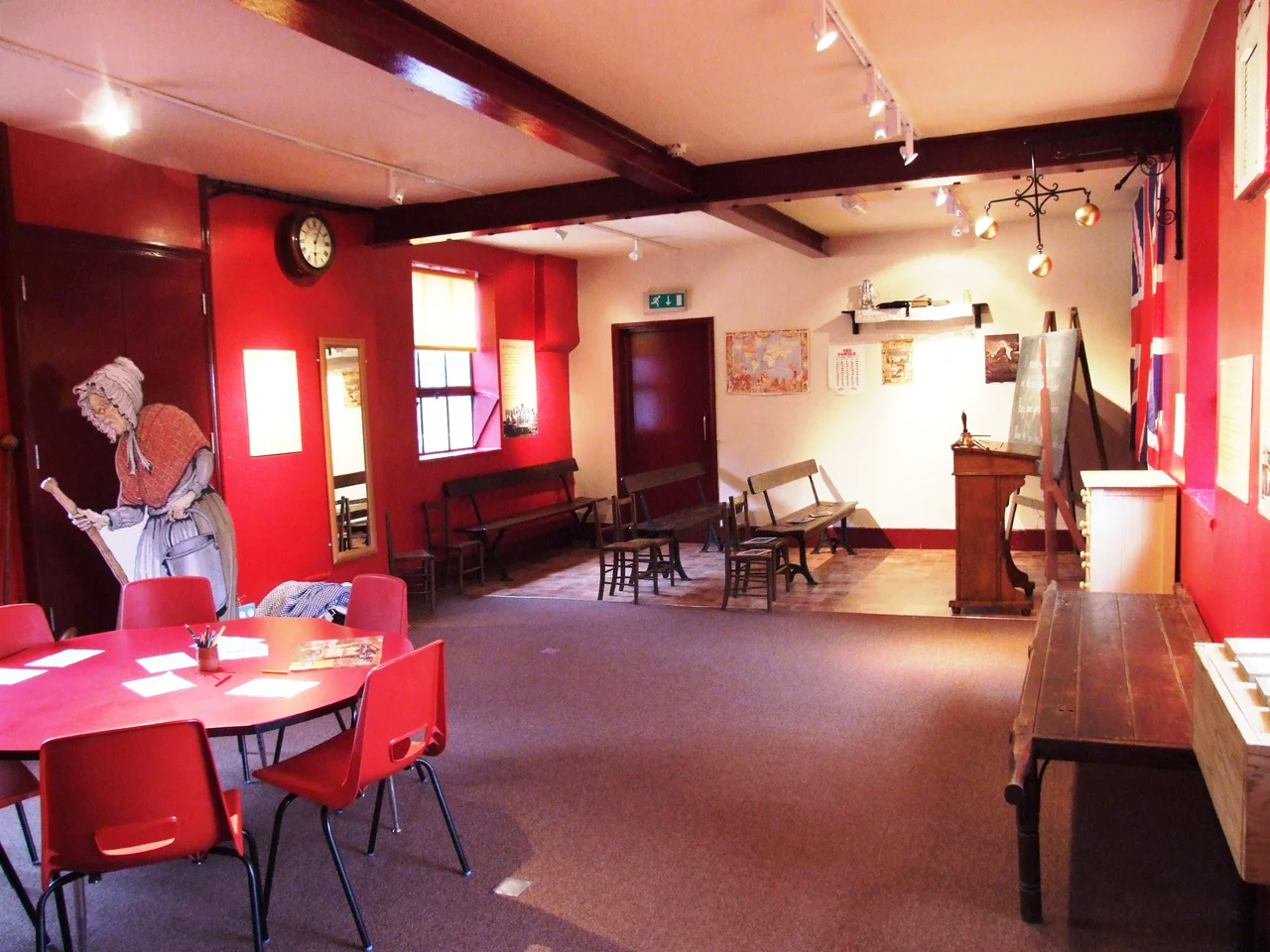
The Northwich Union Workhouse was commissioned in 1837. Sixty-five parishes and townships across nearly all of mid-Cheshire combined into a single Poor Law Union in October 1836, pooling their obligation to support the destitute. The building was designed by the standard logic of the era. Families were separated on arrival: husbands from wives, mothers from children over seven. Inmates wore uniforms. Meals were taken in silence. Work, often pointless work like picking apart old rope, filled the days. The system was meant to be unbearable enough that only the truly desperate would seek shelter, and it succeeded, in the way cruelty often does. Among the surviving spaces is a Victorian workhouse schoolroom, where the children of the destitute were taught to read between bouts of labour, and the Board of Guardians boardroom, where local worthies decided which applicants deserved relief and which deserved refusal.
Mallory, Irvine, and Two Cheshire Boys
In 1981, with subsidence concerns hanging over the 1909 building, the museum collection moved to the former workhouse. Mary, Lady Rochester, drove much of the establishment work, and for nearly thirty years the institution was simply The Salt Museum. The pivot came under curator Matt Wheeler, appointed in 2004, who reshaped the place with ambitious special exhibitions. The most striking, in 2009, was Above the Clouds: Mallory & Irvine and the Quest for Everest. George Mallory and Andrew "Sandy" Irvine, the two climbers who vanished on the upper slopes of Everest in June 1924, were both Cheshire-born, and the exhibition drew artefacts from the Royal Geographical Society and private collectors to tell their story in unprecedented depth. It was shortlisted at the British Museum and Heritage Awards for Excellence. More than 20,000 people came through the doors that year, a remarkable number for a small West Cheshire museum.
What a Museum Becomes
In 2010, with redevelopment under way at the nearby Lion Salt Works, the museum widened its remit and adopted its current name. It is now Weaver Hall Museum and Workhouse, covering the archaeology, architecture, and industries of Cheshire from prehistory to the present. The image library holds more than 8,000 photographs, particularly of salt and chemical industries and the canal traffic that carried their products. There is a mini-cinema called the Regalette, named in honour of Northwich's last surviving picture house, the Regal, which closed in 2007. The building itself is now Grade II listed under the National Heritage List for England, an acknowledgement that the workhouse is not merely an artefact but evidence. The schoolroom and boardroom remain in place, the original purpose preserved alongside the salt pans and Roman brine pots. People come here now to look. The people who came here in 1839 came because they had no choice.
From the Air
Located at 53.25°N, 2.51°W in central Cheshire, on the A533 in Northwich. From the air, the museum building sits just south of the River Weaver near Northwich town centre, with the salt-mining hinterland (including Lion Salt Works at Marston) visible to the north and east. Recommended viewing altitude 2,000–3,500 ft. Watch for the brine-collapse meres scattered through the surrounding farmland: distinctive small lakes formed by subsidence. Nearest airports: Manchester (EGCC) 14 nm east-northeast, Liverpool (EGGP) 19 nm west-northwest, Hawarden (EGNR) 22 nm west-southwest.
Nearby Stories
- Battle of Winwick 2.1 km away
- Astley Deep Pit Disaster 3.8 km away
- Moel Famau 6.5 km away
- Sandon Hall 6.7 km away
- RAF Tern Hill 8.2 km away
- Brindley Water Mill 8.7 km away
- Battle of Maes Moydog 31 km away
- Piel Castle 70 km away