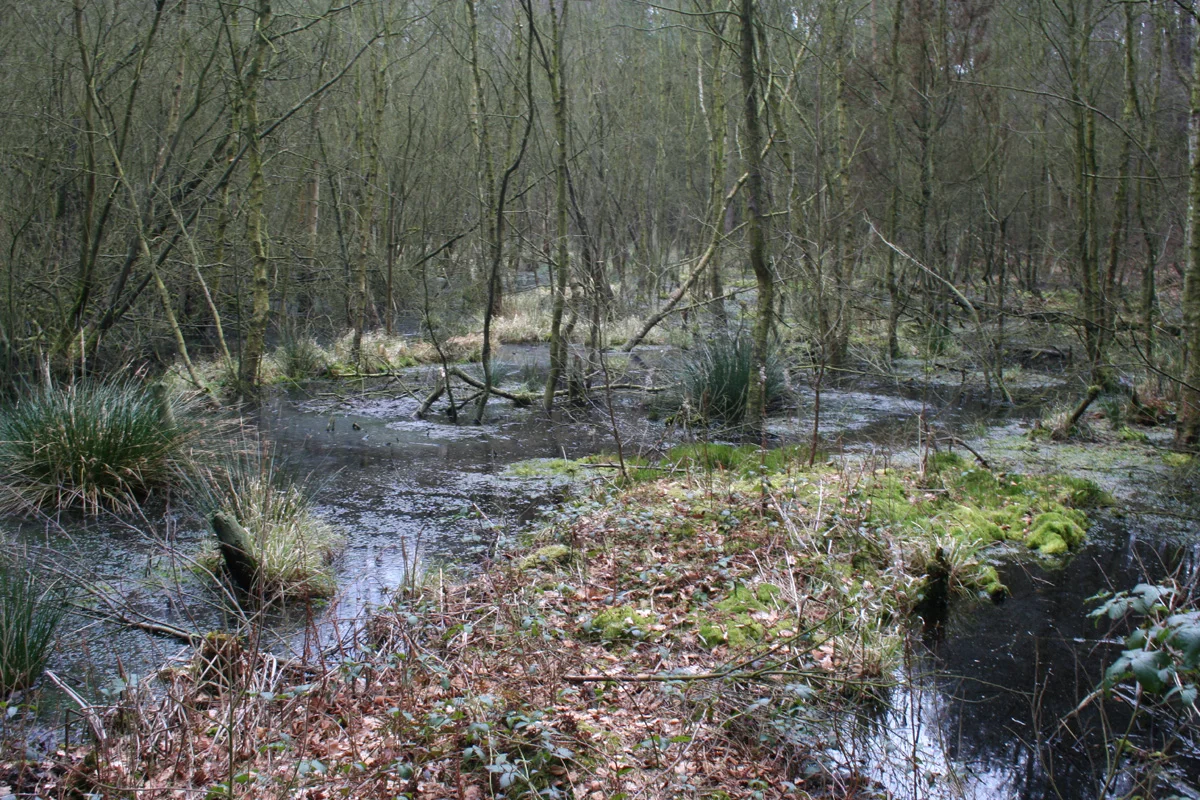

Delamere Forest
The name means forest of the lakes, and the lakes here are kettle holes - pockets of meltwater left behind when the Irish Sea Icesheet retreated north out of Cheshire roughly twenty thousand years ago. Delamere Forest spreads across 972 hectares of central Cheshire, the largest single area of woodland in the county, and it has been three different things over its long life: a Norman hunting reserve where killing a deer could cost you your eyes, a Forestry Commission timber plantation, and the recreational forest of today, where Britain's largest Go Ape course swings between the conifers and music festivals fill the meadows in summer.
When Killing a Deer Cost Your Eyes
The twin medieval forests of Mara and Mondrem were established within the county palatine of Cheshire by the Norman Earls of Chester in the late eleventh century. The area may already have been an Anglo-Saxon hunting ground; the Normans simply formalised the cruelty. Game included wild boar, red, fallow, and roe deer, and the penalty for poaching was blinding, mutilation, or execution. Those punishments were gradually downgraded to fines over the following centuries, but the forest law shaped the landscape and the social order around it for hundreds of years. Mondrem, to the south, was slowly cleared for farmland. Mara, to the north, stayed wooded well into the fourteenth century and held a population of wolves and wild boar long after both species had vanished from most of England. The forest's legal status as a royal hunting reserve survived until 1812, when an Enclosure Act formally disafforested the remaining land, splitting ownership between the Crown and the major surrounding landowners.
Blakemere, Drained and Restored
Blakemere Moss has the best story in Delamere. It was a glacial lake to start with, formed in two adjacent kettle holes, but around 1815 someone decided it would be more useful as farmland and drained it - reportedly using prisoners from the Napoleonic Wars, although the documentation is thin. Through the nineteenth century the dry bed was unsuccessfully planted with oak, and later with Scots pine. The Forestry Commission tried again in the 1940s with pine and western hemlock, which proved equally uneconomic. In 1996 a hydrological survey concluded that the drainage could be reversed. Clear-felling took place in 1998, the drainage points were dammed, and the moss was allowed to re-water itself. Within a few years Blakemere had become a lake again, a kilometre long, ringed with the bleached birch trunks of the trees that had drowned in the rising water. Waterfowl arrived in numbers. Following the success, Natural England's Wetland Vision scheme rewatered another 33 hectares of drained fenland at four further sites in the Delamere area.
Thirteen Counties from a Trig Point
The summit of the forest is Pale Heights, a modest 176 metres but high enough, on a clear day, to give views across thirteen English counties and Welsh principal areas: Cheshire, Cumbria, Derbyshire, Greater Manchester, Lancashire, Merseyside, Shropshire, and Staffordshire in England, plus Conwy, Denbighshire, Flintshire, Powys, and Wrexham in Wales. Three transmitter masts share the summit with a trig point, carrying radio, television, and telephone signals across the north-west. The geology under your feet is more varied than the conifer plantation suggests. Eight different soil types occur in one small valley adjacent to the railway line - brown earths, podsols, peats, gleys - hosting what is reputedly England's first soil trail. Linmer Moss is a rare fen environment where Sphagnum mosses do not dominate; tussock sedge and reedmace grow instead, alongside marsh fern and white sedge, both of them scarce in Cheshire.
Zip Lines and Open-Air Theatre
Modern Delamere is loud during good weather. Britain's largest Go Ape facility opened in the forest in 2006, suspending zip wires, Tarzan swings, tightropes, and nets between the upper branches of the older pines. The northern Hellrunner cross-country race brings runners floundering through bogs and obstacles every winter, and the Sandstone Trail Race finishes in the forest. A parkrun loops around Blakemere Moss every Saturday morning. Since 2003 the Old Pale area has hosted summer concerts - Ian Brown, The Charlatans, Jools Holland, Status Quo, Sugababes, Paul Weller, Tears for Fears, Doves, Elbow - drawing crowds that probably outnumber the people who came through here for any single Norman royal hunt. A timber-framed visitor centre opened in August 2020, with a cafe, a cycle hub, accessible facilities, and 500 parking spaces. The dragonflies on the wetlands include the nationally scarce white-faced darter, observed at Black Lake among other sites. The forest has remembered most of what it once was, and added a few new things on top.
From the Air
Delamere Forest is centred at approximately 53.23 N, 2.68 W in central Cheshire, between Frodsham to the north-west and Tarporley to the south-east. The forest forms a distinct dark patch visible from 3,000-5,000 feet, with Blakemere Moss as a long thin lake running roughly east-west through the eastern half. Pale Heights, the summit, carries three transmitter masts that are useful navigation references. Nearest major airport: Manchester (EGCC), 22 miles east. Liverpool John Lennon (EGGP), 18 miles north-west; Hawarden (EGNR), 12 miles west, useful for general aviation.
Nearby Stories
- Battle of Winwick 2.1 km away
- Astley Deep Pit Disaster 3.8 km away
- Moel Famau 6.5 km away
- Sandon Hall 6.7 km away
- RAF Tern Hill 8.2 km away
- Brindley Water Mill 8.7 km away
- Battle of Maes Moydog 31 km away
- Piel Castle 70 km away